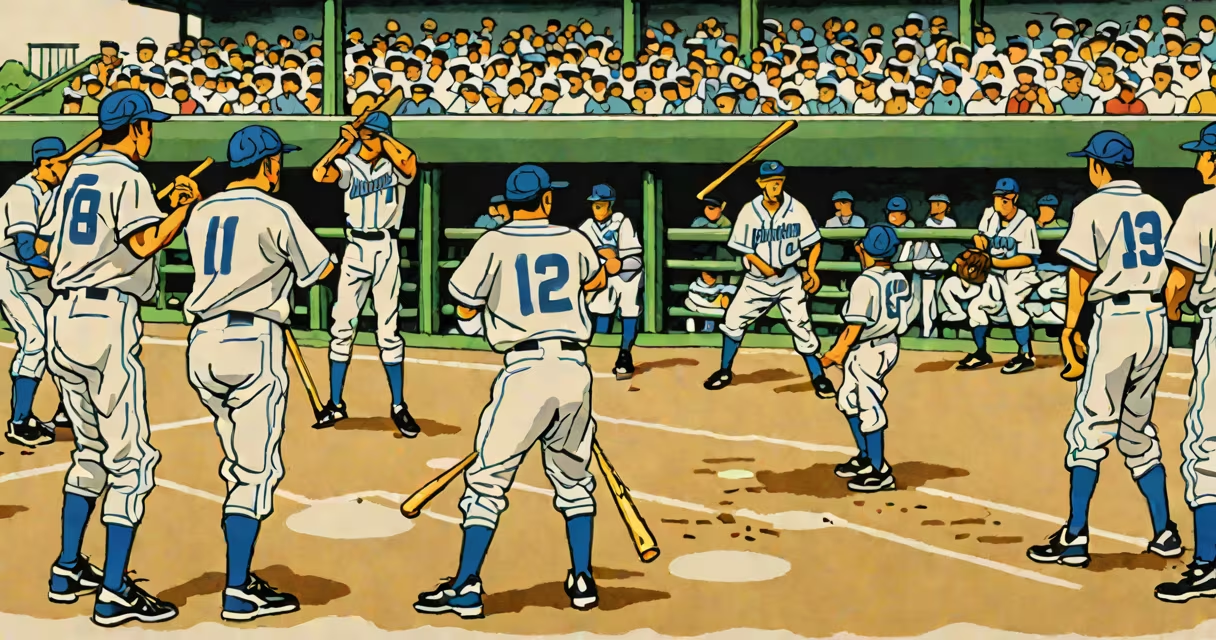
Japanese baseball teams are professional clubs competing in Nippon Professional Baseball (NPB), Japan's highest level of baseball. They play in two leagues-the Central League and the Pacific League-and follow distinct traditions, team structures, and cultural practices different from Major League Baseball (MLB).
NPB was established in 1950 after the merger of two pre-war leagues. Today, it features 12 teams: six in the Central League and six in the Pacific League. Teams operate under private ownership, often tied to major Japanese corporations. For example, the Tokyo Yakult Swallows are owned by the Yakult Corporation, known for its health drinks. This corporate sponsorship model shapes everything from team branding to player contracts.
Each team plays a 143-game regular season, followed by a playoff series between the top teams in each league. The winners face off in the Japan Series, a best-of-seven championship. The 2023 Japan Series was won by the Fukuoka SoftBank Hawks, who have claimed five titles since 2011, reflecting sustained dominance through disciplined management and advanced analytics.
Japanese baseball teams run on a strict hierarchy rooted in tradition and collective discipline. Players join teams through a draft system held annually in November. High school and university players enter the draft, with top prospects selected by teams based on performance evaluations and scouting reports. The 2023 draft saw 12 high school pitchers selected in the first round, including Ryohei Koyama, who signed with the Chiba Lotte Marines.
Teams emphasize consistency over individual flair. Batting order is rarely changed mid-game. Managers often stick to a fixed lineup throughout the season. Pitchers are rotated through a five-man rotation, with relievers entering only after specific pitch counts. A 2022 study by the Japan Sports Research Institute found that NPB teams averaged 1.8 bullpen appearances per game-lower than MLB's 3.4-due to reliance on starters.
Post-game rituals are deeply embedded. After every game, players perform a group bow toward the dugout and fans. Team captains lead chants in Japanese, often referencing the team's founding year or regional pride. The Hiroshima Toyo Carp, founded in 1949, still chant "Hiroshima! We are the ones!" after wins, a tradition that began during their 1965 pennant run.
Japanese baseball teams fall into two leagues with different operational models. The Central League includes teams like the Yomiuri Giants, Chunichi Dragons, and Hanshin Tigers. These teams typically have higher payroll budgets and longer histories. The Yomiuri Giants, established in 1936, have won 22 Japan Series titles-the most in history.
The Pacific League includes teams such as the Hokkaido Nippon-Ham Fighters, Saitama Seibu Lions, and Fukuoka SoftBank Hawks. These teams often rely on new strategies and aggressive player development. The SoftBank Hawks, for example, invested heavily in data analytics and player tracking systems starting in 2010. By 2016, they had reduced infield errors by 28% compared to 2010 levels.
| League | Teams (2024) | Key Features |
|---|---|---|
| Central League | Yomiuri Giants, Chunichi Dragons, Hanshin Tigers, Hiroshima Toyo Carp, Tokyo Yakult Swallows, Osaka Kintetsu Buffaloes | Higher average salaries; older franchises; more traditional uniforms |
| Pacific League | Fukuoka SoftBank Hawks, Hokkaido Nippon-Ham Fighters, Saitama Seibu Lions, Chiba Lotte Marines, Orix Buffaloes, Tohoku Rakuten Golden Eagles | More recent expansion; stronger focus on youth academies; lower attendance averages |
While both leagues follow the same rules, differences in scheduling and fan engagement exist. The Central League uses a balanced schedule where each team plays every other team 18 times. The Pacific League uses a divisional format with interleague games occurring only in the final month of the season.
Japanese baseball teams serve as cultural institutions beyond sport. They represent regional identity, corporate values, and generational continuity. The Tohoku Rakuten Golden Eagles, based in Sendai, were formed in 2005 after the city's recovery from the 2011 earthquake. Their home games became community events, with local schools sending students to cheer. Attendance rose 41% between 2012 and 2015, according to the Japan Association of Sports Economists.
Teams also drive tourism. The Fukuoka SoftBank Hawks' home stadium, Mizuho PayPay Dome Fukuoka, hosted 1.2 million fans in 2023. Local businesses reported a 23% increase in revenue during home game weekends. The city even launched a "Hawks-themed" subway line with themed cars and station art.
There's a common misconception that Japanese baseball teams are less skilled than MLB teams. But data shows otherwise. In 2022, NPB pitchers recorded a 3.15 ERA-lower than MLB's 3.72. The average NPB batter hit .271 with a .348 on-base percentage, outperforming MLB's .243/.320 average in the same season, according to Baseball-Reference.com.
Many assume Japanese baseball teams use wooden bats exclusively. While they do use wood, the bat specifications differ from MLB. NPB bats are shorter (33 inches max vs. 34 inches in MLB), heavier (34 oz avg vs. 32 oz), and have a smaller barrel diameter (2.5 inches vs. 2.625 inches). These differences affect swing mechanics and ball exit velocity.
Another myth is that NPB teams don't import foreign players. In reality, 2023 saw 48 foreign-born players on NPB rosters-about 14% of total players. The Los Angeles Angels' former pitcher Shohei Ohtani played in NPB before joining MLB. His 2013 season with the Hokkaido Nippon-Ham Fighters included a 1.85 ERA and 119 strikeouts in 135 innings.
I once attended a game between the Chunichi Dragons and the Yokohama DeNA BayStars in Nagoya. The crowd of 38,000 stood for the national anthem, then erupted into synchronized clapping during the seventh inning. The energy wasn't just about winning-it was about shared ritual. That moment clarified why Japanese baseball teams aren't just sports entities-they're living symbols of place and memory.
Understanding japanese baseball teams requires seeing them not as replicas of American baseball, but as distinct institutions shaped by geography, business, and tradition. Their success stems from long-term planning, cultural cohesion, and investment in youth development. The Fukuoka SoftBank Hawks' rise from last-place finish in 2005 to five Japan Series titles by 2023 proves that sustained strategy beats short-term gains.