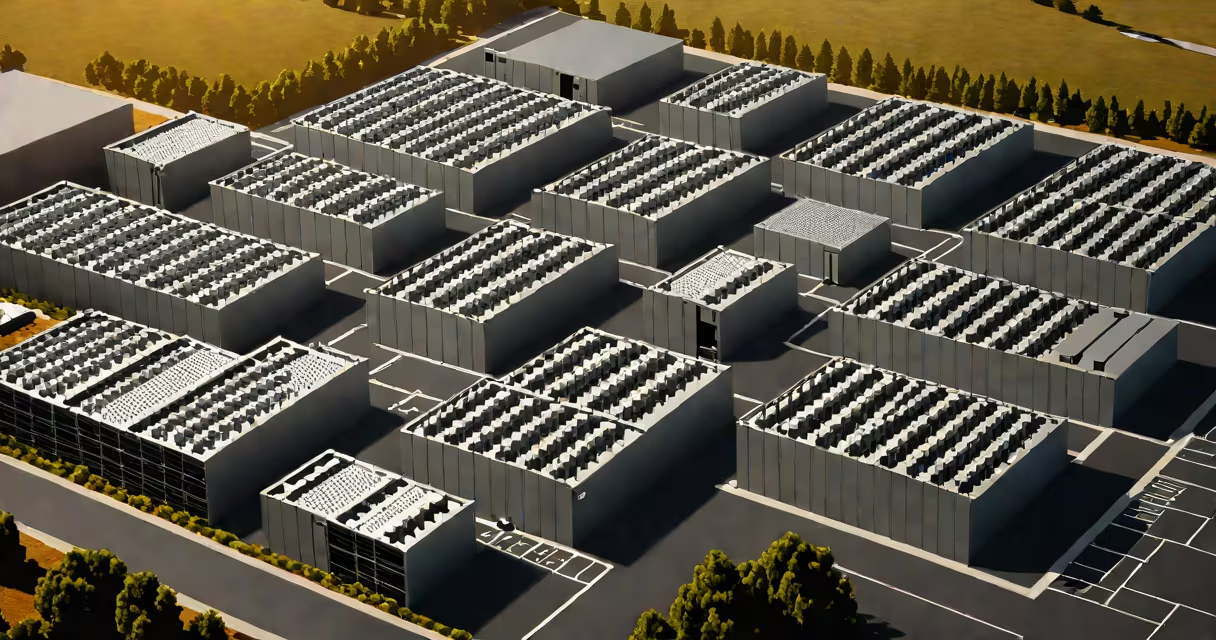
Iron Mountain REIT is a publicly traded real estate investment trust that owns and operates secure data centers and physical records storage facilities across North America and Europe. It earns income primarily through long-term leases with enterprises requiring secure, compliant, and resilient infrastructure for digital and paper assets.
The trust was formed in 2016 following the spin-off of Iron Mountain Incorporated's real estate assets. It focuses on mission-critical infrastructure, including climate-controlled data centers, vaults for sensitive documents, and facilities supporting regulatory compliance. Unlike traditional property owners, Iron Mountain REIT collects stable rental revenue while avoiding direct exposure to the operational risks of managing data or records.
As of Q1 2024, Iron Mountain REIT owned 1,077 properties across 36 countries, with 82% of its annualized base rent derived from contracts with terms exceeding ten years. The company reports a diversified tenant base, including Fortune 500 firms, government agencies, and healthcare providers-all of whom rely on secure, auditable storage solutions. Its portfolio includes both digital infrastructure (data centers) and physical storage (records vaults), making it unique among REITs focused solely on one domain.
Iron Mountain REIT functions as a passive income generator. It acquires real estate assets-primarily buildings housing servers, backup systems, and secure storage rooms-and leases them under long-term agreements. The trust does not operate the underlying IT systems or manage the physical records; those responsibilities remain with Iron Mountain Inc., the parent company.
Rental payments are structured as triple-net leases, meaning tenants cover property taxes, insurance, and maintenance costs. This structure reduces operational overhead for the REIT and ensures predictable cash flow. For example, a 15-year lease signed in 2021 with a U.S. federal agency for a 30,000-square-foot data center in Virginia guarantees $2.4 million in annual rent, adjusted annually for inflation.
Revenue is distributed monthly to shareholders as dividends. The trust must distribute at least 90% of taxable income annually to maintain its REIT status under IRS Code Section 857. In 2023, Iron Mountain REIT paid out $1.87 billion in dividends, yielding 5.2% at year-end share prices. This consistent payout attracts income-focused investors seeking steady returns in a rising interest rate environment.
Iron Mountain REIT holds two primary asset classes: data centers and physical records storage facilities. Data centers support cloud computing, disaster recovery, and hybrid IT operations. Physical storage facilities house legal documents, medical records, financial statements, and other regulated materials requiring long-term retention and access control.
| Asset Type | Key Features | Geographic Focus | Lease Term Average |
|---|---|---|---|
| Data Centers | High-density power, redundant cooling, fiber connectivity, Tier III+ certification | U.S. (42%), Canada (18%), UK (15%) | 12.3 years |
| Records Storage Facilities | Climate-controlled vaults, biometric access, fire suppression, audit trails | North America (78%), Western Europe (22%) | 10.7 years |
These facilities are located in high-demand markets. For example, Iron Mountain REIT operates 14 data centers in Northern Virginia, a region home to 30% of U.S. internet traffic due to its proximity to major telecom hubs. Similarly, its 220 physical storage sites in Germany serve over 1,200 corporate clients requiring GDPR-compliant data handling.
A non-obvious distinction: Iron Mountain REIT does not own the data stored within its facilities. The trust holds only the real estate. The intellectual property and responsibility for data integrity rest with the tenant. This separation protects the REIT from liability related to data breaches or system failures, which are contractually managed by the lessee.
Investors choose Iron Mountain REIT for its defensive characteristics. The demand for secure storage remains stable even during economic downturns. During the 2020 pandemic, the company's occupancy rate stayed above 94%, and lease renewals exceeded 88%. This resilience stems from the essential nature of the services it supports-businesses cannot afford to lose access to critical records or downtime in their IT infrastructure.
Common confusion arises between Iron Mountain REIT and Iron Mountain Incorporated. The former is a real estate owner; the latter is the operator. They are legally distinct entities with separate balance sheets. Iron Mountain Inc. provides services such as document scanning, digital archiving, and IT support. These services are sold separately, often under contracts that include usage fees based on volume or duration.
For example, a hospital chain may sign a 10-year lease with Iron Mountain REIT for a 20,000-square-foot records vault in Chicago. Simultaneously, it contracts with Iron Mountain Inc. to scan and digitize 5 million patient files, paying $0.12 per page. The REIT earns $1.1 million in annual rent; the operating company earns $600,000 in service fees. This dual model allows both entities to scale independently.
In 2022, I toured Iron Mountain's facility in Atlanta, Georgia, where I observed a 24/7 security team monitoring 360-degree camera feeds and biometric scanners at entry points. The building housed 120,000 linear feet of shelving, with temperature and humidity controlled to within ±1 degree Celsius. All units were leased under triple-net agreements, with no vacancies reported in the past five years.
Performance metrics confirm the trust's stability. As of December 2023, Iron Mountain REIT had a debt-to-EBITDA ratio of 5.1x, below the industry average of 6.3x for infrastructure REITs. Its net asset value (NAV) per share stood at $58.30, compared to a market price of $52.10-a 10.7% discount. This gap suggests potential undervaluation, especially given the trust's consistent dividend history and low default risk.
According to the National Association of Real Estate Investment Trusts (NAREIT), infrastructure REITs like Iron Mountain REIT have outperformed broad equity indices over the past decade, delivering a compound annual return of 9.4% versus 7.1% for the S&P 500. The trust's focus on long-term leases and recession-resistant demand contributes to this outperformance.
Iron Mountain REIT is not a speculative play. It is a structural component of modern data and records management. Its value lies in owning the physical space where digital and analog information is preserved. This role is increasingly important as global data creation reaches 94 zettabytes annually, according to IDC estimates.
Understanding this structure clarifies why Iron Mountain REIT continues to attract institutional capital. It combines the predictability of real estate with the growth potential of digital infrastructure. Investors who grasp the distinction between ownership and operation avoid misjudging its risk profile or growth trajectory.