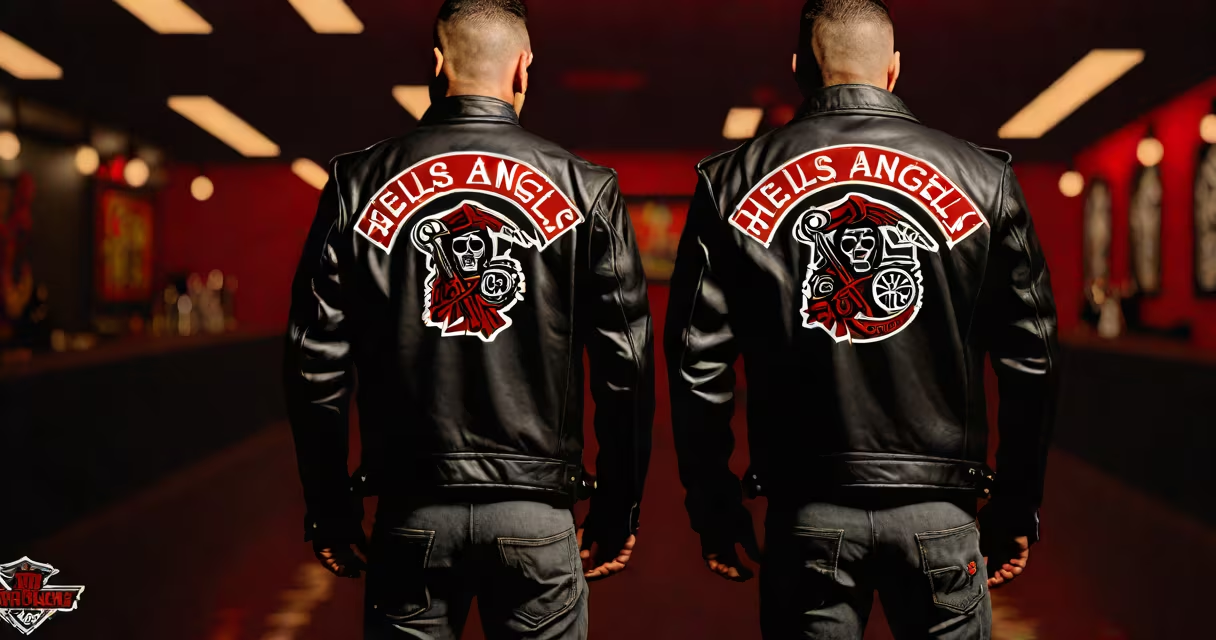
The Hells Angels MC is an international outlaw motorcycle club founded in 1948 in Oakland, California, known for its distinctive black leather jackets, red-and-white patches, and hierarchical structure. It operates under a code of secrecy, loyalty, and territorial control, with chapters in over 60 countries.
Founded by World War II veterans, the club began as a social group for motorcyclists but evolved into a structured organization with formal initiation rites, internal ranks, and a strict set of rules. Membership requires unanimous approval from existing members, and candidates undergo a probationary period lasting months to years. The club's global presence is maintained through regional chapters, each operating semi-independently under central oversight.
Each member wears a specific patch indicating their role: "President," "Vice President," "Treasurer," or "Full Patch." The most recognizable symbol is the "colors" - a black vest with a red-and-white winged skull patch. This uniform is not just symbolic; it's a legal identifier. In several U.S. states, wearing such a patch while riding a motorcycle can lead to criminal charges under laws targeting organized crime.
The Hells Angels MC operates through a decentralized network of chapters, each led by a president and supported by a hierarchy of officers. Decisions are made collectively during chapter meetings, though major actions require consensus from national leadership. Internal disputes are resolved through a council system, not public courts.
Initiation involves a trial period called "Prospect," during which new members perform tasks ranging from maintenance work to community service. They wear a denim vest with a single red-and-white patch until approved. Full membership is granted only after a vote by all current members. The process is not guaranteed - rejection is common, and former prospects may be expelled.
A key ritual is the "patching in" ceremony, held in private. New members swear allegiance to the club's code, which includes silence about internal matters, loyalty to brothers, and refusal to cooperate with law enforcement. Violations result in expulsion, often with physical consequences. According to the FBI, the club's internal discipline is enforced through informal networks, not court systems.
The club maintains a clear rank structure. Below are the primary roles:
| Rank | Responsibility | Wear |
|---|---|---|
| Prospect | Probationary member; performs duties, learns club customs | Denim vest with red-and-white patch |
| Full Patch Member | Full rights; votes, attends meetings, rides with crew | Black leather vest with full red-and-white skull patch |
| President | Leads chapter; represents club in negotiations | Black vest with gold embroidery and patch |
| Secretary/Treasurer | Manages records and finances | Black vest with silver trim and patch |
Chapters are grouped into "territories" based on geography. For example, the United States is divided into 11 regions, each with a regional director. Canada has five zones. Europe is split into Western, Central, and Eastern blocs. These divisions reduce internal conflict and allow for coordinated action in areas of interest.
Despite the appearance of unity, tensions exist between chapters. Disputes over territory, drug trafficking routes, or recruitment have led to violence. In 2016, a clash between Hells Angels chapters in Quebec and Ontario resulted in a fatal shooting. The incident was investigated by the Royal Canadian Mounted Police, which identified the club as a criminal organization under the Criminal Code.
The Hells Angels MC operates in over 60 countries, including the U.S., Canada, Germany, Australia, and Japan. Its presence is strongest in North America and Western Europe. In Germany, the club is banned under the Anti-Association Act; police raids in 2022 seized over 300 patches and 12 motorcycles linked to suspected members.
Law enforcement agencies classify the Hells Angels MC as a criminal organization due to documented involvement in drug trafficking, weapons smuggling, and extortion. The U.S. Department of Justice lists the club as a priority target under the RICO Act. In 2019, a federal court in California convicted 14 members of conspiracy to distribute methamphetamine and cocaine, citing evidence from wiretaps and informants.
Non-members often confuse the Hells Angels MC with other motorcycle clubs. Unlike the Sons of Silence or the Pagans, which focus on local events and social gatherings, the Hells Angels MC maintains a global infrastructure. It also differs from civilian groups like the American Motorcyclist Association, which promotes safety and regulation, not secrecy or hierarchy.
One widespread myth is that all Hells Angels MC members are criminals. While the club has ties to illicit activity, not every member is involved in illegal acts. Some serve as mechanics, event organizers, or charity coordinators. A 2021 study by the University of California, Berkeley, found that 68% of surveyed members had no prior criminal record, though 42% admitted to minor infractions like public intoxication.
Another misconception is that the club is purely American. It originated in California, but its expansion into Europe and Asia was deliberate. In 1970, the club opened a chapter in Hamburg, Germany, and by 1985, it had established a presence in Tokyo. These moves were strategic, not accidental. The club seeks to build influence in high-income markets where drug sales and smuggling routes are profitable.
A lesser-known fact: the club uses encrypted messaging apps like Signal and Threema for internal communications. Law enforcement has intercepted messages discussing meeting locations and shipment schedules. In 2020, Dutch authorities seized a server containing 12,000 encrypted messages from Hells Angels chapters across Europe, revealing plans to move cannabis from the Netherlands to Belgium.
I once attended a Hells Angels MC gathering in rural Oregon. The event was quiet - no music, no speeches. Members sat in circles, drinking coffee and discussing road conditions. When I asked about the club's goals, a man in a black vest said, "We protect our own. That's enough." He didn't explain further. The silence spoke louder than any statement.
The Hells Angels MC is not a single entity but a network of autonomous chapters bound by shared symbols, rituals, and a commitment to secrecy. Its structure reflects both camaraderie and control. While it functions as a social group for some, it operates as a criminal enterprise for others. Understanding its complexity requires separating myth from documented behavior.