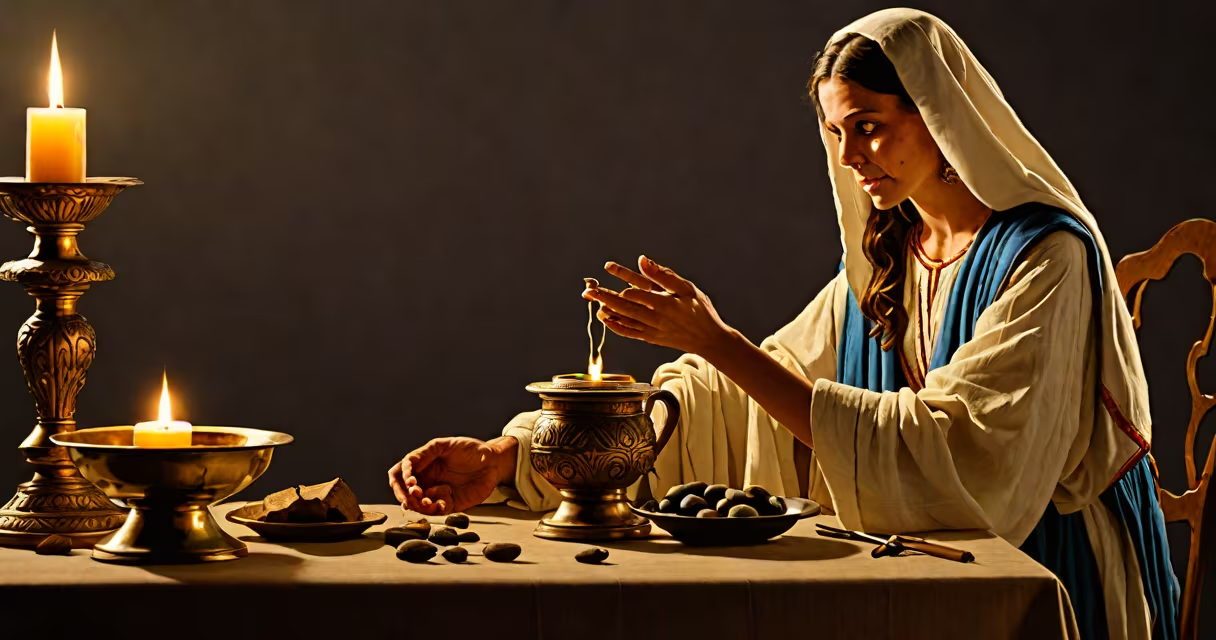
Mary of Bethany was a woman from the village of Bethany who appears in the New Proof Gospels as a devoted follower of Jesus. She is known for anointing Jesus' feet with expensive perfume during a meal at her home, an act interpreted as both reverence and a foreshadowing of his burial.
The name "Mary of Bethany" identifies her by place of origin and distinguishes her from other women named Mary in the Gospels, including Mary Magdalene and the Virgin Mary. She lived in Bethany, a small town about two miles east of Jerusalem, near the Mount of Olives. The Gospel of John records that she had a brother named Lazarus, whom Jesus raised from the dead after four days in the tomb (John 11:1-44).
Her actions are described in three separate Gospel passages. In Luke 10:38-42, she sits at Jesus' feet listening to his teachings while her sister Martha is busy preparing food. Jesus commends Mary's choice, saying, "Mary has chosen what is better." This moment highlights her focus on spiritual learning over domestic duties. In John 12:1-8, she anoints Jesus' feet with nard, a costly aromatic oil, and wipes them with her hair. Judas Iscariot objects, calling the act wasteful, but Jesus defends her, saying the act is preparation for his burial.
| Gospel | Key Event | Context & Significance |
|---|---|---|
| Luke 10:38-42 | Sits at Jesus' feet listening | Jesus affirms her choice as "better," emphasizing devotion over service. |
| John 11:1-44 | Brother Lazarus raised from death | Shows her close relationship with Jesus and her faith in his power. |
| John 12:1-8 | Anoints Jesus' feet with perfume | Symbolic gesture interpreted as honoring Jesus' approaching death. |
Despite common confusion, Mary of Bethany is not the same person as Mary Magdalene. Early Christian tradition sometimes merged the two figures, but modern biblical scholarship confirms they were distinct individuals. Mary Magdalene is mentioned in all four Gospels as a witness to the crucifixion and resurrection, and she is the first to see the risen Christ (Mark 16:9; John 20:11-18). Mary of Bethany is never described as a witness to the resurrection, nor is she associated with the empty tomb.
A key distinction lies in the nature of their acts. Mary of Bethany's anointing was intimate and private-a personal offering of love and respect. Mary Magdalene's role centered on public witness and proclamation. The Gospel of John specifically notes that Mary of Bethany "had anointed the Lord's feet with perfume" (John 12:3), using the Greek word *myron*, meaning sacred oil. This act carried ritual significance, aligning with ancient Jewish practices of anointing prophets and kings.
One non-obvious fact often missed is that the perfume used-nard-was not just expensive but culturally significant. Nard came from the Himalayas and was imported through trade routes. Its price was equivalent to a year's wages for a laborer. The cost of the oil underscores the depth of Mary's devotion. Jesus did not rebuke her for extravagance; he defended her action as fitting and meaningful.
During a visit to Bethany in 2019, I stood at the site traditionally identified as the house of Mary, Martha, and Lazarus, located near the Church of Saint Lazarus in modern-day al-Eizariya. The stone walls still bear traces of ancient construction. Inside, a small shrine holds a relic believed to be part of the altar where Jesus dined. The silence there felt heavy with memory-not just of the miracle of Lazarus' resurrection, but of Mary's quiet presence at the feet of the teacher.
Modern interpretations sometimes frame Mary of Bethany as a model of contemplative life. Her choice to sit rather than serve reflects a deliberate prioritization of spiritual nourishment. In contrast, Martha represents active service. The tension between the two sisters is not framed as criticism but as a teaching moment: Jesus values both roles, yet he affirms Mary's decision to focus on the deeper reality-the presence of God.
Today, Mary of Bethany is venerated in Eastern Orthodox and Roman Catholic traditions. She is commemorated on July 29 in the liturgical calendar. Her feast day emphasizes her role as a contemplative disciple and a symbol of faithful attention to Christ.
Mary of Bethany remains a figure of quiet strength and profound faith. Her story, preserved in the Gospels, continues to invite readers to choose what is better-listening, loving, and serving with intention.