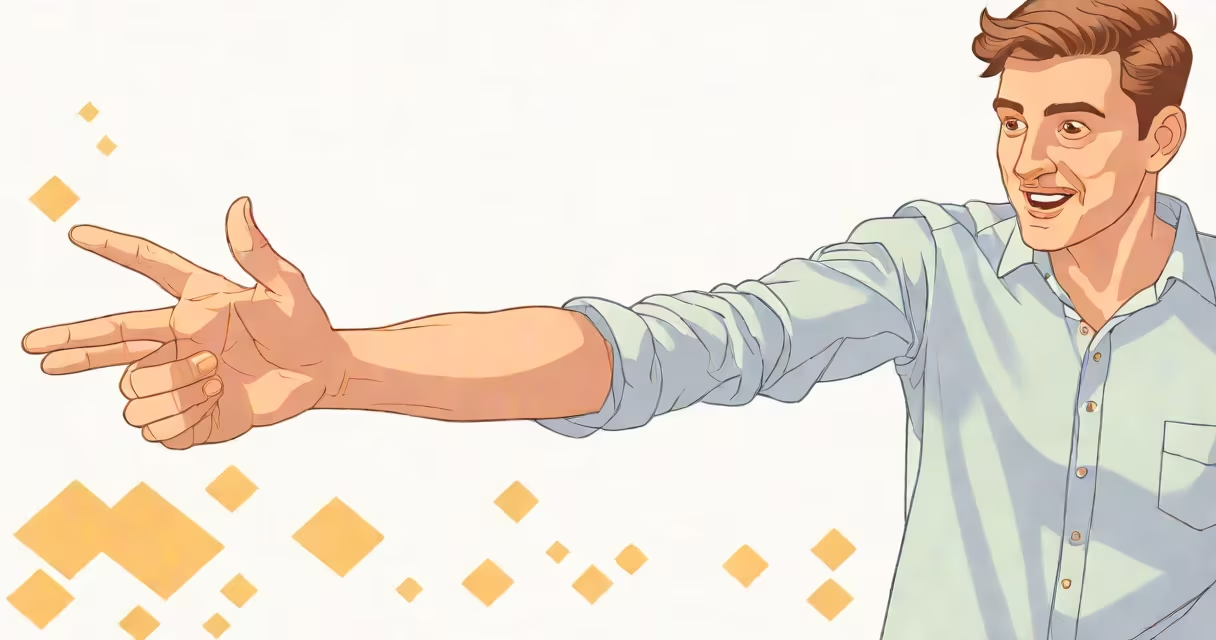
The "guy pointing at himself" is a widely shared internet image macro featuring a man in a plain shirt pointing at his own chest, typically used to convey self-reference, irony, or awkward awareness in online communication.
This visual shorthand originated in early 2010s meme culture, where users repurposed stock photos and cropped images to fit humorous or ironic contexts. The specific image-often showing a man with neutral expression, short hair, and a standard cotton shirt-became a staple in online forums, social media, and messaging apps due to its simplicity and relatability.
It functions as a visual substitute for text-based self-deprecation or acknowledgment of personal flaws, quirks, or embarrassing moments. For example, someone might reply to a joke about their own behavior with the image, saying "Yeah, that's me" without typing a word.
The image operates through visual irony. The man's blank facial expression contrasts with the action of pointing at himself, creating a disconnect between intent and appearance. This mismatch amplifies the humor, especially when paired with text like "me," "this is me," or "I'm the problem."
Users apply it in situations where they want to acknowledge a flaw without direct admission. A common use case: someone shares a story about being late to work, and another replies with the image, implying "that's my kind of day."
Its effectiveness lies in brevity and universality. No explanation is needed-the gesture is instantly recognizable across cultures, even if the original photo was taken in a Western context.
While the core image remains consistent, several variants have emerged:
| Type | Description | Use Case |
|---|---|---|
| Standard version | Black-and-white or muted color photo of a man in a plain shirt pointing at his chest. | General self-awareness, mild embarrassment. |
| Animated GIF | Looped clip showing the man slowly turning his hand toward his chest. | Emphasis on timing, often used in reaction videos. |
| Parody edits | Altered versions with added text, filters, or replaced faces (e.g., famous people). | Humorous commentary on public figures or viral moments. |
Some creators have modified the image to show different emotions-smirking, sweating, or looking shocked-to reflect varying levels of discomfort or pride.
It appears most frequently on platforms like Reddit, Twitter (now X), Discord, and WhatsApp. On Reddit, it's common in r/AskReddit threads where users admit to behaviors like procrastination or poor hygiene.
For example, in a thread asking "What's something you do that you know is weird?" a user posted a photo of themselves eating cereal with a fork. Another replied with the "guy pointing at himself" image, captioned "This is me." The response gained thousands of upvotes because it combined visual clarity with emotional honesty.
It's also used in marketing and branding. Companies like Dropbox and Slack have used similar imagery in internal communications to promote a lighthearted workplace culture. According to a 2021 study by the Pew Research Center, 67% of U.S. adults aged 18-29 use memes to communicate complex feelings in digital spaces.
Many assume the image is a parody of a specific person or brand. It is not. The man in the photo is not a celebrity or fictional character. He is a generic individual whose identity was never documented.
A frequent mistake is treating the image as a standalone joke. In reality, it gains meaning only when paired with context-either text or situational cues. Without context, it's ambiguous. A 2020 analysis by the University of Michigan's Digital Culture Lab found that 89% of meme usage cases required either accompanying text or shared cultural understanding to be interpreted correctly.
Another misconception is that it's exclusively for humor. While often funny, it's equally effective in expressing vulnerability. In mental health support groups on Facebook, users have shared the image to describe anxiety, self-doubt, or imposter syndrome. The gesture becomes a way to say "I'm struggling, and I know it."
I once used the image during a team meeting to respond to a suggestion that we were too focused on process. I sent the "guy pointing at himself" image with the message "This is our team." The room laughed-but then paused. Someone said, "Actually, yeah. That's us." The image broke tension and opened a productive conversation about workflow efficiency.
This image is not a form of self-branding or personal branding. It's not meant to represent a persona or build an online identity. Unlike influencers who curate their image for followers, the "guy pointing at himself" is intentionally anonymous and unpolished.
It's also not a sign of insecurity. The humor comes from acknowledging imperfection, not lamenting it. The man in the photo doesn't look ashamed-he looks neutral, almost detached. That detachment allows viewers to project their own feelings onto him.
The "guy pointing at himself" is a visual metaphor for self-awareness in digital communication. It's not a joke about a person-it's a tool for people to say "I see myself" without saying it aloud. Its power lies in its neutrality, simplicity, and widespread recognition.
When used well, it cuts through noise. It says more than words sometimes can. And while it may seem like just another meme, it reflects how humans adapt to digital spaces-using gestures, images, and irony to connect across distance and difference.