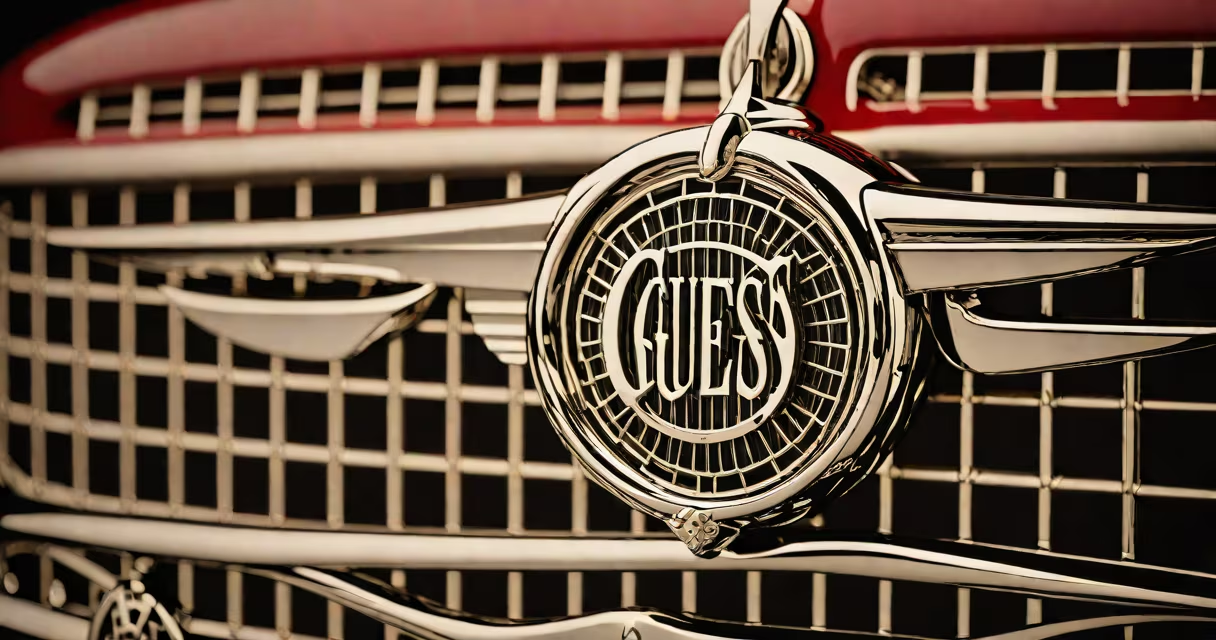
Guess that car logo is a visual puzzle format where players identify a vehicle brand based solely on its emblem. These challenges test recognition of stylized symbols, color schemes, and design motifs used by automakers worldwide.
Each logo functions as a shorthand identifier for a brand's identity, history, and engineering philosophy. The challenge lies in matching a visual fragment-often a silhouette, monogram, or symbolic icon-to the correct manufacturer. This skill combines pattern recognition, cultural familiarity, and exposure to automotive branding.
For example, a red circle with a white "P" inside, set against a black background, instantly identifies Peugeot. A silver arrowhead pointing forward denotes Infiniti. A golden horse galloping across a blue field signals Ferrari. These symbols appear on vehicles, marketing materials, and official documentation, forming part of a global visual language.
Participants view a close-up image of a car logo and must name the brand. The format appears in quizzes, social media posts, mobile apps, and live events. Accuracy depends on prior exposure and attention to detail.
Most platforms use a timed or score-based system. Some allow hints, while others enforce strict limits. The difficulty scales with the complexity of the logo or the obscurity of the brand. For instance, identifying a 1960s Alfa Romeo badge with a serpent coiled around a cross requires historical context.
A common variant involves reverse identification: given a car model, participants guess the logo. This version tests associative memory between vehicle type and brand symbol. For example, seeing a Porsche 911 silhouette may prompt the viewer to recall the crest-style logo with the prancing horse and "Porsche" script.
Car logos fall into three broad categories: symbolic, monogram, and abstract. Each reflects different design philosophies and brand histories.
| Type | Examples | Design Origin | Meaning |
|---|---|---|---|
| Symbolic | Ferrari, Lamborghini, BMW | Animals, heraldry, or national emblems | Represents speed, power, or heritage |
| Monogram | Porsche, Mercedes-Benz, Audi | Initials or combined letters | Emphasizes founder identity or brand simplicity |
| Abstract | Hyundai, Kia, Tesla | Geometric shapes or minimalist forms | Signals innovation and modernity |
Symbolic logos often draw from regional culture. Ferrari's prancing horse stems from World War I pilot Francesco Baracca's personal emblem. Lamborghini's bull represents strength and virility-traits the founder admired. BMW's roundel features a blue-and-white propeller design, referencing the company's early roots in aircraft engine manufacturing.
Monograms prioritize clarity and memorability. The Porsche logo uses a black shield with a red "P" and a white horse. The original 1931 design included a Latin motto: "Porsche - Die Welt im Wagen," meaning "Porsche - The world in a car." The current version simplifies this to focus on brand recognition.
Abstract logos reflect contemporary design trends. Tesla's "T" shape evokes both a battery symbol and a stylized "T" for "Tesla." Hyundai's logo uses a horizontal bar with a subtle curve, suggesting motion and stability. These designs aim for instant legibility across screens, packaging, and signage.
Many people assume that all luxury car logos feature animals or bold crests. This overlooks brands like Volvo, whose logo is a simple circle with a red cross. The cross represents safety-a core brand value since the 1920s.
Another misconception is that all German car logos use black and silver. While BMW and Mercedes-Benz favor those colors, Audi uses a four-ring design in yellow and black, reflecting its origins as Auto Union, which combined four pre-war manufacturers.
One non-obvious fact: the Renault logo's red "R" was originally designed as a flame. The shape evolved from a stylized flame in the 1900s to a modernized serif letter. This transformation shows how brand identity adapts over time.
Even experienced viewers misidentify logos due to visual similarity. For example, the Citroën double-chevron symbol resembles a stylized "C" but is actually derived from the company's founder's initials-"C" for Citroën and "T" for his wife's name, Thérèse. The double chevron became a registered trademark in 1927.
Consider a logo featuring a gold lion rampant on a green shield. The animal faces left, with its tongue extended. The word "Jaguar" appears beneath in bold serif font. This is the original Jaguar logo from 1935.
At first glance, the lion may resemble the one used by the British royal family. But the key difference lies in posture and detail. The royal lion stands upright with a crown, while the Jaguar lion is crouched, ready to pounce. The tail curls upward, and the claws are sharply defined.
Context matters. The 1935 logo was used during the production of the SS Jaguar 100, a sports car developed for racing. The lion symbolized agility and dominance-qualities the brand wanted to project. Today, the logo has been simplified to a single-line lion, but the original remains iconic among collectors.
When presented with this image in a "guess that car logo" challenge, accurate identification requires both visual memory and contextual awareness. Without knowing the car's model or year, the answer relies entirely on recognizing the distinctive features of the emblem.
As someone who once spent two hours trying to identify a faded logo on a 1950s Ford truck, I learned that scale and condition drastically affect recognition. A worn or low-resolution image can obscure critical details. Always check for symmetry, color gradients, and embedded text.
Identifying car logos enhances consumer engagement. Brands use consistent visual cues to build trust and loyalty. When a customer recognizes a logo quickly, they associate it with quality, reliability, or performance.
Automotive journalists, collectors, and enthusiasts rely on logo recognition to authenticate vehicles. A mismatched or altered logo can signal a replica or modified car. For example, a 1970s Maserati with a fake Trident logo is less valuable than one with the original.
These skills also apply in education and research. According to the Society of Automotive Engineers (SAE International), visual branding plays a role in consumer decision-making. A 2021 study found that 68% of buyers identified a vehicle's brand within 3 seconds of seeing its logo.
Mastering "guess that car logo" isn't about memorizing every emblem. It's about understanding how design communicates identity, history, and intent. With practice, even obscure logos become recognizable through pattern recognition and contextual clues.