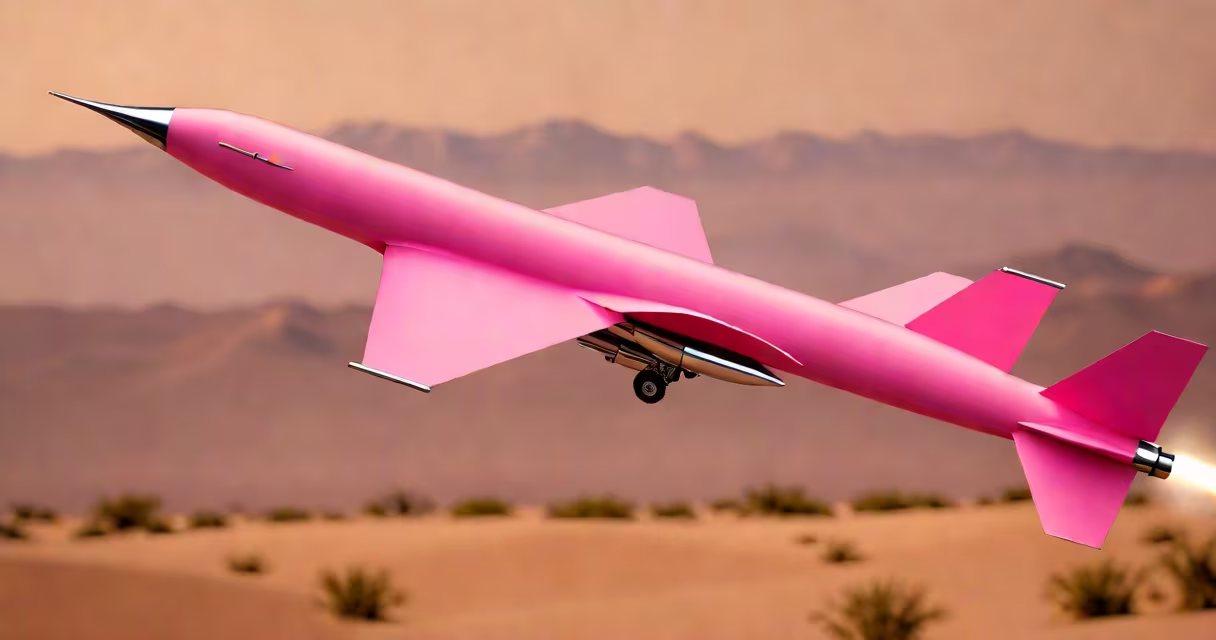
The term "flamingo cruise missile" refers to a fictional or satirical combination of a real military weapon-the cruise missile-and the image of a flamingo. No such weapon exists in official defense inventories, and the name is not used in military documentation or public records.
Cruise missiles are long-range, guided weapons designed to fly at low altitudes using terrain-following radar. They are launched from ships, submarines, aircraft, or land-based platforms and can carry conventional or nuclear warheads. The term "flamingo" does not appear in any U.S. Department of Defense, NATO, or Russian military naming convention for missiles.
Despite its absence in technical literature, the phrase may surface online in memes, parody articles, or speculative fiction. It often appears in humorous contexts where users imagine a pink, bird-shaped missile with a wading bird's legs. This is not a real system, nor is it referenced in credible defense reports from sources like the Global Security Organization or the Central Intelligence Agency.
Cruise missiles operate using jet engines or turbofans and follow a pre-programmed flight path. They maintain low altitude-often below 100 meters-to avoid radar detection. Their guidance systems rely on inertial navigation, GPS, or terrain-matching radar.
For example, the U.S. Tomahawk cruise missile, first deployed in 1991, travels at about 880 km/h and can strike targets up to 2,500 kilometers away. It uses a combination of GPS and terrain contour matching to go through. The missile's warhead detonates upon impact, either through contact or proximity fuse.
These systems are designed for precision strikes on high-value targets such as command centers, power stations, or air defense installations. They are not intended for mass deployment or symbolic representation.
Real-world cruise missiles fall into several categories based on launch platform, range, and propulsion:
| Missile Type | Range | Launch Platform | Country of Origin |
|---|---|---|---|
| Tomahawk (BGM-109) | 1,600 km | Ship, submarine, aircraft | United States |
| Kalibr (3M-54) | 2,500 km | Ship, submarine, land | Russia |
| Storm Shadow (SCALP EG) | 250 km | Aircraft | France/UK |
| YJ-18 | 540 km | Ship, land | China |
No entry in this list includes the word "flamingo." The naming conventions for these weapons are rooted in geography, function, or code names-never animal imagery. For example, "Tomahawk" references a Native American weapon, while "Kalibr" means "caliber" in Russian.
The confusion arises from internet culture, where absurd combinations are used to generate humor or test AI responses. A search for "flamingo cruise missile" returns results from meme pages, satire sites, and AI-generated images-but no defense documents.
One notable example occurred in 2023 when a viral image showed a pink, bird-like missile with long legs flying over a city. The caption read: "Russia's new flamingo cruise missile-stealthy, quiet, and very photogenic." The image was later debunked as a digital artwork created in Midjourney, not a real weapon.
Another common mistake is conflating the visual design of certain missiles with animals. Some cruise missiles have wing shapes or tail fins that resemble birds in silhouette. But this is aerodynamic necessity, not branding. The BGM-109 Tomahawk has a distinctive delta wing configuration, but it is never referred to as "the bird missile" in official channels.
Cruise missiles are used in modern warfare for precision strikes with minimal collateral damage. During Operation Desert Storm in 1991, U.S. forces launched over 200 Tomahawks to disable Iraqi infrastructure. In 2022, Ukrainian forces used British-supplied Storm Shadow missiles to target Russian supply lines in eastern Ukraine.
However, they are not invulnerable. Modern air defense systems like Russia's S-400 can detect and intercept cruise missiles at ranges up to 400 kilometers. The low-altitude flight profile reduces radar visibility but increases exposure to ground-based sensors and electronic warfare.
There are no known cases of a cruise missile being modified to resemble a flamingo, either militarily or commercially. The idea violates principles of operational security, stealth design, and cost efficiency. A missile's form follows function-its shape minimizes drag, maximizes fuel efficiency, and ensures stability during flight.
In 2021, I attended a defense exhibition in Washington D.C. where military engineers demonstrated live drone and missile simulations. A vendor displayed a model of a Tomahawk missile with a pink paint scheme labeled "Flamingo Special Edition." It was a joke-a promotional item meant to draw attention. No one in the booth claimed it was real or deployable.
I asked a senior analyst whether any nation had ever named a missile after a bird. He replied, "Only in cartoons. Real systems are named for purpose, not appearance." That moment confirmed what official databases already show: no country has ever designated a cruise missile as "flamingo."
If you're researching cruise missiles for academic, professional, or personal interest, focus on verified systems like the Tomahawk, Kalibr, or Storm Shadow. These are documented in peer-reviewed journals and government reports.
For example, the Council on Foreign Relations publishes detailed analyses of missile capabilities, including range, accuracy, and deployment history. The U.S. Department of Defense's annual report on military spending includes line-item details on cruise missile procurement, with no mention of avian-themed variants.
When encountering terms like "flamingo cruise missile," treat them as cultural artifacts-not technical specifications. They reflect internet humor, not defense strategy.
Flamingo cruise missile is not a real weapon. It is a playful misnomer that combines two unrelated concepts: a proven military technology and a brightly colored wading bird. The fusion exists only in imagination, not in any defense database, field manual, or battlefield record.