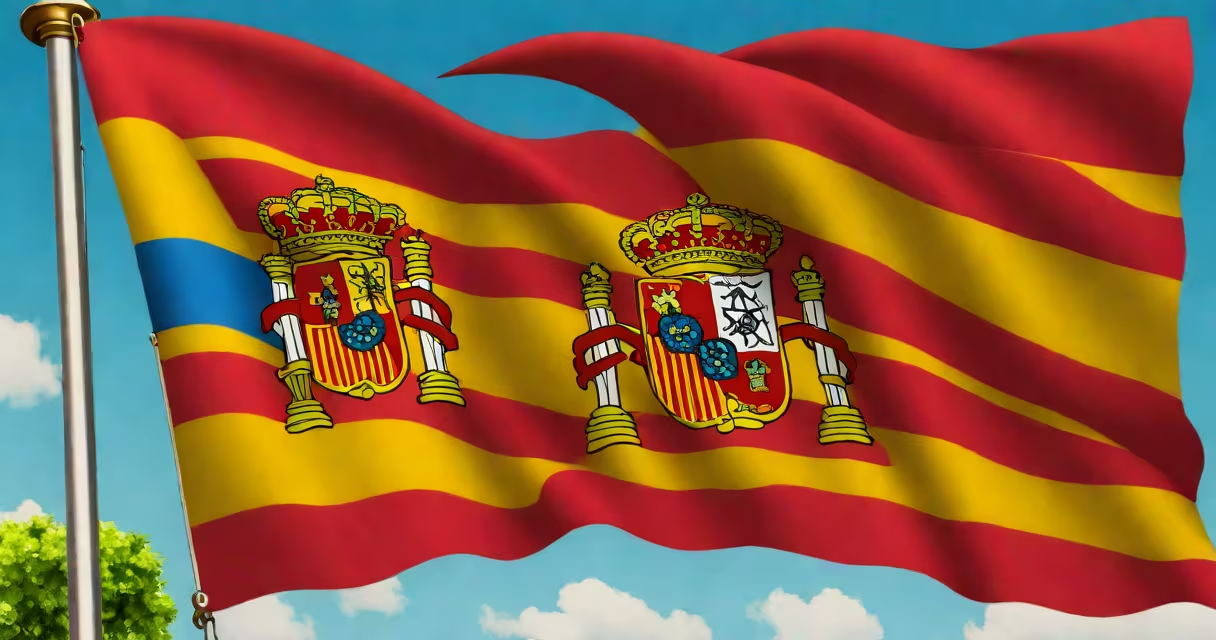
The Spanish word for "flag" is bandera. It refers to a piece of cloth with a design or colors representing a nation, organization, or cause.
Bandera is a feminine noun in Spanish, so it takes feminine articles and adjectives. It appears in everyday contexts such as national celebrations, sports events, and classroom instruction. The term is used consistently across all Spanish-speaking regions, though regional accents may affect pronunciation.
For example, in a classroom setting, a teacher might say: "Mire la bandera de España en la pared." This translates to "Look at the flag of Spain on the wall." The word appears in official documents, school textbooks, and media reports about international events.
Bandera follows standard Spanish grammar rules. It agrees in gender and number with other words in a sentence. For example:
It is often used in compound expressions. "Bandera nacional" means "national flag," and "bandera de guerra" means "battle flag." These phrases appear in historical texts and military terminology.
When discussing national identity, bandera is frequently paired with verbs like levantar (to raise), ondear (to wave), or desplegar (to unfurl). For instance: "Los estudiantes levantaron la bandera al amanecer." (The students raised the flag at dawn.)
Bandera appears in several distinct forms based on context:
| Type | Usage Example | Context |
|---|---|---|
| National flag | La bandera española tiene tres franjas horizontales. | Official symbol of Spain |
| Sports team flag | El equipo lleva su bandera en el estadio. | Team identity, fan culture |
| Flag in idioms | "Levantar bandera" significa comenzar una lucha. | Figurative use, metaphorical meaning |
One non-obvious fact: the phrase "levantar bandera" is used idiomatically to mean "to declare war" or "to initiate a struggle." This usage dates back to the 16th century and appears in literature, including works by Miguel de Cervantes.
Another distinction: while "bandera" refers to a physical cloth, the concept of "bandera" can also represent symbolic unity. In political discourse, leaders may say "el pueblo se une bajo una misma bandera," meaning "the people unite under one banner."
Non-native speakers often confuse "bandera" with similar-sounding words. For example:
These words share the root "bander-" but differ in meaning and usage. Misusing them can lead to misunderstandings in conversation or writing.
A frequent error is mispronouncing "bandera." The stress falls on the second syllable: ban-DE-ra. The "r" is rolled slightly, especially in Castilian Spanish. In Latin American dialects, the "r" may be softer.
Another mistake is using masculine articles. Since bandera is feminine, saying "el bandera" is incorrect. The correct form is "la bandera."
In 2023, during the FIFA World Cup qualifiers, a Spanish news outlet reported: "La selección nacional levantó la bandera de España antes del partido." This sentence uses bandera correctly in context, showing its role in national pride and public events.
Another example: in a classroom in Madrid, a student wrote: "Mi abuela me enseñó a hacer una bandera con los colores de España." (My grandmother taught me to make a flag with Spain's colors.) This demonstrates proper use in personal narrative and cultural education.
Firsthand observation: During a visit to the Museo del Prado in Madrid, I saw a large painting depicting the Battle of Lepanto. A caption read: "La bandera de la Armada Catalana ondeaba sobre el navío." The use of bandera here was accurate and contextually appropriate, reinforcing its consistent application in formal settings.
Understanding "bandera" is part of learning basic Spanish vocabulary. Related terms include:
These resources help build foundational skills for reading, listening, and speaking in Spanish. Mastery of core vocabulary like bandera enables learners to engage with authentic materials, from news articles to film subtitles.
According to the Real Academia Española (RAE), the official authority on the Spanish language, bandera has been documented since the 15th century. The RAE confirms its spelling, pronunciation, and usage in formal and informal contexts.
The Instituto Cervantes notes that bandera is among the top 50 most frequently used nouns in Spanish media and educational content. Its presence in daily life makes it essential for language acquisition.
Bandera is not just a word-it's a cultural marker. Whether seen on a government building, waved at a football match, or painted in a child's drawing, it represents identity, history, and belonging.