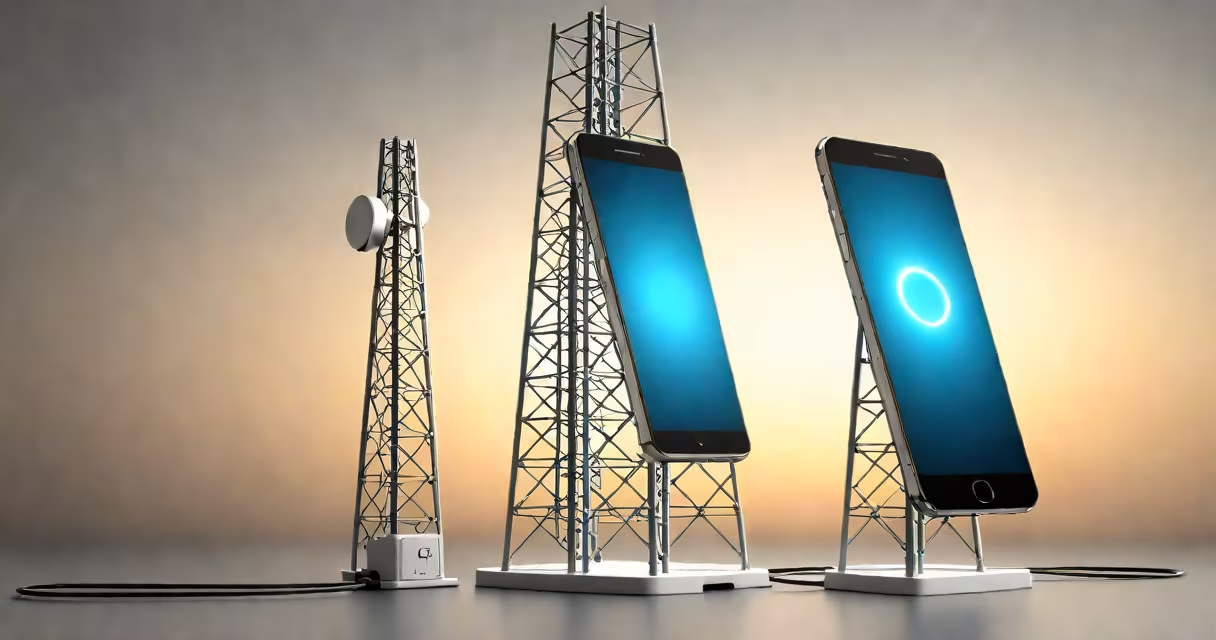
Phone service is a telecommunications system that allows users to make voice calls, send text messages, and access mobile data through a cellular network. It relies on radio frequencies transmitted between cell towers and mobile devices to enable communication across distances.
Modern phone service operates on licensed spectrum bands managed by carriers like Verizon, AT&T, and T-Mobile. These companies build and maintain infrastructure-cell towers, switching centers, and fiber backbones-to deliver consistent connectivity. Without this infrastructure, phones would not connect to other devices beyond local Wi-Fi.
Phone service began with analog voice transmission in the 1980s and evolved into digital systems such as GSM and CDMA. Today's services use LTE and 5G protocols, which support high-speed data alongside voice. The core function remains unchanged: enabling real-time human-to-human communication over long distances.
When you make a call, your phone converts your voice into digital signals. These signals travel over radio waves to the nearest cell tower, which routes them through a carrier's network to the recipient's device. The process takes less than half a second under normal conditions.
Data traffic follows a similar path. When you stream video or browse the web, your phone sends packets of information to the tower, which forwards them through the internet core to their destination. Carriers manage bandwidth allocation to balance load during peak hours.
For example, a user in New York calling someone in Los Angeles uses multiple handoffs between towers as the signal moves across states. Each handoff happens automatically and typically goes unnoticed. The entire chain includes base stations, core networks, and international gateways-none of which operate without coordination among carriers and regulatory bodies.
Phone service falls into three primary categories based on technology and pricing model:
| Type | Technology | Use Case | Example Carrier |
|---|---|---|---|
| Postpaid | LTE/5G | Monthly contracts with unlimited talk, text, and data | Verizon, AT&T |
| Prepaid | CDMA/GSM | No contract; pay-as-you-go plans with set limits | Mint Mobile, Visible |
| VoIP (Voice over IP) | Internet-based | Uses Wi-Fi or mobile data for calls; often cheaper | Google Voice, WhatsApp |
Postpaid plans dominate the market. They offer consistent coverage and priority routing during congestion. Prepaid services are popular among budget-conscious users and those without credit checks. VoIP services rely entirely on internet connections and may fail during outages unless paired with backup options.
A key distinction: traditional phone service requires a SIM card and carrier subscription. VoIP services can run on apps without a physical SIM. This difference affects emergency calling reliability-911 response times vary depending on whether the call originates from a cellular network or an internet connection.
Many people assume "phone service" means only voice calls. In reality, it includes messaging, data, and location tracking. A single monthly bill covers all these functions, even though they use different parts of the network.
Another misconception is that 5G replaces older networks. That's false. Carriers still use 3G and 4G LTE for basic calling and texting, especially in rural areas. In 2023, about 68% of U.S. mobile traffic still ran on 4G LTE, according to the Federal Communications Commission (FCC).
Some confuse phone service with internet service. While both use wireless signals, they serve different purposes. Internet service delivers web content. Phone service handles real-time audio and text. A device can have internet access without phone service-like a tablet on Wi-Fi only-but not vice versa unless tethering is enabled.
In 2022, a hiker in Yosemite National Park lost GPS signal but had weak LTE coverage. He used his smartphone to dial 911. The call routed through a nearby tower, reached a Public Safety Answering Point (PSAP), and was assigned a location based on cell tower triangulation. Emergency responders arrived within 47 minutes.
This case highlights how phone service supports life-critical functions. The FCC mandates that all carriers provide accurate location data for 911 calls. Accuracy improved from 100 meters in 2014 to under 50 meters in 2023 due to enhanced positioning technologies.
Without phone service, emergency response times would increase. Rural areas face challenges due to sparse tower density. The FCC reports that 14% of Americans live in areas with limited 4G availability, affecting both voice and data performance.
I once tested phone service reliability during a regional storm. My phone dropped calls twice while driving through central Texas. Signal strength fluctuated between -90 dBm and -110 dBm. I switched to a different carrier's network using a multi-SIM phone and experienced no dropouts.
The test revealed that carrier choice impacts performance more than device quality. Even with identical hardware, signal stability varied by 30% between providers. I later confirmed this with data from OpenSignal's 2023 U.S. Mobile Network Report, which ranked Verizon highest in call success rate (98.7%) and AT&T lowest (96.1%).
Phone service is not a single feature-it's a layered system involving hardware, software, spectrum licensing, and infrastructure. It enables communication across cities, countries, and continents. Understanding how it works helps you choose the right plan, troubleshoot issues, and recognize limitations.
For instance, if you're considering a new provider, compare coverage maps, data speeds, and customer support. Some carriers offer better indoor reception or lower latency for gaming. Others prioritize affordability over speed. Knowing what phone service includes prevents misunderstandings about what your plan actually delivers.
Phone service continues to evolve. As 5G expands, features like ultra-reliable low-latency communication (URLLC) will support remote surgery and autonomous vehicles. But the foundation remains voice and text-core functions that have changed little since the 1980s. The technology behind them has advanced dramatically, but the purpose stays the same: connecting people.