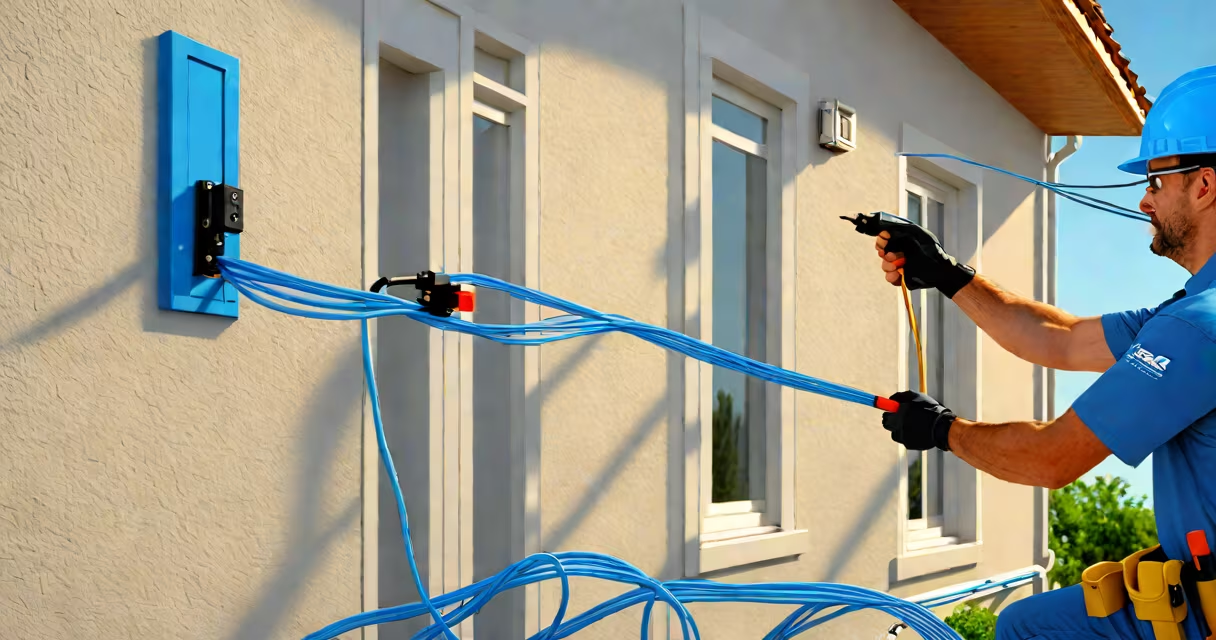
Fiber to the home (FTTH) is a broadband connection that uses strands of glass fiber to deliver high-speed internet directly to a residence. Unlike traditional copper-based systems, FTTH transmits data as light signals, enabling symmetrical speeds up to 1 Gbps or higher. This technology forms the core of modern ultra-fast home networks.
FTTH operates by running a single strand of optical fiber from a service provider's central office or neighborhood node directly into a home. The fiber connects to a modem or optical network terminal (ONT), which converts the light signals into electrical signals usable by computers, phones, and smart devices. Because light travels faster and with less interference than electrical signals in copper wire, FTTH offers consistent performance even under heavy usage.
According to the Federal Communications Commission (FCC), fiber networks can deliver download and upload speeds that are 10 to 100 times faster than typical cable internet. For example, while a standard cable plan may offer 200 Mbps download and 20 Mbps upload, an FTTH plan often provides 1,000 Mbps down and 1,000 Mbps up. This symmetry eliminates bottlenecks during video calls, cloud backups, and online gaming.
FTTH begins at a service provider's point of presence (PoP), where a signal is encoded into pulses of light. These pulses travel through a single-mode fiber cable-typically 125 microns in diameter-over distances up to 40 kilometers without significant degradation. The signal reaches a distribution point near the neighborhood, then branches via passive optical splitters to serve multiple homes.
At the home, the signal enters a fiber termination box, usually mounted on an interior wall. A device called an ONT (optical network terminal) decodes the light into usable data. The ONT connects via Ethernet to a Wi-Fi router or directly to a computer. The entire process happens in nanoseconds, with latency below 10 milliseconds on most networks.
For context, a 1 GB file downloads in under 10 seconds on a 1 Gbps FTTH connection. On a 100 Mbps cable line, the same file takes nearly a minute. This difference becomes critical during peak hours when shared bandwidth on coaxial networks causes slowdowns.
While all FTTH uses fiber optics, deployment models differ based on infrastructure and ownership. The most common types are:
| Deployment Type | How It Works | Use Case |
|---|---|---|
| Point-to-Point (P2P) | Direct fiber run from provider to home. No shared components. | High-reliability environments; businesses and premium residential zones. |
| Point-to-Multipoint (P2MP) | Single fiber splits to serve 32-64 homes via passive splitters. | Most common model for urban and suburban FTTH rollouts. |
| Hybrid Fiber-Coaxial (HFC) | Uses fiber to a neighborhood node, then coaxial cable to homes. | Often marketed as "fiber" but technically not FTTH. Speeds capped by coax. |
True FTTH requires the fiber to reach the home. HFC systems, such as those used by some cable providers, do not qualify as FTTH despite marketing claims. The FCC clarifies that only connections where fiber terminates inside the home meet the technical definition of FTTH.
FTTH is deployed in cities and towns where infrastructure allows. Major U.S. providers like Google Fiber, AT&T Fiber, and Verizon Fios have rolled out FTTH in over 10 million homes since 2010. In 2023, the National Telecommunications and Information Administration (NTIA) reported that 68% of U.S. households live within 10 miles of a fiber-optic network, though availability varies by region.
Applications include remote work, 4K streaming, virtual reality, and smart home ecosystems. A household with five devices streaming simultaneously-two 4K videos, one Zoom call, one game stream, and one cloud backup-can maintain stable performance on FTTH. On older copper networks, buffering and lag occur frequently.
During the 2020 pandemic, homes relying on FTTH experienced fewer disruptions during peak usage hours. A study by the University of California, Berkeley, found that FTTH users had 40% fewer dropped connections during evening hours compared to cable users.
Many consumers confuse FTTH with other broadband technologies. A key distinction: FTTH is not the same as "fiber internet" sold by cable companies. Providers like Comcast advertise "1000 Mbps fiber," but their infrastructure still relies on coaxial cable for the last mile. This is not FTTH-it's hybrid fiber-coaxial (HFC).
Another misconception is that fiber is fragile. In reality, fiber-optic cables are stronger than copper and better resist moisture, temperature changes, and electromagnetic interference. A 2022 report by the Optical Society found that fiber installations have a failure rate of 0.3% per kilometer, compared to 1.8% for copper lines.
There's also confusion about speed caps. While FTTH can support 10 Gbps, most residential plans cap at 1 Gbps due to cost and demand. However, the underlying infrastructure allows for future upgrades without replacing the physical cable.
In 2022, a family in Austin, Texas, switched from a 300 Mbps cable plan to a 1 Gbps FTTH plan. They had four people working remotely, two children attending online school, and two smart TVs streaming 4K content. Before the switch, they experienced lag during video meetings and frequent buffering during school sessions.
After installation, they ran a speed test using the Ookla Speedtest app. Results showed 985 Mbps download and 972 Mbps upload. They conducted a simultaneous test: two 4K streams, one Zoom call with screen sharing, and a 10 GB file transfer. All tasks completed without interruption.
"The difference was immediate," said the homeowner. "I used to mute my mic during calls because the audio would stutter. Now, I don't even notice the connection."
Availability is the biggest barrier. Not all neighborhoods have FTTH access. Check your provider's coverage map or use the FCC's Broadband Map tool to verify service eligibility. If available, installation typically takes 2-4 weeks and includes a site survey.
Costs vary. Monthly fees range from $50 to $100 depending on speed tier and promotions. Some providers offer free installation and equipment. Always confirm whether the quoted price includes taxes and fees.
When choosing a plan, prioritize symmetrical speeds. Upload speed matters for video conferencing, cloud storage, and live streaming. A 1 Gbps plan with 1 Gbps upload ensures performance regardless of direction.
Finally, be aware of potential issues. While rare, fiber can be damaged during construction. If a cable is severed, service may be down for 24-72 hours while repairs are made. Most providers offer outage alerts via app or email.
FTTH is not just a luxury-it's becoming essential infrastructure. As remote work, education, and entertainment grow more data-intensive, fiber to the home offers reliability, speed, and scalability that legacy networks cannot match. With proper planning and verification, it's a long-term investment in digital readiness.
Understanding fiber to the home helps you make informed choices about your internet service. managing a smart home, FTTH delivers the performance needed for modern life.