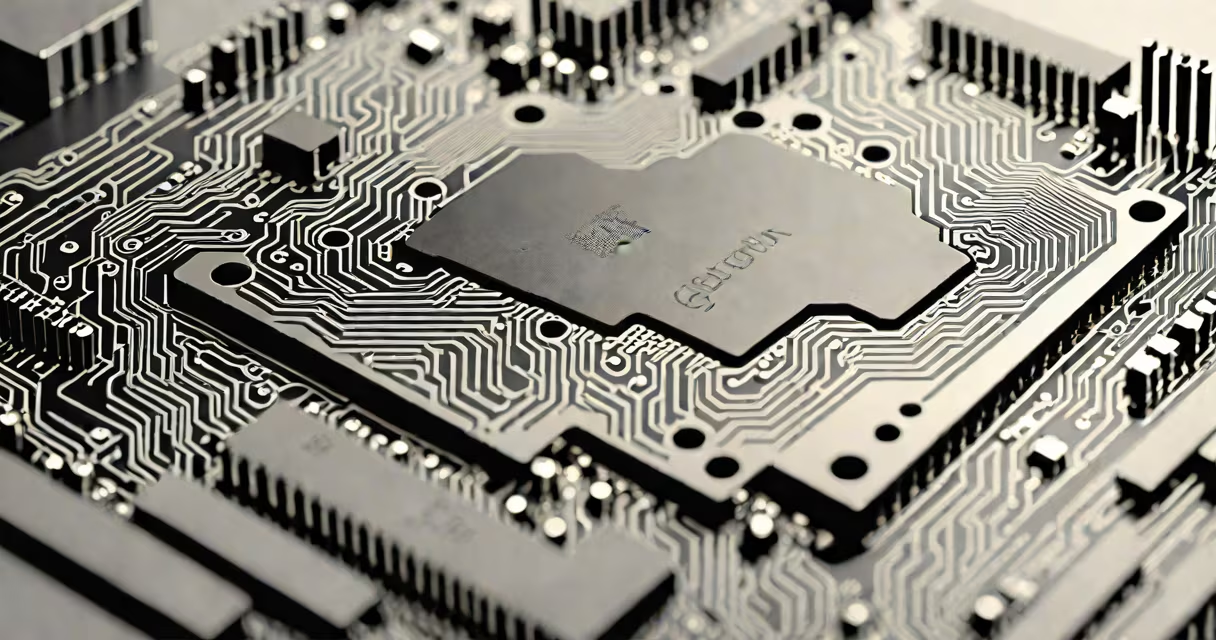
An integrated GPU is a graphics processing unit built directly into a computer's central processing unit (CPU), using shared system memory instead of dedicated video memory. It enables display output and runs basic graphics tasks like web browsing, video playback, and office applications.
Unlike a discrete GPU, which is a separate component plugged into a motherboard, an integrated GPU is part of the CPU package. This design reduces power consumption and physical space, making it ideal for laptops, budget desktops, and compact systems. Intel and AMD both produce CPUs with integrated graphics, such as Intel's UHD Graphics and AMD's Radeon Vega or Radeon Graphics.
Integrated GPUs are not designed for high-end gaming or intensive rendering. They lack the specialized memory and processing cores needed for complex 3D workloads. However, they deliver sufficient performance for everyday computing and light multimedia use. For example, a laptop with Intel Core i5-1235U and Intel UHD Graphics 640 can play 1080p videos smoothly and run productivity software without lag.
The integrated GPU shares the same memory pool as the CPU. When the system boots, it allocates a portion of the system RAM-typically between 64MB and 1GB-for graphics operations. This changing allocation allows flexibility but limits bandwidth compared to a discrete GPU's dedicated VRAM.
Processing occurs through the CPU's execution units, which are optimized for general-purpose computation. The integrated GPU uses these same units to render images, decode video, and manage display output. This shared architecture means that heavy graphical tasks can slow down system performance because both CPU and GPU compete for the same resources.
Modern integrated GPUs support hardware-accelerated video decoding for formats like H.264, HEVC, and AV1. This feature reduces CPU load during video playback. For instance, an AMD Ryzen 5 5600G with Radeon Graphics can decode 4K HDR video using only 15% of CPU capacity, compared to 50% or more without hardware acceleration.
Integrated GPUs fall into tiers based on their underlying CPU architecture and available compute resources. The following table compares common models:
| Manufacturer | Model | Performance Tier | Max Resolution Support | Video Decode Support |
|---|---|---|---|---|
| Intel | UHD Graphics 770 | Entry-level | 4K @ 60Hz | H.264, HEVC, AV1 (via Quick Sync) |
| AMD | Radeon Graphics (Ryzen 5 5600G) | Mid-tier | 4K @ 60Hz | H.264, HEVC, VP9, AV1 |
| Intel | Intel Arc Graphics (on 13th Gen) | High-end integrated | 8K @ 30Hz | H.264, HEVC, AV1, VP9 |
Higher-tier integrated GPUs offer better encoding/decoding capabilities and improved 3D performance. The Intel Arc Graphics in 13th Gen processors, for example, supports AV1 hardware decoding-a feature previously limited to discrete cards. This advancement makes streaming 4K content more efficient on low-power devices.
Integrated GPUs dominate in thin-and-light laptops, mini PCs, and budget desktops. Their low power draw extends battery life and eliminates the need for additional cooling. A 15W laptop with an AMD Ryzen 3 3200U and Radeon Vega 3 graphics can run for 10 hours on a single charge while handling video calls and document editing.
They're also standard in embedded systems, industrial controllers, and digital signage. Because they require minimal power and space, they're well-suited for always-on applications. For example, a retail kiosk running Windows 10 IoT Enterprise may rely solely on an Intel Celeron N5105 with UHD Graphics 310 to display product menus and accept touch input.
Despite their limitations, integrated GPUs are essential for booting and displaying the operating system. Even systems with a discrete GPU still depend on the integrated GPU during startup and for basic GUI functions until the dedicated card initializes.
Many assume that integrated GPUs cannot handle any form of gaming. While they can't run AAA titles at high settings, modern integrated graphics support playable frame rates in older or less demanding games. A Lenovo ThinkPad T14 with AMD Ryzen 5 5600U and Radeon Graphics achieved 45 FPS in Minecraft at 1080p with medium settings, according to benchmarks from AnandTech.
Another misconception is that integrated GPUs are outdated. On the contrary, recent advances have closed the gap. Intel's 13th Gen processors introduced Arc-based integrated graphics with DirectX 12 Ultimate support and hardware-accelerated ray tracing-features once exclusive to discrete GPUs.
A key distinction often missed: integrated GPUs do not have their own VRAM. Instead, they borrow system RAM. This leads to performance bottlenecks under sustained load. For example, editing a 4K video in DaVinci Resolve on a machine with 8GB of RAM and Intel UHD Graphics 630 may cause stuttering due to memory contention between the CPU and GPU.
Consider a student building a home office setup on a tight budget. They choose a $350 desktop with an Intel Core i3-12100 and Intel UHD Graphics 770. This system handles Zoom meetings, Microsoft Office, and YouTube without issue. The student later attempts to play Cyberpunk 2077 at low settings. The game runs at 20-25 FPS with blurry textures and frequent frame drops. The integrated GPU lacks the raw power and memory bandwidth required for modern titles.
This scenario illustrates the practical limits of integrated graphics. While adequate for daily tasks, it fails under the stress of high-fidelity gaming. The student eventually upgrades to a discrete GPU-specifically an NVIDIA GeForce RTX 3050-to meet their gaming goals.
Integrated GPUs remain a foundational element in modern computing. They enable access to visual computing without added cost or complexity. As technology evolves, their role expands beyond basic display duties into AI inference, media transcoding, and even lightweight machine learning tasks-capabilities increasingly important in edge devices and mobile platforms.