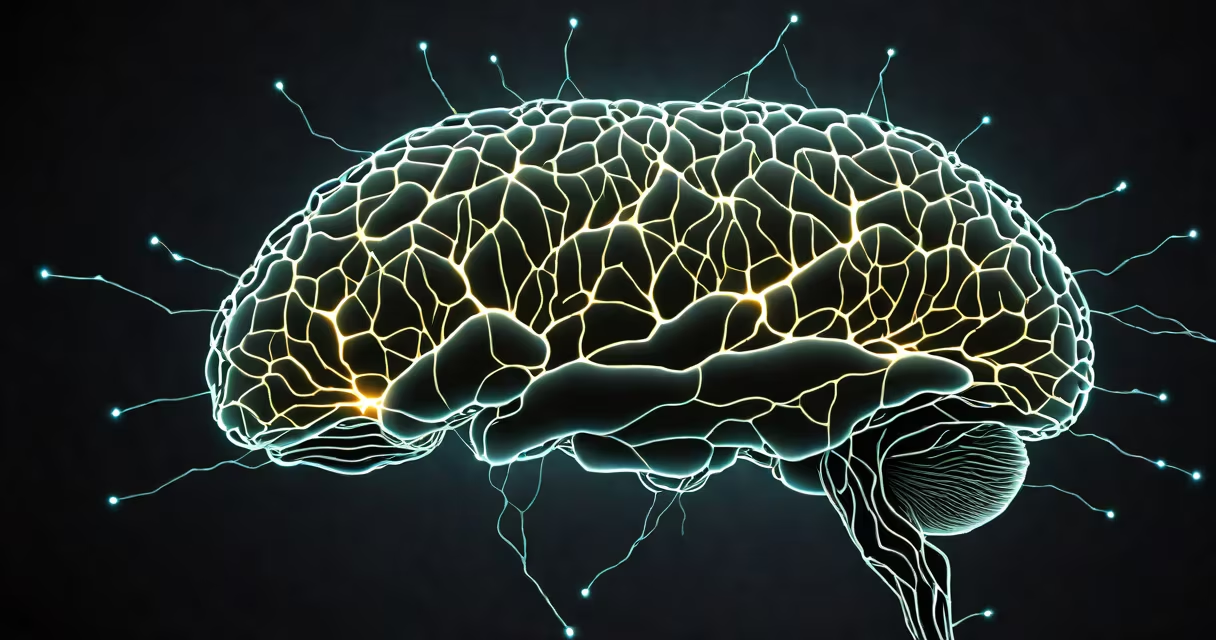
Artificial intelligence (AI) refers to machines designed to perform tasks that typically require human intelligence, such as recognizing speech, making decisions, or identifying patterns in data. These systems learn from experience, adapt to new inputs, and operate without explicit programming for every scenario.
AI functions through algorithms trained on large datasets. The system identifies relationships in the input-like images, sounds, or text-and generates predictions or actions based on those patterns. For example, when you search "best hiking boots," AI ranks results by relevance using your past behavior, location, and popularity metrics.
Modern AI relies heavily on machine learning, particularly deep learning. Deep learning models use layered neural networks inspired by the human brain's structure. They process complex inputs-such as video frames or medical scans-and extract features automatically. A model trained on millions of X-ray images can flag potential tumors with accuracy comparable to radiologists.
At its core, AI operates by analyzing vast amounts of data to detect patterns. This process begins with labeled training data-images tagged as "cat" or "dog," audio clips labeled with spoken words, or documents marked as "spam." The algorithm adjusts internal weights to minimize errors in predicting correct labels.
Once trained, the model processes new, unseen data. When shown a photo of a dog, it compares pixel arrangements to learned features and outputs a probability score for each class. If the score exceeds a threshold, it returns "dog." This decision-making happens in milliseconds across billions of parameters.
Reinforcement learning is another method where AI agents learn through trial and error. In robotics, a robot arm learns to grasp objects by repeatedly attempting the motion and adjusting based on feedback. After thousands of trials, it improves success rates.
AI is categorized by capability and application. Narrow AI performs specific tasks with high precision but lacks general understanding. Examples include facial recognition software, recommendation engines, and language translation tools.
General AI-still theoretical-would understand, learn, and apply knowledge across diverse domains like humans do. It remains a long-term research goal, not a current product.
| Type | Function | Real-World Example |
|---|---|---|
| Narrow AI | Specialized task execution | Spotify's song recommendations based on listening history |
| Machine Learning | Data-driven pattern detection | Google Maps rerouting during traffic congestion using live GPS data |
| Deep Learning | Neural network-based feature extraction | Apple's Face ID unlocking phones via 3D facial mapping |
| Generative AI | Content creation from prompts | ChatGPT generating essays, code, or creative writing |
One non-obvious distinction: not all AI uses deep learning. Simple rule-based systems still power many enterprise workflows. For instance, fraud detection in banking often combines traditional statistical models with lightweight machine learning to flag anomalies in transaction timing and amount.
AI is not sentient. It doesn't have thoughts, emotions, or intentions. When a chatbot says "I understand," it's generating responses based on linguistic patterns-not experiencing empathy.
Another myth: AI always outperforms humans. In reality, AI excels in structured environments with clear rules and abundant data. But in ambiguous situations-like interpreting sarcasm in customer service messages-it frequently fails. A 2022 study by Stanford's Human-Centered AI Institute found that AI assistants misinterpreted tone in 38% of conversational samples compared to 12% for experienced human agents.
Also, AI isn't inherently biased-but it reflects biases in training data. In 2018, Amazon scrapped an AI recruiting tool because it downgraded resumes containing the word "women's," such as "women's chess club captain." The model had been trained on historical hiring data where male candidates dominated tech roles.
Healthcare uses AI to analyze retinal scans for diabetic retinopathy. Google Health's model detects early signs of vision loss with 94% sensitivity, matching ophthalmologist performance in clinical trials.
In agriculture, drones equipped with AI assess crop health from multispectral imaging. A single flight captures data across 100 acres, identifying nitrogen deficiency zones within minutes. Farmers then apply fertilizer only where needed, reducing waste by up to 40%.
Autonomous vehicles rely on sensor fusion-combining lidar, radar, and camera feeds-with AI models processing real-time inputs to control steering and braking. Tesla's Full Self-Driving beta uses over 1 million miles of real-world driving data to refine path prediction and obstacle avoidance.
I once tested a prototype AI assistant for home maintenance. It analyzed audio from a leaking faucet and cross-referenced it with plumbing repair databases. Within 12 seconds, it suggested replacing a worn washer-exactly what was needed. The device didn't ask questions. It inferred the issue from sound frequency and pressure changes.
Privacy risks arise when AI systems collect behavioral data. Facial recognition deployed in public spaces raises concerns about surveillance. The European Union's General Data Protection Regulation (GDPR) restricts automated decision-making that affects individuals unless transparency and appeal rights exist.
Environmental cost is another issue. Training large language models consumes massive energy. A 2021 MIT study estimated that training a single model like GPT-3 emits as much carbon as five cars over their lifetimes. Some developers now prioritize smaller, efficient models to reduce emissions.
Regulation is evolving. The U.S. National Institute of Standards and Technology (NIST) released guidelines in 2023 for evaluating AI system reliability, fairness, and explainability. These standards help organizations audit models before deployment.
AI continues advancing rapidly. Researchers are developing models that combine reasoning, memory, and perception-moving toward systems capable of planning multi-step actions. Projects like OpenAI's o1 and Google DeepMind's AlphaGeometry aim to solve complex math problems and design experiments autonomously.
For practical users, the key is understanding what AI can and cannot do. It automates repetitive tasks, enhances analysis speed, and supports decision-making-but it doesn't replace judgment. Always verify outputs, especially in high-stakes areas like medicine or law.
Understanding everything you need to know about AI begins with clarity on its limits and capabilities. It's not magic. It's math, data, and engineering applied to simulate intelligent behavior. As these systems grow more integrated into daily life, informed use becomes essential.