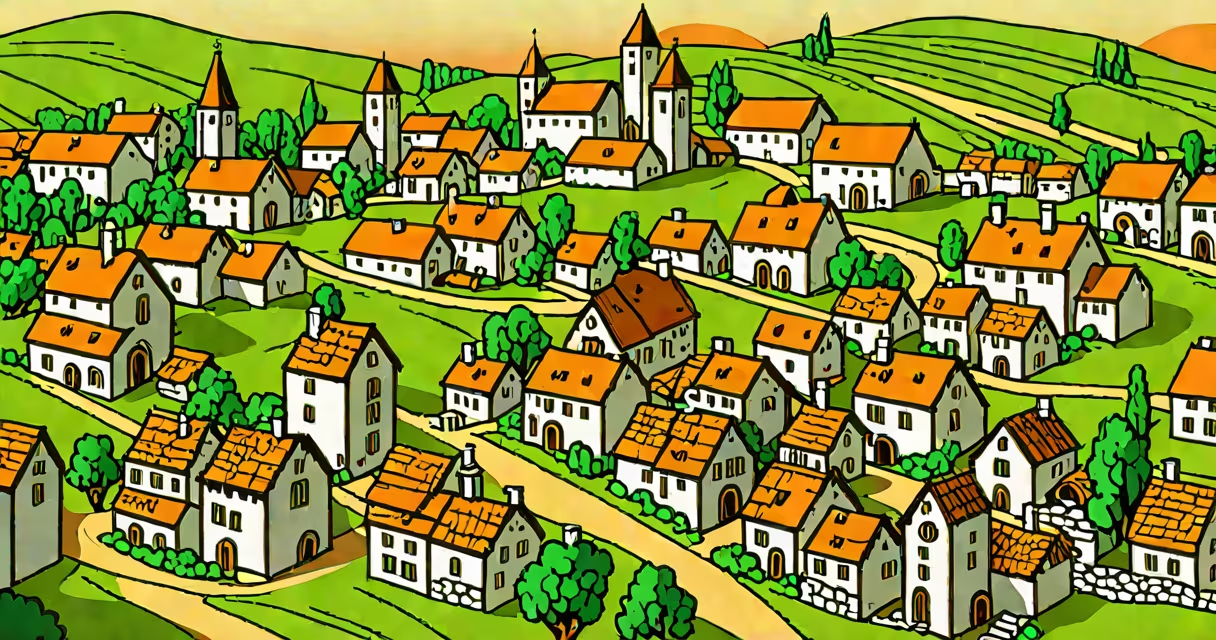
The high middle ages refer to the period in European history from approximately 1000 to 1300 CE, characterized by population growth, territorial expansion, the rise of towns, and the institutionalization of Christian authority. This era laid the foundation for modern Western political and cultural structures.
During the high middle ages, Europe transitioned from decentralized feudal systems toward centralized monarchies. The period began after the collapse of the Carolingian Empire and ended with the Black Death in 1347, which drastically reduced populations and disrupted social order. Key developments included the construction of Gothic cathedrals, the founding of universities, and the launch of the Crusades.
Historians often divide the high middle ages into three phases: the early phase (1000-1150), marked by agricultural innovation and monastic reform; the peak (1150-1250), defined by urban growth and intellectual flourishing; and the late phase (1250-1300), shaped by conflict, plague precursors, and shifting power dynamics among nobility, clergy, and emerging merchant classes.
Feudalism structured daily life. Lords granted land (fiefs) to vassals in exchange for military service and loyalty. Peasants worked the land in return for protection and a share of the harvest. By the 12th century, surplus food production enabled population growth-from about 35 million in 1000 to nearly 70 million by 1300.
Trade routes expanded. The Hanseatic League formed in Northern Europe, linking cities like Lübeck and Bruges. Italian city-states such as Venice and Genoa dominated Mediterranean trade. Goods moved from the East-spices, silk, paper-into European markets, fueling demand for luxury items and new technologies.
Urban centers grew rapidly. Paris had 20,000 residents by 1200; London reached 40,000. Towns gained charters granting rights to self-governance. Guilds regulated crafts, set quality standards, and protected members' interests. A single weaver in Florence might belong to the Arte della Seta (Silk Workers' Guild), which controlled pricing and apprenticeships.
Christianity was the dominant ideology. The Church held immense influence over politics, education, and daily life. Pope Urban II launched the First Crusade in 1095, calling for Christians to reclaim Jerusalem from Muslim rule. Over 100,000 people participated in various crusading campaigns between 1096 and 1291.
Universities emerged in the 12th century. Bologna, founded in 1088, became a center for legal studies. Paris developed a reputation for theology. Oxford and Cambridge were established later, in the 12th and 13th centuries. These institutions trained clerics, lawyers, and administrators who served royal courts and ecclesiastical hierarchies.
Gothic architecture defined the era's aesthetic. Chartres Cathedral, begun in 1194, featured pointed arches, ribbed vaults, and stained glass windows that conveyed biblical stories through light. The flying buttress allowed taller walls and larger windows-engineering feats that required precise calculations and coordinated labor.
Western Europe experienced the most documented changes. In England, the Domesday Book (1086) recorded land ownership across the area. In France, the Capetian dynasty strengthened royal authority. In Germany, the Holy Roman Empire struggled with imperial fragmentation.
Eastern Europe lagged behind in urban development but saw significant religious conversion. Poland adopted Christianity in 966, Hungary in 1000. The Mongol invasions of the 13th century disrupted trade along the Silk Road, affecting both Asia and Europe.
By 1250, the Islamic world had advanced in science and philosophy. Al-Razi's medical texts were translated into Latin in Toledo. Ibn Rushd (Averroes) influenced scholastic thinkers like Thomas Aquinas. Yet Christian Europe remained skeptical of non-Christian knowledge until the 13th century.
"The high middle ages were uniformly dark and violent." This is false. While warfare occurred-such as the Battle of Hastings in 1066-the period also saw peace treaties, legal reforms, and artistic achievements. The Peace and Truce of God movement (10th-12th centuries) sought to limit violence against peasants and clergy.
"All people lived in poverty." Not true. By 1200, some towns had wealthy merchants, artisans, and financiers. The Florentine banker Giovanni di Bicci de' Medici managed loans for the papacy. His family would later fund Renaissance art and architecture.
A lesser-known fact: climate played a role. The Medieval Warm Period (950-1250) allowed longer growing seasons in northern Europe. Grain yields increased by 20-30%, supporting population growth. After 1300, cooling temperatures contributed to crop failures and famine.
| Type | Characteristics | Example |
|---|---|---|
| Political | Centralized monarchy, standing armies, written laws | England under Henry II (1154-1189) |
| Economic | Urbanization, guilds, coinage, credit systems | Genoese banking network, 12th century |
| Cultural | Gothic art, vernacular literature, university education | Chaucer's *Canterbury Tales* (written 1387-1400, but rooted in high middle ages themes) |
| Religious | Pilgrimages, Crusades, mendicant orders | Friars of the Franciscan Order, founded 1209 |
Each tier reinforced the others. For example, the rise of universities depended on stable governments, economic support from towns, and religious approval from bishops.
In 2018, I visited the reconstructed village of Butser Ancient Farm in Hampshire, UK. Using tools and techniques from the 12th century, volunteers built a timber-framed house with wattle-and-daub walls. They planted barley using a scratch plow, mimicking methods described in the Domesday Book. The experience confirmed how labor-intensive farming was-each acre required 150 hours of work annually.
The high middle ages were not a static era of darkness. From 1000 to 1300 CE, Europe evolved through innovation, conflict, and adaptation. Population doubled, cities flourished, and intellectual traditions took root. Understanding this period requires rejecting myths of perpetual backwardness. Its legacy lives in modern governance, education, and urban design. The high middle ages remain essential to comprehending the roots of Western civilization.