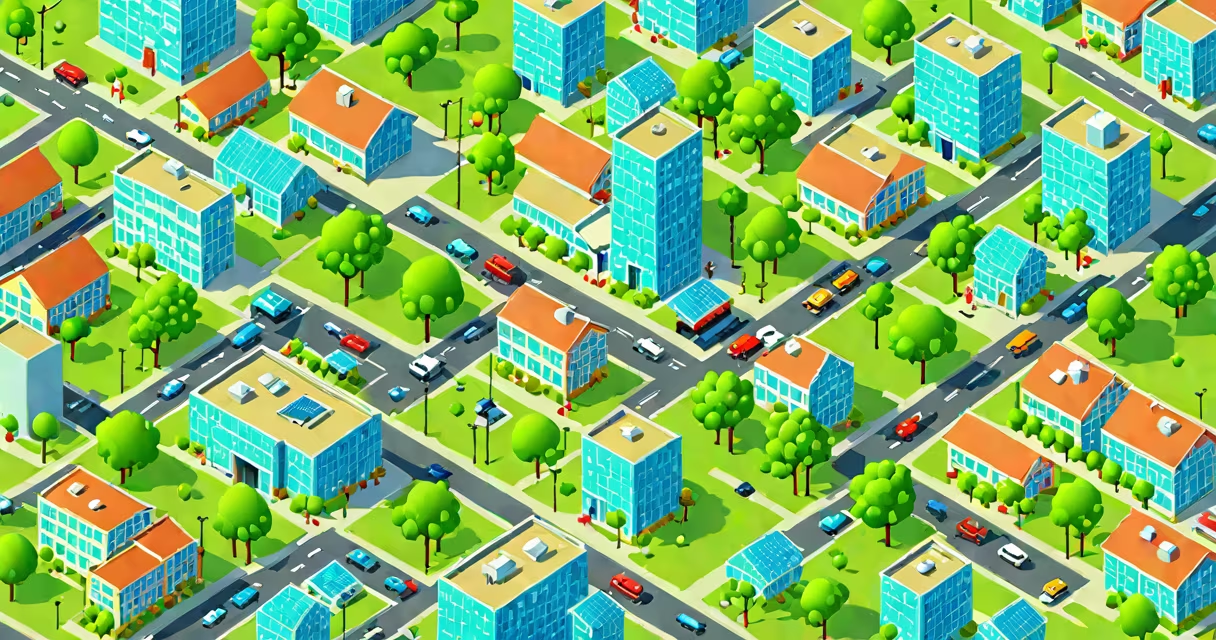
Sustainable cities are urban areas designed to meet current residents' needs without compromising future generations' ability to meet theirs. They balance economic growth, social equity, and environmental protection through integrated planning and resource management.
These cities prioritize clean energy, efficient public transit, waste reduction, and abundant green space. They function within planetary boundaries-using renewable resources, minimizing emissions, and adapting to climate risks. The goal is long-term resilience, not just short-term convenience.
The concept emerged from the 1987 Brundtland Report's definition of sustainability: "development that meets the needs of the present without compromising the ability of future generations to meet their own needs." This structure applies directly to urban environments, where population density intensifies resource demands.
They operate through interconnected systems that manage energy, water, waste, mobility, and housing efficiently. For example, district heating networks reuse industrial waste heat to warm homes, reducing reliance on fossil fuels. In Copenhagen, 50% of all trips are made by bicycle, supported by dedicated lanes and traffic signals prioritizing cyclists.
Water conservation is another core function. Singapore uses NEWater-recycled wastewater treated to drinking standards-to supply 40% of its water needs. Rainwater harvesting and permeable pavements reduce stormwater runoff and prevent flooding during monsoon seasons.
Urban planning integrates nature into infrastructure. Green roofs in Toronto reduce building cooling loads by up to 25%, while also absorbing rainwater and lowering citywide temperatures. These features aren't decorative-they actively lower energy consumption and improve air quality.
Sustainable cities rely on four foundational elements: energy efficiency, transportation equity, circular economies, and inclusive governance.
| Component | Description | Real-World Example |
|---|---|---|
| Energy Efficiency | Use of renewables and smart grids to cut carbon output. | Freiburg, Germany, generates 60% of its electricity from solar and biomass. |
| Transit-Oriented Development | High-density housing near mass transit hubs reduces car dependency. | Curitiba, Brazil, pioneered bus rapid transit (BRT) in 1970s, serving 2 million daily riders. |
| Circular Waste Systems | Waste is reused or recycled rather than landfilled. | San Francisco diverts 80% of waste from landfills via mandatory composting and recycling. |
| Inclusive Urban Design | Public spaces and services accessible to all income levels and abilities. | Medellín, Colombia, built cable cars and libraries in informal settlements to connect marginalized communities. |
Not all sustainable cities look the same. Some focus on technological innovation-like Masdar City in Abu Dhabi, which aims to be carbon-neutral using solar power and electric shuttles. Others emphasize social cohesion, such as Vienna's housing model, where 60% of apartments are publicly subsidized and managed under rent control.
People often confuse sustainable cities with green cities. A green city may have many trees and parks but still depend heavily on imported energy or private vehicles. Sustainability goes beyond aesthetics-it requires systemic change in how resources are sourced, consumed, and returned to ecosystems.
Another myth is that sustainability requires high costs. While initial investments in infrastructure can be significant, long-term savings emerge from reduced energy bills, lower healthcare costs due to cleaner air, and fewer disaster recovery expenses. A 2021 study by the World Bank found that every $1 invested in resilient urban infrastructure saves $4 in future damages.
Some assume sustainability is only for wealthy nations. But cities like Kigali, Rwanda, and Surabaya, Indonesia, have implemented successful waste sorting programs and expanded public transport despite limited budgets. Success hinges on local context, community involvement, and phased implementation-not just funding.
Malmö transformed a former industrial port area into Western Europe's largest eco-district-Västra Hamnen. The project began in 1997 and now houses 10,000 people. Key features:
Since completion, the district produces 20% more energy than it consumes. Residents report higher satisfaction with air quality and neighborhood safety. The model has been replicated in over 20 European cities.
I visited Malmö in 2022 and walked through the central park, where children played near a restored wetland. The air smelled of pine and damp earth. A sign read: "This land was once toxic. Now it feeds the city." That moment crystallized what define sustainable cities really means-not perfection, but regeneration.
Over half the world's population lives in cities. By 2050, that number will reach 6.7 billion. Without sustainable design, urban growth will accelerate climate change, deepen inequality, and strain natural systems.
According to the United Nations, cities account for 70% of global CO₂ emissions. But they also hold 80% of the solution-through compact design, shared mobility, and decentralized energy systems. The shift isn't optional; it's survival.