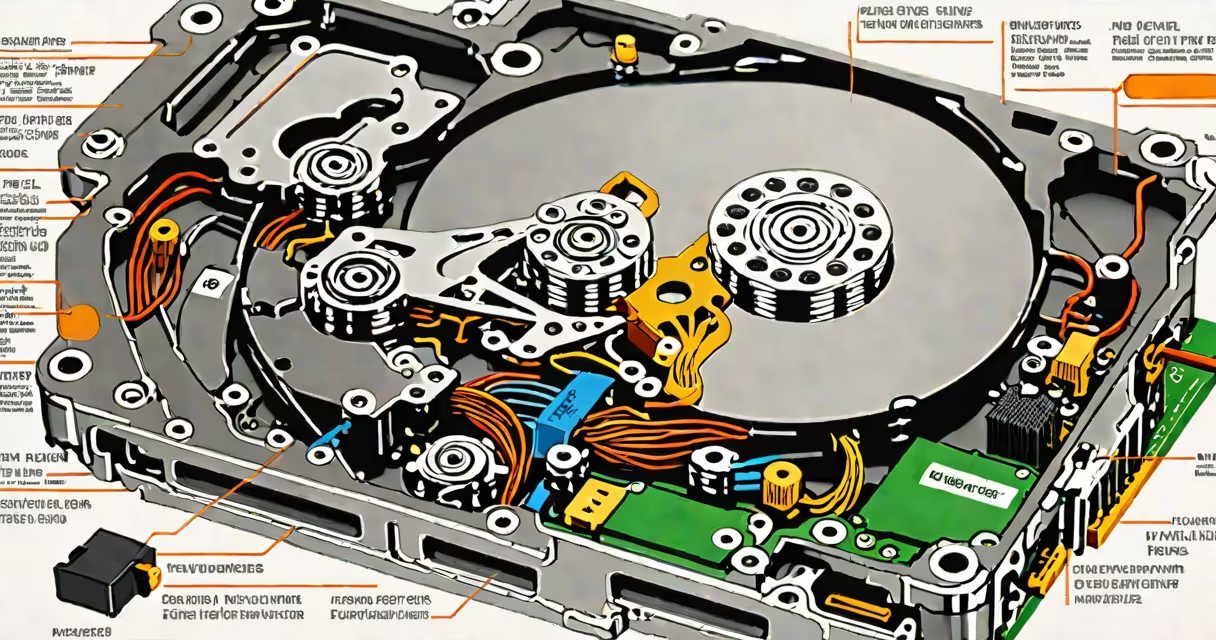
A hard disk drive (HDD) stores digital data on rapidly spinning magnetic platters using movable read/write heads guided by an actuator arm. The core components include the platters, heads, actuator, spindle motor, and electronic controller-all working in concert to retrieve and write data at speeds measured in milliseconds.
The platters are the primary data storage surfaces. Typically made of aluminum or glass coated with a thin layer of magnetic material, they spin at 5,400 to 15,000 RPM depending on the drive model. A 7,200 RPM drive completes a full rotation in about 8.3 milliseconds. Data is stored in concentric tracks divided into sectors-each sector holds 512 bytes of raw data, though modern drives use 4KB logical sectors for efficiency.
Read/write heads float nanometers above the surface of each platter, riding on a cushion of air generated by the spinning motion. These heads are mounted on an actuator arm that moves them precisely across the platter surface. The arm's movement is controlled by a voice coil actuator-a linear motor that allows positioning accuracy within microns. This mechanism enables the head to access specific sectors in under 10 milliseconds on average.
The spindle motor spins the platters at a constant speed. It uses a precision bearing system and is powered by the drive's internal power supply. High-performance drives often feature fluid changing bearings (FDB) to reduce vibration and noise. A typical 3.5-inch desktop HDD draws around 6 watts during operation, with most energy going to the spindle and actuator.
At the heart of the drive is the controller circuit board. It manages data flow between the host computer and the platters, handles error correction, and translates logical addresses into physical locations on the disk. The controller also performs bad sector remapping and wear leveling-though unlike SSDs, HDDs don't have flash memory cells to wear out. Instead, failure occurs when mechanical parts degrade or the head crashes onto the platter surface.
| Component | Function | Typical Specifications |
|---|---|---|
| Platters | Store data magnetically on rotating surfaces | 1-5 platters, 2.5" or 3.5" size, 5400-15,000 RPM |
| Read/Write Heads | Read and write data via electromagnetic induction | Float 3-5 nm above surface, use giant magnetoresistance (GMR) sensors |
| Actuator Arm | Moves heads across platter surface | Positioning accuracy: ±0.1 μm, response time: ~1 ms |
| Spindle Motor | Rotates platters at fixed speed | 5,400-15,000 RPM, FDB or sleeve bearing |
| Controller Board | Manages data flow, error correction, and drive operations | Onboard processor, firmware updates via SATA interface |
One common misconception is that HDDs store data permanently even when powered off. While data remains on the platters until overwritten, the drive itself is fragile. A sudden power loss or physical shock can cause a head crash-where the head touches the spinning platter, potentially damaging the magnetic coating. Recovery from such events is nearly impossible without specialized cleanroom equipment.
Another misunderstanding is that higher RPM always means better performance. While faster spin rates reduce average seek time, the bottleneck often lies in the controller's ability to process data. For example, a 15,000 RPM enterprise drive may achieve 180 MB/s sustained transfer rates, but a 7,200 RPM drive with advanced caching and improved firmware can match or exceed that in real-world usage.
I once disassembled a failed 2TB hard drive for a repair lab. The platters were intact, but the read/write head had struck the surface during transport. The resulting scratches caused irreversible data loss. Even though the platters spun freely and the motor worked, the drive wouldn't initialize due to corrupted sector maps. This experience confirmed that the mechanical nature of HDDs makes them vulnerable to physical stress-unlike solid-state drives, which have no moving parts.
For users needing large capacity at low cost, a 2TB hard drive offers 2,000,000,000,000 bytes of storage for under $60. That's less than $0.03 per gigabyte. The components of a hard disk drive make this possible through high-density magnetic recording techniques like perpendicular magnetic recording (PMR), which increased storage density by over 50% compared to older longitudinal methods.
Understanding the components of a hard disk drive reveals why they remain relevant despite the rise of SSDs. Their mechanical design enables affordable, high-capacity storage-but also introduces failure modes unique to moving parts. When choosing between storage options, knowing how each component functions clarifies trade-offs in speed, reliability, and cost.