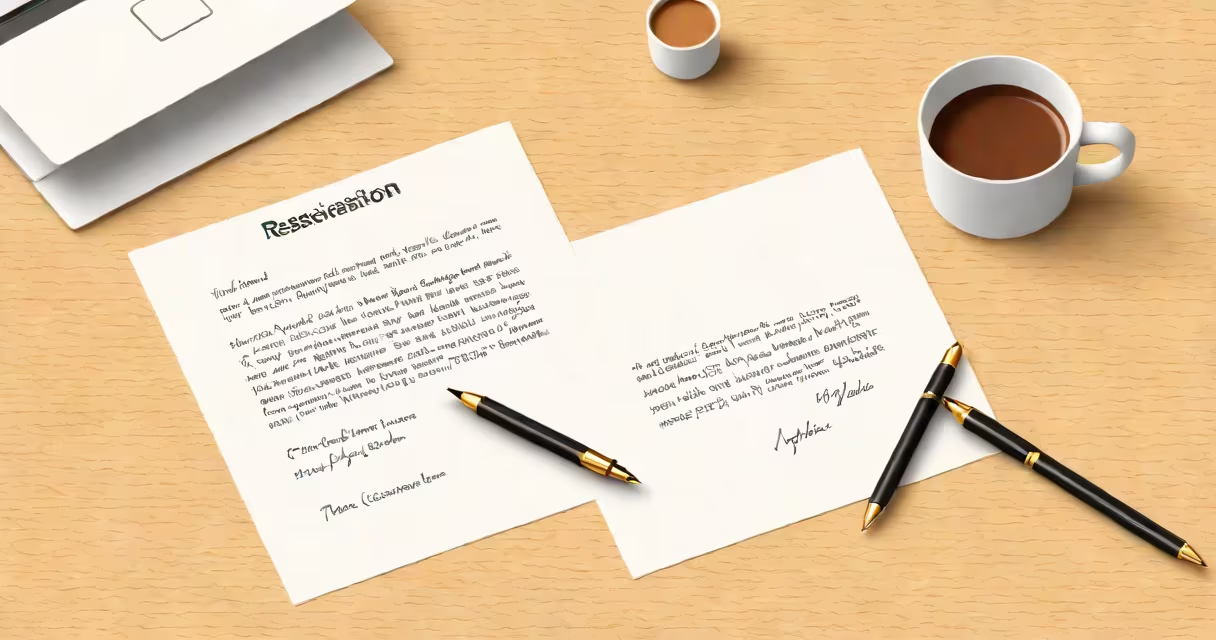
A good resignation letter formally announces your departure from a job, specifies your last working day, expresses gratitude, and maintains a respectful tone. It serves as a documented record of your intent to leave and sets the tone for your exit. This letter is not a negotiation tool but a professional closure.
Resignation letters are written to inform employers of your decision to leave a position. They are typically submitted in writing, either via email or printed and signed, depending on company policy. A well-crafted version avoids emotional language, doesn't justify your departure in detail, and refrains from criticizing management or coworkers. The goal is clarity and courtesy.
The standard format includes your name and contact details, the recipient's name and title, a clear subject line, a formal salutation, and a concise body. The body contains three core elements: the announcement of resignation, the effective date of departure, and appreciation for the opportunity. The letter closes with a polite sign-off and your signature.
When you submit a resignation letter, you trigger a formal process. HR may begin preparing an exit interview, update internal records, and initiate handover planning. Your letter acts as a legal and procedural milestone. It confirms your intent, establishes a timeline, and provides a paper trail.
Even if you've already spoken to your manager verbally, submitting a written letter ensures consistency. Verbal announcements can be misremembered or overlooked. A written document prevents ambiguity about your last day and reduces the risk of misunderstandings during the transition.
For example, if you plan to leave on June 30, 2024, stating that in the letter allows your employer to schedule training sessions, transfer responsibilities, and notify stakeholders. Delaying submission can disrupt team workflows and damage your professional credibility.
A good resignation letter follows a consistent structure. It begins with your contact information and the date. Then comes the recipient's name, title, and department. The subject line should read: "Resignation - [Your Full Name] - [Last Working Day]."
The body uses three short paragraphs:
For example:
Dear Ms. Patel,
I am writing to formally resign from my position as Senior Project Coordinator, effective Friday, June 30, 2024. After three years with the company, I have decided to pursue a new role that aligns closely with my long-term career goals.
I want to thank you for the mentorship and opportunities I've received during my time here. I am committed to ensuring a smooth handover and am happy to assist in training a replacement or documenting ongoing projects before my departure.
Sincerely,
James Reed
Do not include salary discussions, benefits, or demands. These belong in separate conversations. Avoid mentioning personal reasons unless they're neutral, such as relocating for family. Never say "I'm leaving because of the boss." That damages your reputation.
There are two primary formats: email and printed. Email is standard in most industries. Print and sign only if required by your organization or if you're leaving under sensitive circumstances. Always save a copy of the letter for your records.
Common errors include:
One mistake often missed: failing to adjust the tone based on your relationship with the recipient. A letter to a direct supervisor can be slightly warmer than one to HR. But even then, maintain professionalism. Emotional phrasing undermines your credibility.
According to the Society for Human Resource Management (SHRM), 68% of employees who resign without a formal letter report unresolved handovers or delayed reference checks. A properly formatted letter reduces friction and supports future employment references.
A good resignation letter is not a performance review, a grievance statement, or a job application. It is not meant to negotiate severance or request a promotion. Those topics require separate, structured conversations.
Some confuse it with a resignation email that lacks formality. An email without a subject line, proper greeting, or clear end date fails to meet professional standards. A message that says "I quit" in all caps is not acceptable in any workplace.
Another misconception: that you must give two weeks' notice. While two weeks is standard, some roles require four weeks or longer. Check your employment contract or employee handbook. If you're in a probationary period, one week may suffice. Always confirm the expected notice period with HR.
For example, a software engineer at a tech startup was asked to stay until the end of the fiscal quarter. The company had a policy requiring three months' notice for senior roles. Submitting a two-week notice would have violated the agreement and damaged trust.
Consider Sarah Chen, a marketing specialist at a mid-sized firm. She planned to leave on August 15, 2024. Her resignation letter included:
She sent the letter via email with a clear subject line and attached a PDF copy. She followed up with a brief in-person conversation. The company completed her exit interview within 48 hours and provided a positive reference.
Best practices include:
One non-obvious rule: never send a resignation letter from a personal email account. Use your work email. Sending from a personal account can appear unprofessional and may delay processing.
Resignation letters are used in nearly every industry-healthcare, finance, education, tech, government. They are mandatory in regulated sectors like banking and pharmaceuticals, where documentation is required for compliance.
In healthcare, for example, a nurse resigning from a hospital must submit a formal letter. The facility logs it for audit purposes and ensures patient care continuity. Failure to do so can result in disciplinary action or delays in license renewal.
Why it matters: a good resignation letter protects both parties. For you, it preserves your reputation. For your employer, it enables orderly transitions. It signals responsibility and respect, qualities valued in leadership roles.
According to the U.S. Bureau of Labor Statistics, 2.7 million workers resign annually. Of those, 83% cite professionalism in their exit process as a factor in receiving favorable recommendations. A well-written letter increases your chances of getting a strong reference.
Many believe a resignation letter must be dramatic or emotionally charged. This is false. The most effective letters are calm, concise, and respectful. Emotional language weakens your position and may lead to a negative reference.
Another myth: that you can withdraw your resignation after sending it. You can, but only if the employer hasn't acted on it. Once HR begins replacing you or reallocating duties, withdrawal becomes difficult. Always assume the letter is binding upon receipt.
Some think they can resign on a Friday and leave immediately. Most companies expect you to honor your notice period. Leaving early without approval risks losing your final paycheck or severance.
One correction often missed: the difference between resignation and termination. Resignation is voluntary. Termination is involuntary. A resignation letter cannot be used to claim unemployment benefits. Only terminated employees qualify.
After managing a team at a nonprofit, I once received a resignation letter that read: "I'm done. See you never." The sender was fired within days for violating the code of conduct. A good resignation letter avoids such extremes.
| Item | Required? |
|---|---|
| Clear subject line | Yes |
| Recipient's name and title | Yes |
| Announcement of resignation | Yes |
| Specific last day | Yes |
| Gratitude expression | Yes |
| Offer to assist with transition | Yes |
| Professional closing | Yes |
| Proofread and saved copy | Yes |
Always send a good resignation letter before your last day. Submit it in advance of your exit interview. Keep a copy for your personal file. Use this template as a foundation, but personalize it to reflect your role and experience.