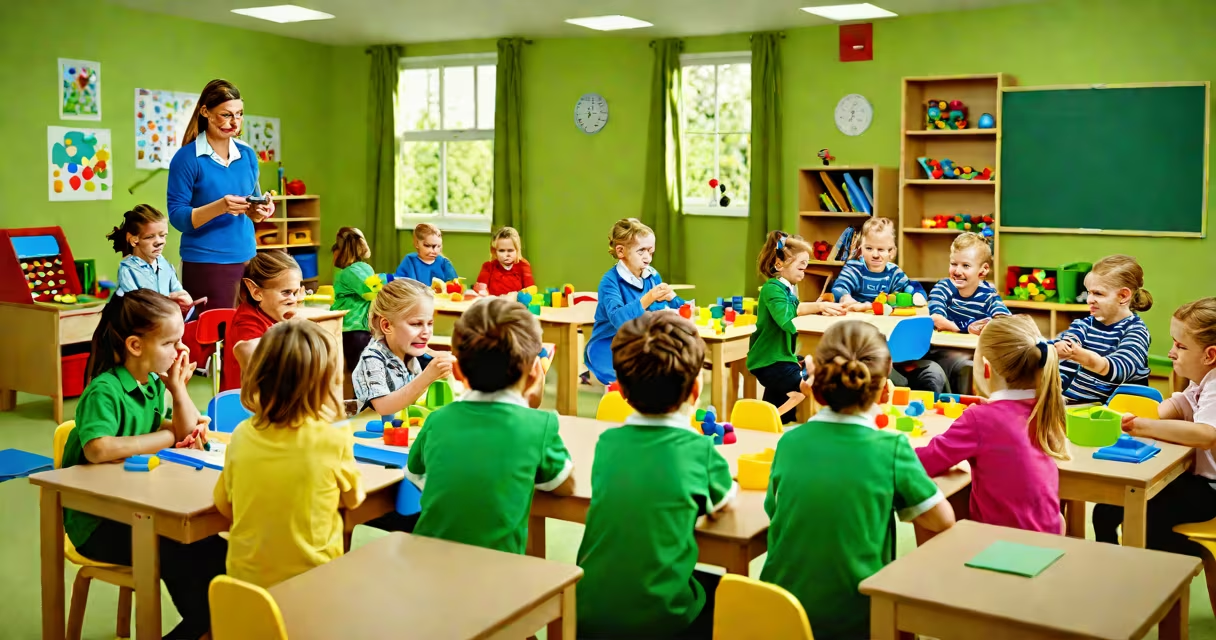
The early years foundation stage (EYFS) is the statutory structure for early education in England, guiding how children aged 0-5 are taught, assessed, and cared for in nurseries, preschools, and reception classes. It sets the standards for learning, development, and welfare across all early years providers.
Established by the Department for Education (DfE), the EYFS ensures consistency in early education quality. It applies to all registered early years providers, including childminders, nurseries, and schools. The structure is legally binding and requires providers to meet specific welfare and educational standards.
Under the EYFS, children progress through seven areas of learning and development. These are split into prime and specific areas. Prime areas-personal, social, and emotional development; physical development; and communication and language-are prioritized in the early stages. Specific areas-literacy, mathematics, understanding the world, expressive arts and design-build on these foundations later.
Each child's progress is tracked using the EYFS profile, a formal assessment completed at the end of the academic year in which they turn five. This profile evaluates children against nine early learning goals across the seven areas. Teachers and practitioners observe children daily, recording observations in learning journals and planning activities based on individual needs.
Assessment is continuous and observational. There are no standardized tests before age five. Instead, educators use ongoing assessments to identify strengths and gaps. For example, if a child struggles to name colors during free play, the practitioner may introduce a sorting game with colored blocks and track improvement over time.
Providers must also meet welfare requirements. These include staff-to-child ratios (1:3 for under-2s, 1:4 for 2-3-year-olds), health and safety checks, and safeguarding procedures. All staff must have current DBS checks and training in child protection.
The EYFS outlines seven key areas of development. The first three-personal, social, and emotional development; physical development; and communication and language-are known as the prime areas. They form the foundation for all other learning and are emphasized heavily in the first two years of a child's education.
The four specific areas-literacy, mathematics, understanding the world, and expressive arts and design-develop later. Literacy includes both reading and writing skills. Mathematics covers counting, shapes, and patterns. Understanding the world involves exploring people, places, technology, and the environment. Expressive arts and design encourages creativity through music, dance, drama, and visual art.
| Area Type | Specific Areas | Focus Age Range |
|---|---|---|
| Prime | Personal, social, and emotional development Physical development Communication and language |
0-3 years |
| Specific | Literacy Mathematics Understanding the world Expressive arts and design |
3-5 years |
A real-world example: A nursery in Bristol uses the EYFS to structure a weekly theme around "The Rainforest." Children explore animal habitats (understanding the world), build nests from sticks and leaves (expressive arts), count how many leaves fall from a tree (mathematics), and role-play as explorers (communication and language).
Many assume the EYFS is a rigid curriculum with worksheets and formal lessons. This is incorrect. The structure emphasizes play-based learning, where children learn through exploration, experimentation, and guided discovery. Activities are designed to be engaging and age-appropriate, not academic.
Another misconception is that EYFS is only for nursery schools. It applies to all registered early years providers, including childminders and school reception classes. A childminder in Leeds must follow the same standards as a private nursery in London.
Some parents confuse EYFS with the International Baccalaureate Primary Years Programme (PYP). While both focus on inquiry-based learning, PYP is optional and used in international schools. EYFS is mandatory in England and includes legal welfare standards not found in other frameworks.
I observed a reception class in Manchester during a visit to a primary school following the EYFS. Children spent 30 minutes building a cardboard city with ramps, tunnels, and bridges. The teacher didn't direct them. Instead, she asked, "What happens when the ball rolls down this slope?" and "Can you make a door that opens?" The children discussed friction, balance, and space-all concepts from science and math, learned through play.
This moment confirmed a key insight: EYFS doesn't replace learning-it reframes it. Concepts aren't taught in isolation. A child learns about size while choosing which box fits a toy, about numbers while sharing crayons, about emotions while resolving a conflict over a toy train.
The EYFS is used in all early years settings across England. It governs over 12,000 registered providers, including independent nurseries, local authority-run services, and school-based early years programs. It helps children from all backgrounds receive consistent, high-quality early education.
Research from the National Foundation for Educational Research (NFER) shows that children who attend EYFS-compliant settings are more likely to develop strong language skills and social confidence by age five. A 2022 study found that 78% of children in EYFS settings met or exceeded expected levels in communication and language, compared to 63% in non-compliant settings.
One non-obvious fact: The EYFS does not require children to master reading or writing by age five. Instead, it focuses on foundational skills like listening, speaking, and recognizing letters. A child may not write their name yet but can describe a story they've heard in detail-a sign of strong language development.
The EYFS differs from models like Montessori or Reggio Emilia in its legal enforceability. While those approaches prioritize child-led exploration, they are not mandated by law. The EYFS combines child-centered pedagogy with national standards and accountability.
For example, a Montessori school in Bath may use practical life exercises and sensory materials, but unless it is registered with Ofsted and follows the EYFS, it cannot claim to be compliant with the statutory structure. Registration requires meeting EYFS welfare and educational standards.
Parents often ask whether EYFS limits creativity. The opposite is true. The structure allows flexibility in delivery. A provider can use storytelling, puppetry, or outdoor play to teach the same goal. The outcome matters more than the method.
The early years foundation stage is the legal and educational core of early childhood education in England. It helps every child, regardless of background, receives a nurturing, structured, and developmentally appropriate start to learning. Its emphasis on observation, play, and individual progress sets it apart from traditional academic models.