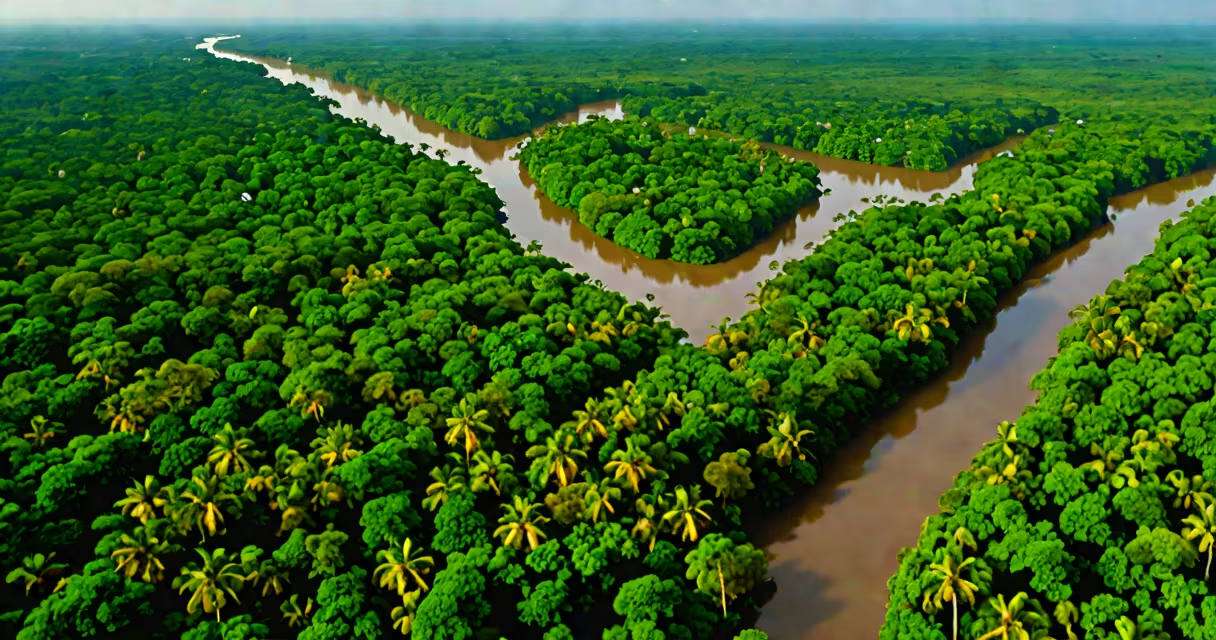
Suriname is known for its untouched tropical rainforests, diverse cultural mix, and status as the only Dutch-speaking country in South America. It ranks among the world's most biodiverse nations, with over 10,000 plant species and 600 bird species documented within its borders.
Located on the northeastern coast of South America, Suriname covers 163,820 square kilometers-larger than the United Kingdom-but has a population of just under 600,000 people. This low population density allows much of the country to remain undeveloped. Over 90% of Suriname lies within primary tropical rainforest, making it one of the most forested nations on Earth.
The country's name derives from the Surinam River, which flows through the interior. Indigenous peoples have inhabited the region for over 10,000 years. The arrival of European colonizers in the 17th century brought enslaved Africans, indentured laborers from India and China, and Dutch administrators, creating a multicultural society that persists today.
Suriname's environment defines its national character. The country hosts the largest intact tropical rainforest in the Western Hemisphere. The Central Suriname Nature Reserve, a UNESCO World Heritage Site since 2000, protects over 1.6 million hectares of undisturbed forest. It includes rare ecosystems like savannas and tepui plateaus-tabletop mountains that rise abruptly from the jungle floor.
Scientists have discovered new species in Suriname annually. In 2022, researchers identified a previously unknown frog species, *Eleutherodactylus surinamensis*, in the Sipaliwini District. The country's rivers support more than 1,000 fish species, including the giant arapaima, which can grow up to 3 meters long.
Despite its ecological richness, Suriname faces environmental challenges. Illegal logging and gold mining threaten forest integrity. In 2021, satellite monitoring detected over 1,200 illegal mining sites in protected areas. Mercury pollution from artisanal gold extraction has contaminated waterways and affected indigenous communities downstream.
Suriname's population reflects four major ethnic groups: Hindustanis (descendants of Indian indentured workers), Creoles (Afro-Surinamese), Javanese (from Indonesia), and Maroons (escaped slaves who formed independent communities). These groups coexist in a society where religious diversity is common-Christianity, Hinduism, Islam, and traditional African beliefs all hold space.
Religious festivals reflect this blend. Diwali, celebrated by Hindustani communities, features lantern displays and feasts. Sinterklaas, a Dutch-origin holiday, is observed with gift-giving and processions. The annual Keti Koti celebration marks Juneteenth-style emancipation from slavery on July 1st, with street parades and speeches honoring freedom.
Food in Suriname combines flavors from Asia, Africa, and Europe. A typical meal may include roti (Indian flatbread), stamppot (a mashed vegetable dish with pork), and soto (spiced chicken soup). The national dish, *soto keriting*, features beef stew served with rice and fried plantains.
Suriname earns recognition in several distinct categories:
| Type | Examples | Why It Matters |
|---|---|---|
| Biodiversity hotspot | Central Suriname Nature Reserve, Tumuc-Humac Mountains | Home to 10% of global bird species and 15% of mammal species in a single country. |
| Cultural mosaic | Five official languages: Dutch, Sranan Tongo, Hindi, Javanese, and English | One of only two countries in the Americas with Dutch as an official language. |
| Gold producer | Annual output: ~15 tonnes (2023) | Suriname ranks among the top 20 gold-producing nations globally. |
Suriname's economy relies heavily on natural resource exports. Gold accounts for 40% of export revenue. Bauxite and oil contribute smaller shares. The government owns 51% of the state-owned mining company, Stichting Mineraalontginning Suriname (SMOS).
Many assume Suriname is part of the Caribbean due to its location near the equator and proximity to the Caribbean Sea. However, it is geographically and politically a South American nation. It is a member of the Union of South American Nations (UNASUR) and the Organization of American States (OAS).
Another misconception is that Suriname is poor. While GDP per capita was $7,400 in 2023 (World Bank), the country has high levels of income inequality. The richest 10% earn nearly 40% of total income. Yet, public services like healthcare and education are free and accessible nationwide.
Some confuse Suriname's capital, Paramaribo, with other regional capitals. Paramaribo is the only capital city in the Americas with a UNESCO World Heritage-listed inner city. Its colonial architecture, built between 1667 and 1800, includes the Fort Zeelandia and the historic Church of St. Peter and Paul.
In 2019, I spent five days in the Sipaliwini Reserve with a team of biologists. We tracked jaguar signs using camera traps. On the third morning, we heard a low growl near our camp. A male jaguar passed within 15 meters-silent, unafraid. Later, we found a fresh kill: a peccary. The forest wasn't just a backdrop-it was alive, breathing, and indifferent to human presence.