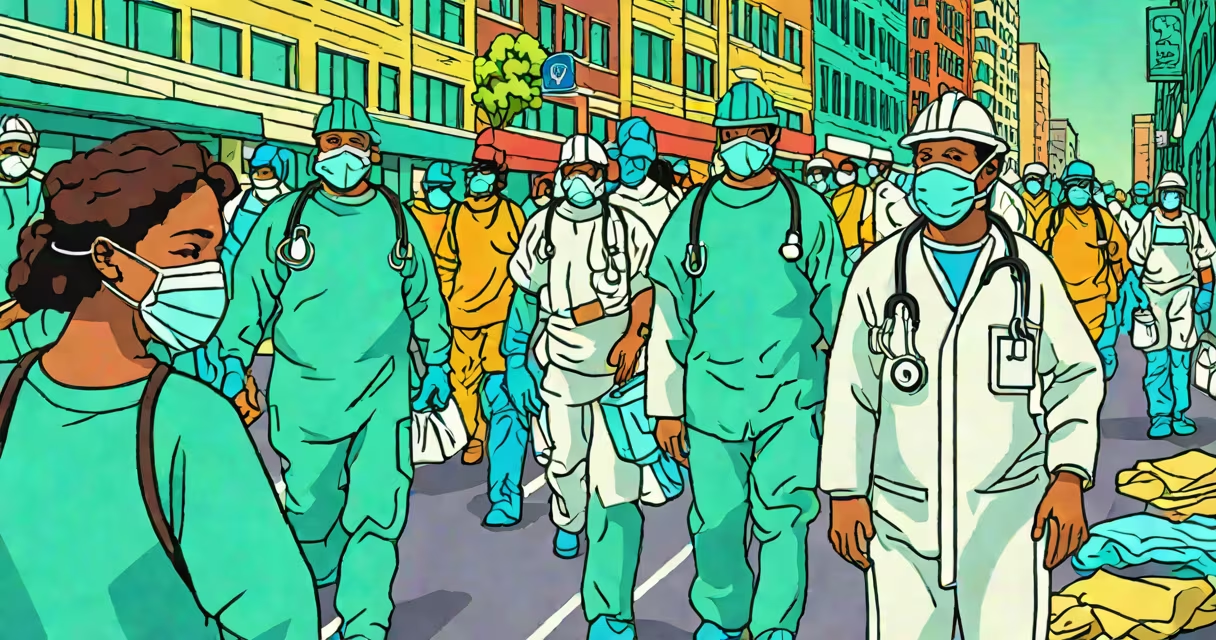
An epidemic is a sudden increase in the number of cases of a disease in a specific population or geographic area, exceeding what is normally expected. It signals a significant public health concern requiring coordinated response.
Epidemics occur when a pathogen spreads rapidly through a community, often due to high transmission rates, low immunity, or poor sanitation. The term applies to both infectious diseases like influenza and non-infectious conditions such as obesity spikes in a population, though it most commonly refers to contagious illnesses.
The World Health Organization defines an epidemic as "an occurrence of disease in excess of normal expectancy." This distinguishes it from endemic levels (constant, predictable presence) and pandemics (global spread).
Outbreaks begin when a pathogen-such as a virus, bacterium, or prion-enters a susceptible host population. Transmission occurs through direct contact, airborne particles, contaminated food or water, or vectors like mosquitoes.
For example, during the 2014 Ebola outbreak in West Africa, the virus spread quickly because of close contact with bodily fluids, limited healthcare infrastructure, and cultural burial practices that involved touching the deceased. In that year, over 28,000 cases were reported, with more than 11,000 deaths, according to the WHO.
Transmission efficiency depends on the basic reproduction number (R₀), which estimates how many new infections one infected person causes. An R₀ above 1 indicates sustained spread. Measles has an R₀ of 12-18, making it highly transmissible and prone to epidemics when vaccination coverage drops below 95%.
Epidemics vary by cause, scale, and setting. Common types include:
| Type | Definition | Example |
|---|---|---|
| Infectious | Caused by pathogens spreading person-to-person or via environment | Cholera in Haiti after the 2010 earthquake |
| Non-infectious | Driven by environmental or behavioral factors rather than microbes | Lead poisoning epidemic in Flint, Michigan (2014-2016) |
| Foodborne | Spread through contaminated food or drink | Salmonella outbreak linked to peanut butter in 2008-2009 |
| Vector-borne | Transmitted by insects or animals | Dengue fever surge in Puerto Rico in 2010 |
Environmental triggers such as climate change can expand the range of vector-borne diseases. Warmer temperatures allow mosquitoes to survive longer and reproduce faster, increasing risk of malaria and Zika virus in previously unaffected areas.
One lesser-known factor is social disruption. After Hurricane Katrina in 2005, displaced populations in temporary shelters experienced a spike in respiratory infections due to overcrowding and lack of clean water-conditions that enabled an epidemic of pneumonia and bronchitis.
Health agencies use surveillance systems to detect early signs of an epidemic. These include reporting networks, lab testing, and real-time data dashboards. The U.S. Centers for Disease Control and Prevention (CDC) operates the National Notifiable Diseases Surveillance System, which collects data on over 100 reportable conditions.
When anomalies appear-like a cluster of unexplained fevers in a school district-investigators conduct field investigations. They interview patients, collect samples, map locations, and analyze patterns to identify the source.
During the 2015-2016 Zika outbreak in Florida, local health departments used mosquito trap data and travel history records to pinpoint infection clusters. By combining GIS mapping with genetic sequencing of the virus, they confirmed local transmission and implemented targeted insecticide spraying.
Many confuse an epidemic with a pandemic. A pandemic involves widespread global transmission across multiple continents. The 2009 H1N1 flu pandemic affected over 200 countries and caused an estimated 151,700 to 575,400 deaths worldwide, per WHO data.
Another misconception is that epidemics always involve deadly diseases. The 2019-2020 measles resurgence in Europe saw over 100,000 cases across 30 countries, primarily in regions with low vaccination rates. While mortality was low (around 1%), the sheer volume overwhelmed clinics and triggered emergency responses.
Some assume epidemics are purely biological events. But human behavior plays a key role. During the 2014 Ebola crisis, misinformation about treatment centers led to violent attacks on health workers. This hindered containment efforts and worsened the outbreak.
Monkeypox, typically rare and confined to Central and West Africa, emerged in 2022 as an epidemic in Europe and North America. Over 28,000 cases were reported globally by the end of the year, mostly among men who have sex with men.
Public health teams used contact tracing and genomic analysis to confirm the strain's origin and transmission routes. Vaccination campaigns were rolled out in cities like London and New York, targeting high-risk groups. The response slowed spread but did not eliminate transmission entirely.
This episode highlighted how a disease previously seen as regional can trigger an epidemic in new settings due to international travel and changing sexual networks.
An epidemic is not simply a large number of cases-it's a measurable deviation from baseline expectations that demands action. Early detection, accurate data, and timely intervention reduce harm. What is an epidemic? It's a warning sign that a population's health is under threat-and that urgent steps are needed to protect lives.