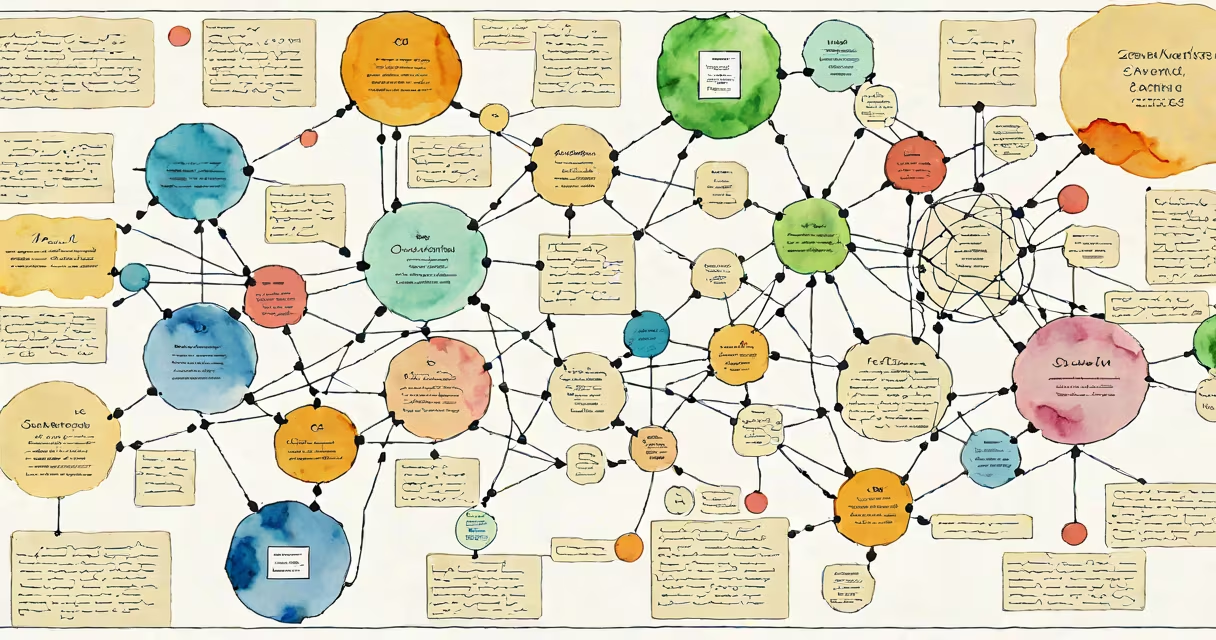
A semantic data model organizes data by defining the meaning of entities and their relationships, enabling systems to interpret context and infer new knowledge. Unlike traditional models that store data in rigid tables, it uses formalized vocabularies and logic to represent real-world concepts and their interdependencies.
This model underpins intelligent systems like search engines, recommendation engines, and AI-driven analytics. It's not just about storing facts-it's about encoding how those facts relate to each other in ways that machines can reason about.
For example, when a system knows that "Barack Obama" is a "U.S. President," "born in Hawaii," and "married to Michelle Obama," it can answer queries like "Who was president during the 2008 financial crisis?" without needing explicit instructions for every possible question.
Semantic data models rely on formal ontologies-structured frameworks that define classes, properties, and constraints. These ontologies use standardized languages like RDF (Resource Description Structure) and OWL (Web Ontology Language) to describe data in machine-readable form.
Data is stored as triples: subject-predicate-object. For instance, "Barack Obama - served_as - U.S. President" forms a statement that can be linked to others. The system treats these as assertions, not just records. This allows inference: if "Barack Obama" is a "person" and all "persons" have a "birth_place," then the system can deduce his birth place even if not explicitly stated.
Google's Knowledge Graph uses this principle. When you search "Leonardo da Vinci," the results include his birth date, profession, and notable works-not because Google retrieved them from a single database, but because it connected known facts across millions of web pages using semantic rules.
Three key elements make up a semantic data model:
Models vary by purpose and complexity. Here's a comparison of common types:
| Type | Use Case | Example |
|---|---|---|
| Simple RDF Graph | Basic metadata tagging | Linking a product page to its brand, category, and price |
| Ontology-Based Model | Enterprise knowledge management | Healthcare system linking symptoms, diseases, and treatments via SNOMED CT |
| Knowledge Graph | Search, recommendations, AI reasoning | Amazon's product network connecting items, users, reviews, and categories |
One non-obvious distinction: a semantic data model isn't the same as a relational database-even when both store structured data. A relational model defines tables and foreign keys. A semantic model defines meaning. You can map one to the other, but they serve different purposes.
For instance, a hospital might store patient records in a SQL database with columns for name, diagnosis, and treatment. But a semantic model adds that "diagnosis = 'Type 2 Diabetes'" implies "treatment includes insulin therapy and dietary counseling," based on medical guidelines encoded in an ontology.
Organizations use semantic data models to integrate data across departments, systems, and formats. They're essential in industries requiring precise understanding of complex domains.
In healthcare, the National Library of Medicine's Unified Medical Language System (UMLS) integrates over 150 vocabularies to standardize clinical terminology. This lets systems compare data from different hospitals-even when they use different terms for the same condition.
Financial institutions apply semantic models to detect fraud. By modeling relationships between accounts, transactions, and users, systems can flag unusual patterns-like multiple accounts being funded from the same IP address-without hard-coded rules.
When I built a customer support system for a SaaS company, we used a semantic model to link user behavior (clicks, feature usage) with support tickets. Instead of manually tagging every ticket, the system inferred that "frequent login failures" correlated with "high volume of export requests," leading to faster resolution paths.
Many confuse semantic data models with natural language processing (NLP). NLP analyzes unstructured text-like emails or chat logs-to extract meaning. A semantic model structures that meaning into a consistent, reusable format.
You can use NLP to generate statements like "John left the meeting early," then feed them into a semantic model that stores "John - attended - meeting," "John - departed - meeting," and infers "John missed the discussion on budget changes."
Another mistake: assuming semantic models require AI. While AI enhances their power, the core is logic-based representation. A well-designed ontology works even without machine learning-though AI improves scalability and accuracy.
Also, semantic models aren't limited to large enterprises. A small e-commerce site can use a lightweight version to link products, suppliers, and shipping zones. Using standards like Schema.org, it can improve visibility in search results.
Suppose you run a bookstore. Your sales database tracks purchases, but doesn't know why someone bought a book on quantum physics. A semantic data model fills that gap.
Create a basic ontology:
Now define relationships:
Book("The Elegant Universe") - has_genre - Physics
Book("The Elegant Universe") - recommended_for - AgeGroup(16-25)
User("Sarah") - likes - Genre(Physics)
User("Sarah") - purchased - Book("The Elegant Universe")
When Sarah returns, the system recommends books on string theory, not romance novels. It reasons: "Sarah likes Physics, and this book is in Physics, so recommend it."
This works even if Sarah never rated the book. The model infers interest based on shared semantics.
Businesses adopting a B2C model benefit too. Amazon's recommendation engine relies on a semantic layer to connect user preferences, product attributes, and purchase history. Without it, suggestions would be random, not contextual.
A semantic data model turns raw data into actionable knowledge. It's not just about storage-it's about understanding.