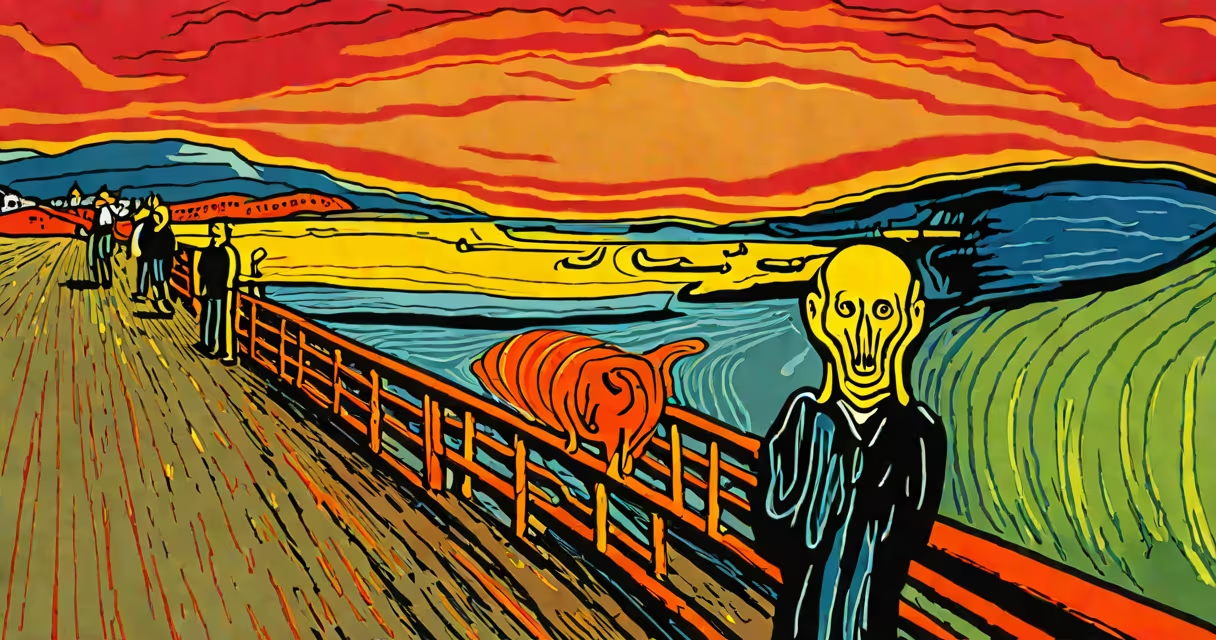
The Scream, painted by Norwegian artist Edvard Munch in 1893, depicts a figure with an agonized face standing on a bridge, mouth open in a silent scream, set against a swirling, blood-red sky. It symbolizes existential dread and the overwhelming anxiety of modern life, rooted in Munch's personal experiences with fear and mental illness.
Munch created multiple versions of The Scream between 1893 and 1910, using tempera, oil, and pastel on cardboard or canvas. The most famous version, painted in 1893, is held at the National Gallery in Oslo. The artwork emerged during a period of intense personal crisis-Munch had lost his mother and sister to tuberculosis, and he struggled with depression and hallucinations. These events shaped the emotional core of the piece.
The painting's composition amplifies psychological tension. The figure's elongated limbs and distorted facial features reflect internal turmoil rather than physical reality. The sky swirls in unnatural hues-deep reds and oranges-suggesting a world in flux, possibly mirroring Munch's perception of emotional collapse. According to the Munch Museum, the painting was influenced by a moment Munch described in his diary: "I felt a great scream pass through nature." This moment occurred during a walk near Oslo, where he claimed to hear nature screaming.
The Scream uses visual distortion to convey emotional experience, not physical observation. The figure's form is stretched and simplified, lacking anatomical accuracy. This abstraction aligns with early Expressionist principles, which prioritized inner feeling over realistic representation. Munch rejected naturalism to express psychological states, making The Scream a foundational work of modern art.
Color plays a critical role. The sky's violent red and orange contrast sharply with the cool blues and grays of the water and bridge. This clash creates visual dissonance, reinforcing the sense of unease. The lack of perspective-bridges and landforms appear compressed-further destabilizes the viewer's sense of space. The result is a scene that feels both immediate and surreal.
A lesser-known fact: Munch originally titled the 1893 version *Der Schrei der Natur* ("The Scream of Nature") in German. He later changed it to *Skrik* in Norwegian. The title shift reflects a move from externalizing fear as a feature of nature to internalizing it as a human condition. This evolution underscores how the painting evolved from a reaction to the environment into a statement about the individual mind.
Munch produced four major versions of The Scream between 1893 and 1910. Each differs in medium, color intensity, and emotional tone. The original 1893 version is a pastel on cardboard, known for its vibrant, almost hallucinogenic palette. The 1895 version, painted in oil and tempera, is darker and more restrained. The 1910 version, part of a series called *The Frieze of Life*, presents a more stylized, less distressed figure.
| Version | Year | Medium | Key Features |
|---|---|---|---|
| First Version | 1893 | Pastel on cardboard | Bright red sky, expressive brushwork, fragile surface |
| Second Version | 1895 | Oil and tempera on canvas | Darker tones, more controlled composition |
| Third Version | 1910 | Tempera on canvas | More geometric, less emotional intensity |
| Fourth Version | 1912 | Oil on canvas | Repetition of theme, stronger symbolic structure |
Each version reflects Munch's evolving understanding of anxiety. The 1893 version captures raw panic. By 1910, the figure appears more resigned, suggesting that fear becomes a permanent state rather than a sudden event. This progression shows how the meaning of The Scream shifted from a single moment of terror to a lifelong condition.
The Scream remains one of the most recognizable images in Western art. It appears in films, advertisements, political cartoons, and internet memes. Its image is frequently used to represent stress, burnout, or societal breakdown. In 2012, a version of The Scream sold at auction for $119.9 million, making it one of the most expensive paintings ever sold.
Modern psychology recognizes The Scream as a visual metaphor for mental health struggles. The American Psychological Association notes that anxiety disorders affect nearly 30% of adults at some point in their lives. The painting's enduring relevance lies in its ability to translate invisible emotions into visible form. It gives shape to feelings many people experience but cannot name.
One common misconception is that The Scream represents a person screaming in pain. In reality, the figure's mouth is open, but no sound is depicted. The silence is intentional. Munch wanted to show the moment before sound-when fear is too vast to articulate. This absence of noise makes the image more haunting than any scream could be.
Many assume The Scream is a depiction of a specific event, such as a suicide or a natural disaster. But Munch never intended it as narrative. The figure is anonymous, gender-neutral, and timeless. There is no setting beyond the bridge and the sky. The painting resists interpretation as a story because it is about feeling, not plot.
Another error is equating The Scream with modern anxiety caused by technology. While the painting is often used to illustrate digital fatigue or social media burnout, Munch created it decades before the internet. His inspiration came from personal grief, not societal pressure. The painting's power lies in its universality-not in its reference to any particular era.
I once stood in front of the 1893 version at the National Gallery in Oslo. The pastel surface was fragile, slightly cracked. When I looked at the eyes-the hollow, staring gaze-I felt a physical pull. Not fear, but recognition. That moment confirmed what scholars have long argued: The Scream transcends time because it speaks to a shared human vulnerability.
Understanding what The Scream means requires looking beyond the image. It is not a portrait of a man in distress. It is a mirror. It shows us our own moments of isolation, doubt, and dread. The painting's meaning is not fixed-it changes with the viewer. But its core message remains constant: in the face of overwhelming emotion, we are not alone.
Art historians agree that The Scream continues to resonate because it captures a universal experience. As the MoMA notes, "The Scream is not about a single event-it is about the feeling of being overwhelmed by existence itself." This insight explains why the painting remains central to discussions about mental health, identity, and artistic expression.