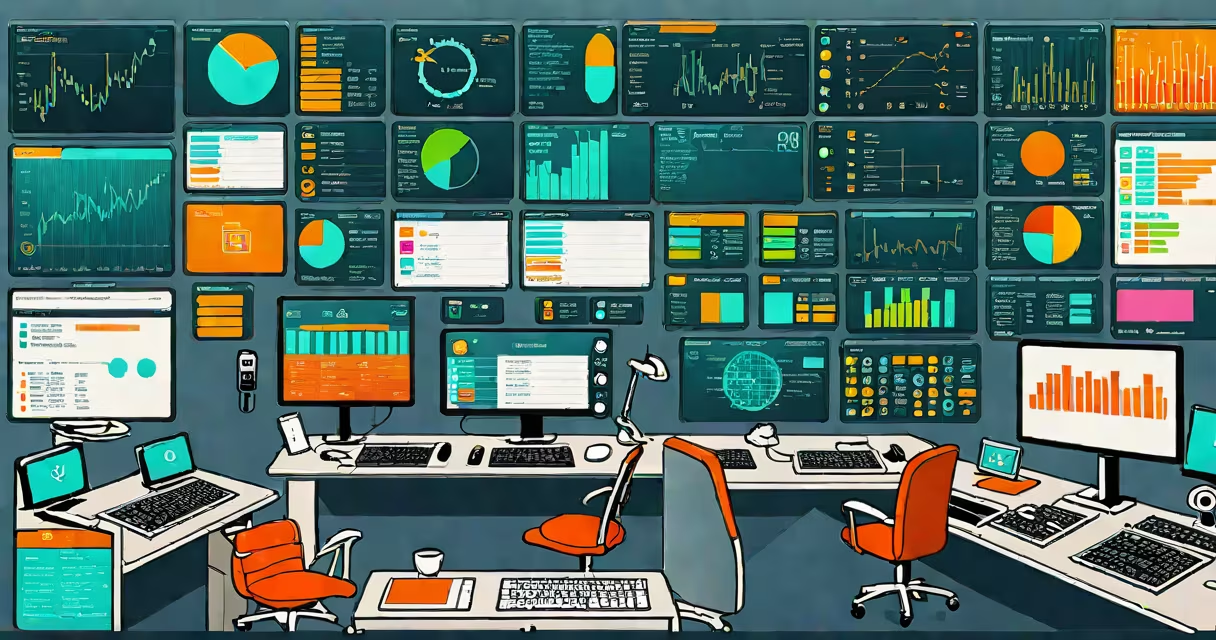
An enterprise business set is a centralized software platform that integrates core business functions-such as finance, human resources, supply chain, customer relationship management, and operations-into a single, interconnected system. Designed for large organizations, it enables real-time data sharing, automated workflows, and consistent reporting across departments.
These systems run on enterprise-grade infrastructure, often hosted on-premises or in the cloud, and support thousands of users across multiple locations. They replace fragmented legacy systems with a unified architecture that reduces errors, improves compliance, and accelerates decision-making. Major vendors include Oracle, SAP, Microsoft Dynamics 365, and Workday.
For example, a multinational manufacturer using Oracle's E-Business Set manages procurement, production scheduling, payroll, and inventory from one dashboard. When a sales order triggers a production workflow, the system automatically updates material requirements, assigns labor hours, and adjusts financial forecasts-all without manual input.
At its core, an enterprise business set operates on a shared database and common application layer. All modules-finance, HR, logistics-access the same data in real time. This eliminates data silos and ensures consistency across business units.
When a new employee is hired, the HR module creates a profile, assigns benefits, and notifies payroll. The system then updates the workforce budget in the finance module and allocates training resources through the learning management system. Each action triggers automated updates downstream.
Security is enforced via role-based access control. A regional manager may see sales performance by territory but cannot view individual employee salaries. Audit trails track every change, ensuring compliance with regulations like SOX and GDPR.
Enterprise business suites vary by vendor and deployment model. The most common types are:
| Type | Deployment | Primary Use Cases | Example Vendors |
|---|---|---|---|
| On-Premise | Installed locally on company servers | High-security environments, custom workflows | Oracle E-Business Set, SAP S/4HANA |
| Cloud-Based | Hosted by third-party providers | Scalable operations, remote teams, rapid deployment | Microsoft Dynamics 365, Workday, NetSuite |
| Hybrid | Combines on-premise and cloud components | Regulated industries, phased migration | SAP HANA Cloud, Oracle Fusion Cloud |
Core modules typically include financial management, supply chain execution, human capital management, and customer service. Advanced versions integrate AI-driven analytics, predictive modeling, and mobile access.
One non-obvious distinction: not all enterprise software qualifies as a set. A standalone CRM or accounting tool may be enterprise-grade but lacks cross-functional integration. True enterprise business set platforms enforce data consistency across all modules-changes in one affect others automatically.
Many people mistake an enterprise business set for a collection of separate tools tied together by middleware. That's not the same. A set shares a single database schema, authentication system, and user interface structure. Tools connected via APIs still operate independently unless they're part of a unified platform.
For instance, a company using G Set for email and calendars while running separate systems for payroll and inventory isn't using an enterprise business set. These tools lack integrated workflows. But if the same company adopts Microsoft Dynamics 365, which includes finance, HR, and sales modules under one login and shared data layer, it becomes a true enterprise business set.
I once observed a retail chain migrate from five disconnected systems to Oracle E-Business Set. Before, weekly financial reports took three days to compile due to inconsistent data entry. After implementation, the same report generated in under 15 minutes with 99.8% accuracy. The difference wasn't just speed-it was trust in the data.
Enterprises face complex challenges: global supply chains, regulatory audits, multi-currency transactions, and rapid scaling. An enterprise business set provides a single source of truth. It reduces operational risk, cuts administrative overhead, and supports strategic planning.
According to Gartner, organizations using integrated enterprise suites achieve 30% faster month-end close cycles compared to those relying on point solutions. McKinsey notes that companies with unified systems report 25% higher employee productivity in finance and operations roles.
For large businesses, adopting an enterprise business set isn't optional-it's foundational. It enables agility, transparency, and scalability. As operations grow, so does the cost of fragmentation. A well-implemented set reduces complexity, not just in IT but across the entire organization.