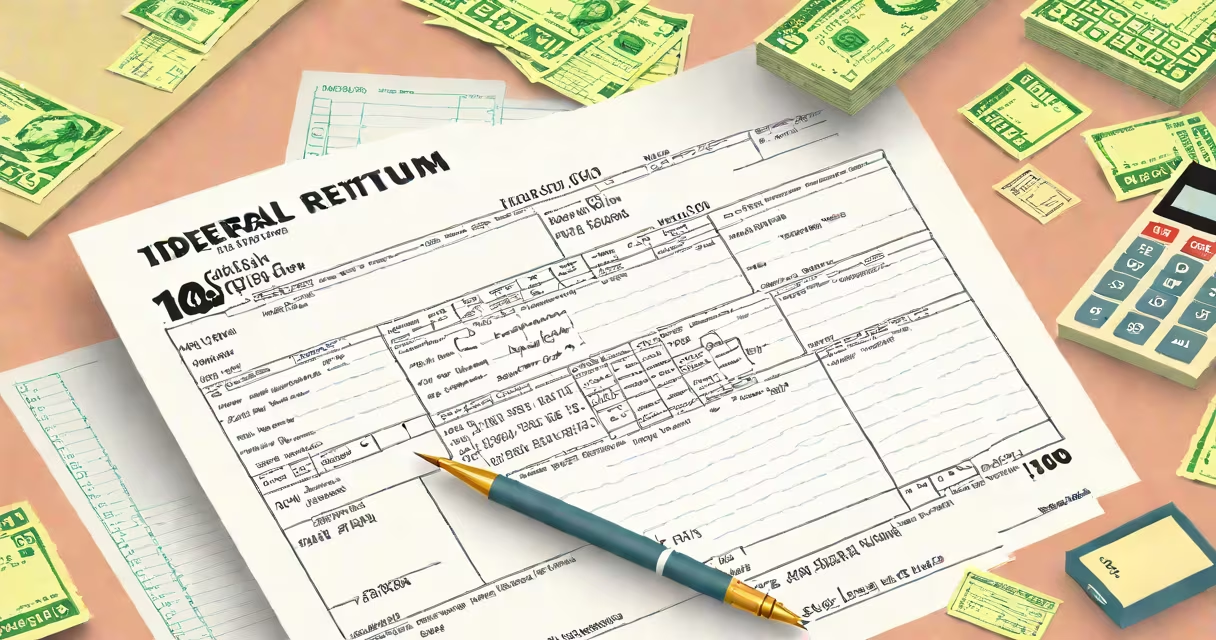
A federal tax return is a document filed with the Internal Revenue Service (IRS) that reports your annual income, calculates your tax liability, and determines whether you owe money or are due a refund. It uses standardized forms like Form 1040, 1040A, or 1040EZ, with Form 1040 being the most common for individuals with complex financial situations.
The form is structured around key sections: personal information, income details, adjustments to income, credits and deductions, and the final tax calculation. It includes lines for wages, self-employment income, investment earnings, and other taxable events. The IRS requires specific data fields, such as Social Security numbers and filing status, to validate returns and prevent fraud.
Form 1040 consists of multiple pages, including a front page with primary data and supporting schedules (like Schedule A for itemized deductions or Schedule C for business income). All pages must be signed and dated. Electronic filings through IRS-certified software or tax professionals often generate PDF versions that mirror the physical form's layout.
The federal tax return processes your financial data through a series of calculations. After entering your gross income, you subtract eligible adjustments (such as student loan interest or IRA contributions) to arrive at adjusted gross income (AGI). From AGI, you apply standard or itemized deductions to determine taxable income.
Next, the system applies tax rates based on your filing status and income level. Credits-like the Earned Income Tax Credit or Child Tax Credit-are subtracted directly from your tax bill. If your total credits exceed your tax liability, you receive a refund. If not, you owe additional taxes.
For example, a single filer earning $60,000 in 2023 with $10,000 in itemized deductions and claiming two dependents would report $50,000 as taxable income. Using the 2023 tax brackets, their base tax would be $7,436. With a $4,000 Child Tax Credit and $1,500 Earned Income Tax Credit, their final tax owed drops to $1,936. If they paid $6,000 in withholding, they'd receive a $4,064 refund.
Each federal tax return contains several core elements:
Supporting documents are attached to the return or referenced in schedules. For instance, a taxpayer with rental income must file Schedule E, listing property details, expenses, and net profit. A freelancer reporting $25,000 in freelance work must attach Schedule C showing $8,000 in business expenses.
According to the IRS, nearly 150 million individual tax returns were filed in 2023, with over 70% submitted electronically. The agency uses automated systems to verify data against third-party records like W-2s and 1099s. Discrepancies trigger audits or notices.
Many people assume a tax return is just a list of income and taxes owed. In reality, it's a detailed financial statement that reflects your entire year's economic activity. It's not a balance sheet or a bank statement-it's a legal declaration under penalty of perjury.
One common error is confusing the tax return with the tax ID. A tax return reports your financial data to the IRS, while a tax ID (like a Social Security Number or Employer Identification Number) identifies you or your business for tax purposes. You cannot file a return without a valid tax ID, but the ID itself doesn't contain your income or deductions.
Another misconception is that all tax returns are the same. The IRS offers different forms based on complexity. Form 1040 is used by most individuals. Form 1040A was eliminated after 2018. Form 1040EZ was discontinued in 2018 for simplicity. Now, only Form 1040 is available for most filers, though some may still use Form 1040-NR for non-resident aliens.
For clarity, here's a comparison of IRS forms used in 2023:
| Form | Use Case | Eligibility | Complexity Level |
|---|---|---|---|
| Form 1040 | Most individual returns | Anyone with income, deductions, or credits beyond basic thresholds | High |
| Form 1040-SR | Seniors (age 65+) | Same as Form 1040, but with larger print and simplified instructions | Medium |
| Form 1040-NR | Non-resident aliens | Foreign nationals with U.S. income but not U.S. residents | High |
I once helped a client file their first return using TurboTax. They had freelance income, a home office deduction, and child care expenses. The software guided them through each schedule, flagged inconsistencies, and generated a printable version. When we reviewed the final draft, the refund estimate matched the IRS projection within $12. That accuracy came from proper form structure and correct data entry.
After submission, you can track your return's status using the IRS "Where's My Refund?" tool. This service updates every 24 hours and shows the current processing stage. Returns typically take 21 days to process if filed electronically, compared to 6-8 weeks for paper returns.
If you need to check the status of your return, visit the IRS website and enter your Social Security Number, filing status, and the exact amount of your expected refund. The system confirms whether the return has been received, processed, or refunded.
Understanding what a federal tax return looks like reduces anxiety and improves accuracy. It's not a mystery-it's a structured, standardized document designed to reflect your financial year and legally.