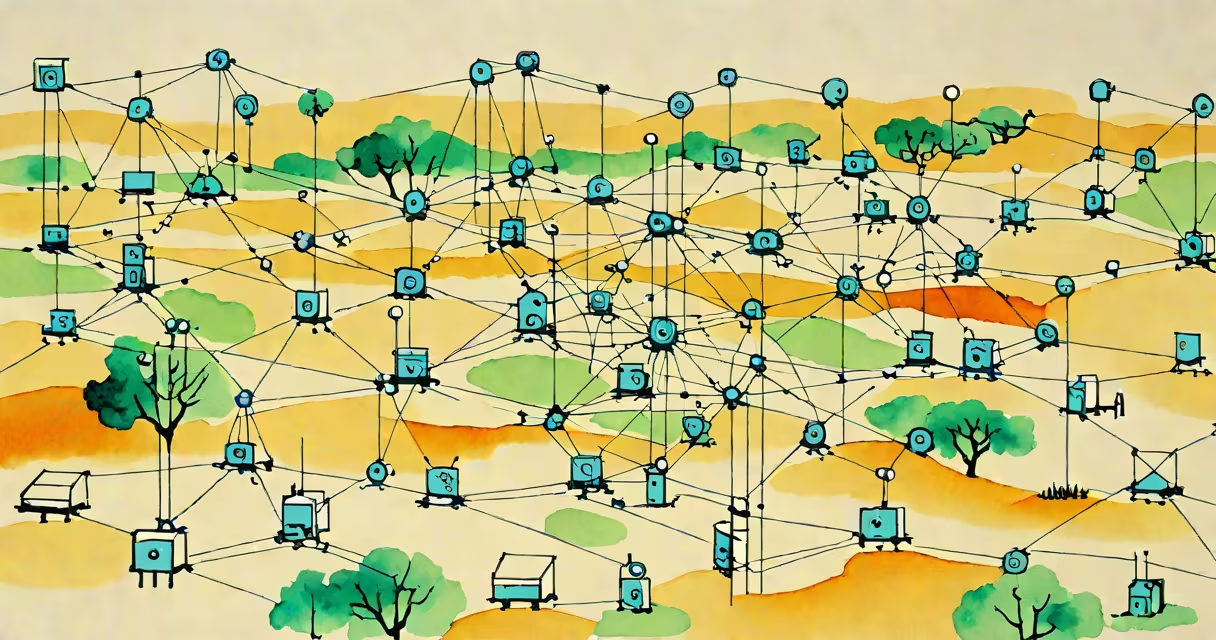
Wireless sensor networks (WSNs) are collections of spatially distributed autonomous devices that monitor physical or environmental conditions-such as temperature, humidity, vibration, or light-and transmit the data wirelessly to a central location for analysis. These systems operate without wired connections, relying on battery-powered nodes communicating via radio frequencies.
Each node in a WSN contains a sensor, a microcontroller, a transceiver, and a power source. Nodes form a mesh or tree topology, forwarding data through intermediate nodes to reach a base station. This decentralized architecture allows deployment in remote or hazardous environments where cabling is impractical.
WSNs are foundational to the Internet of Things (IoT), enabling continuous monitoring in agriculture, infrastructure health, wildlife tracking, and industrial settings. For example, a vineyard may deploy hundreds of soil moisture sensors across a hillside, each sending readings every 15 minutes to a gateway connected to a cloud dashboard.
WSNs operate in cycles: sensing, processing, communication, and power management. A node wakes periodically to sample data from its sensor-say, measuring soil moisture every hour. The microcontroller processes the reading, checks if it exceeds a threshold (e.g., dryness level), and decides whether to send it.
Data transmission uses protocols like Zigbee, Bluetooth Low Energy (BLE), or IEEE 802.15.4. These standards balance range, bandwidth, and energy efficiency. A node may relay data through multiple hops-each passing the message to the next closest node-until it reaches the sink node (base station).
Energy conservation is critical. Nodes often sleep between sampling intervals, waking only to collect and transmit data. Some systems use energy harvesting-converting ambient light, heat, or motion into electricity-to extend operational life beyond five years without battery replacement.
WSNs vary by deployment scale, topology, and application. Common configurations include star, mesh, and cluster-based layouts.
| Type | Structure | Use Case | Pros & Cons |
|---|---|---|---|
| Star | Nodes connect directly to a central hub | Small-scale home monitoring | Simple setup; single point of failure |
| Mesh | Nodes route data through neighbors | Large farms, city-wide pollution tracking | Self-healing; high redundancy; higher complexity |
| Cluster-Head | Groups of nodes report to local leaders | Forest fire detection, battlefield surveillance | Reduced energy use; scalable; requires coordination |
Cluster-based architectures improve scalability. In a forest fire detection system, groups of temperature and smoke sensors report to a cluster head, which aggregates data and sends only alerts-reducing traffic and extending battery life.
WSNs are used in precision agriculture, where soil sensors track moisture levels across fields. A study by the University of California, Davis, showed that WSN-guided irrigation reduced water usage by 30% while maintaining crop yield.
In industrial settings, WSNs monitor machinery vibrations to predict failures. A factory in Germany installed 400 vibration sensors on conveyor belts. When anomalies were detected, maintenance teams received alerts within 10 seconds, reducing downtime by 45%.
Environmental scientists use WSNs to track wildlife migration. Researchers in Yellowstone National Park deployed 120 GPS-tagged sensor nodes across elk habitats. Data revealed previously unknown migration routes, influencing park conservation planning.
WSNs are frequently mistaken for standalone IoT devices or Wi-Fi-enabled cameras. Unlike a smart thermostat, which connects to a home network and runs on AC power, a WSN node operates independently, often in battery mode, with minimal computational capacity.
Another misconception is that all WSNs require constant connectivity. In reality, many function in intermittent modes-sending data only when thresholds are breached. A flood warning system in Bangladesh uses rain sensors that activate only during monsoon season, conserving energy and reducing false alarms.
A key distinction: WSNs focus on data acquisition and transmission, not on acting upon data. While a smart thermostat adjusts heating based on room temperature, a WSN simply reports that temperature. Action requires a separate control system.
I once installed a WSN in a remote orchard in Oregon to monitor frost risk. The nodes were solar-charged and transmitted data every 30 minutes. After six months, only 12 out of 60 nodes failed-not due to hardware, but because their batteries degraded faster than expected under prolonged UV exposure. This highlighted a lesser-known factor: environmental stress affects not just sensors, but the entire node lifecycle.
Many guides omit that WSN performance degrades over time due to node drift-where sensor calibration shifts slightly after months of operation. A temperature sensor might read 2°C too high after 18 months. Without periodic recalibration, data becomes unreliable. The U.S. National Institute of Standards and Technology (NIST) recommends recalibrating WSN nodes every 12 months to maintain accuracy.