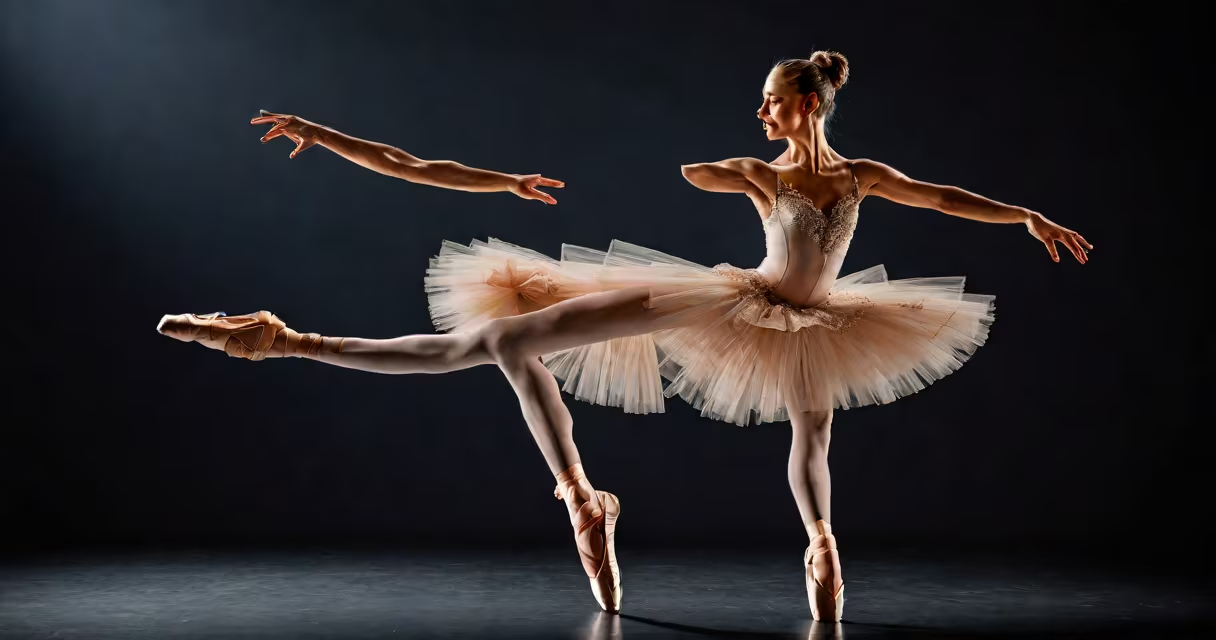
Ballet dance is a highly structured form of performance art rooted in European tradition, defined by precise movements, formalized positions, and strict technical discipline. Its core characteristics include turnout of the legs, pointed feet, elevated positions, and controlled, fluid motion executed with grace and symmetry.
The foundation of ballet lies in five basic positions of the feet and arms, established in the 17th century by King Louis XIV's Royal Academy of Dance. These positions create a consistent structure for movement, ensuring uniformity across training and performance. All ballet dancers begin with mastering these positions, which serve as the building blocks for every step, leap, and turn.
Ballet relies on a system of codified movements performed with precision and control. Dancers execute steps such as pliés (bending the knees), tendus (extending the foot along the floor), and pirouettes (spins) using specific body alignment. The spine remains upright, the shoulders relaxed, and the head aligned with the torso to maintain balance and aesthetic line.
Turnout-the outward rotation of the legs from the hips-is one of the most defining features. It allows for greater range of motion and creates the elongated silhouette characteristic of classical ballet. Turnout is not optional; it is a required element of training, developed through years of stretching and strengthening exercises.
Dancers train for years to achieve the physical strength and flexibility needed to perform complex sequences. A single arabesque-a pose where one leg extends behind the body while the dancer balances on the other-requires core stability, hip flexibility, and ankle strength. Without proper alignment, even a simple movement becomes unstable or unsafe.
Several technical components distinguish ballet from other dance styles. Here's how they function:
| Characteristic | Description | Why It Matters |
|---|---|---|
| Turnout | Legs rotated outward from the hips, typically 180 degrees. | Enables fluid movement across the stage and supports balance during jumps and turns. |
| Pointed Feet | Toes extended forward, heels lifted. | Creates visual continuity and sharpness in lines; essential for en pointe work. |
| Center of Gravity | Weight centered over the balls of the feet. | Allows for quick transitions and controlled landings during jumps. |
| Port de Bras | Arm movements coordinated with the upper body. | Enhances expression and maintains spatial awareness during choreography. |
These elements are not decorative-they are functional. For example, the way a dancer raises their arm during a port de bras affects the entire line of the body. Misalignment reduces efficiency and increases injury risk. According to the Royal Academy of Dance (RAD), proper technique prevents overuse injuries in young dancers, who often begin training as early as age six.
Many assume ballet is solely about grace and beauty. In reality, it demands intense physical conditioning. A dancer performing a series of fouettés-rapid turns on one foot-must generate torque from the core and maintain focus to avoid dizziness. This is not artistic flair; it is biomechanical precision.
Another misconception is that ballet is outdated. While rooted in 18th-century traditions, modern companies like the New York City Ballet and the Royal Ballet regularly commission new works that blend classical technique with contemporary themes. George Balanchine's *Serenade* (1935), for example, uses traditional ballet vocabulary but explores abstract emotion and spatial design in ways that feel fresh today.
A lesser-known fact: ballet does not require long hair or tutus. While these are iconic in performance, they are costume choices, not technical requirements. A dancer in a leotard and tights performs the same movements regardless of attire. The focus is always on form, not appearance.
Consider the grand jeté-a large leap across the stage. To execute it correctly, a dancer must:
This move requires explosive power from the glutes and hamstrings, precise timing, and spatial awareness. Even a slight misalignment in the pelvis can cause imbalance. A single error can result in a fall or injury. According to the International Association for Dance Medicine & Science (IADMS), improper execution of jumps contributes to 30% of acute injuries in professional dancers.
I once observed a student attempt a grand jeté during a class at a regional conservatory. She had perfect turnout and strong extensions but failed to engage her core. As she landed, her lower back collapsed, causing immediate pain. The instructor corrected her: "You're not jumping with your legs-you're jumping with your whole body." That moment highlighted how ballet is not isolated muscle work but integrated neuromuscular coordination.
Ballet remains central to professional dance companies worldwide. The Bolshoi Theatre in Moscow, the Paris Opera Ballet, and the American Ballet Theatre all follow classical training methods. These institutions preserve historical techniques while adapting them for modern audiences.
Ballet is also used in cross-training for athletes. Gymnasts, swimmers, and even football players incorporate ballet-based warm-ups to improve balance, flexibility, and body control. A 2021 study published in the Journal of Sports Sciences found that athletes who trained in ballet-specific drills showed a 14% improvement in changing balance over eight weeks.
For dancers, mastering the main characteristics of ballet is not about mimicry-it's about developing a shared language of movement. When a group performs a synchronized sequence, each dancer must interpret the same cues with identical precision. This level of consistency is only possible through rigorous training and adherence to technique.
Understanding the main characteristics of ballet dance reveals it as a disciplined art form grounded in physics, anatomy, and repetition. It is not merely performance-it is a system of movement designed for efficiency, endurance, and expressive clarity. Whether on stage or in rehabilitation, ballet's principles remain relevant.