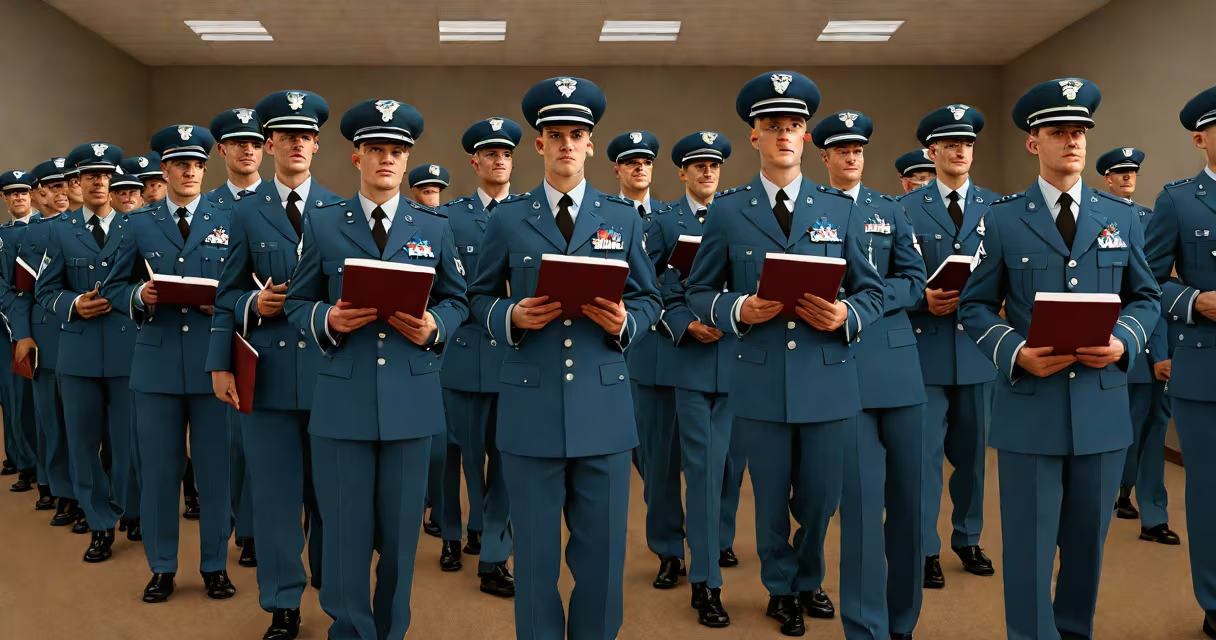
Squadron Officer School (SOS) is a 10-week professional military education course for newly commissioned U.S. Air Force officers, designed to develop leadership, decision-making, and ethical judgment for squadron-level responsibilities.
SOS is part of the Air Force's career progression system and is required for all new second lieutenants before they assume command of a flight or squadron. The curriculum focuses on practical leadership skills, mission execution, and the ethical challenges of military service. Graduates emerge ready to lead small units in complex environments.
Unlike technical training, SOS emphasizes judgment, communication, and team dynamics. It is not a combat or flying course, though many participants are pilots or maintainers. The school is held at multiple locations, including Maxwell Air Force Base in Alabama and Joint Base San Antonio, Texas.
Each cohort begins with a week of orientation covering Air Force core values, standards, and expectations. Officers then engage in daily seminars, scenario-based exercises, and group problem-solving sessions. They learn to assess risk, manage resources, and lead under pressure using real-world cases from recent operations.
Instruction is delivered through a combination of lectures, role-playing, and peer-led discussions. Officers rotate through different leadership roles during simulations, such as commanding a simulated airfield during a crisis or managing personnel during a deployment cycle. These exercises mimic conditions officers may face in their first assignment.
Assessment is continuous. Officers receive feedback on written reports, oral presentations, and behavior during group tasks. Final evaluation includes a capstone project-a leadership challenge based on a current Air Force operational issue, such as managing a cyber incident or coordinating joint forces during a humanitarian mission.
Squadron Officer School is standardized across the Air Force, but delivery varies slightly by location and cohort size. There are three primary formats:
| Format | Duration | Delivery Mode | Target Audience |
|---|---|---|---|
| Resident | 10 weeks | In-person at Maxwell AFB or JBSA | Most new officers |
| Virtual | 10 weeks | Online with live instruction and synchronous sessions | Officers assigned to remote locations |
| Hybrid | 10 weeks | Combines online modules with short in-person residencies | Officers with scheduling constraints |
All formats cover the same core competencies: leading teams, making decisions under uncertainty, and applying Air Force doctrine. The virtual and hybrid models use secure platforms and require consistent internet access and webcam participation.
SOS does not award academic credit. It is a professional development course, not a degree program. Completion is mandatory for advancement to the rank of first lieutenant and eligibility for command assignments.
Squadron Officer School is used across the U.S. Air Force to standardize leadership preparation. It helps every new officer, regardless of specialty-whether in cyber, logistics, intelligence, or flying-receives the same foundational training in command and responsibility.
For example, a newly commissioned pilot who has trained at the Air Force Academy will attend SOS before being assigned to a fighter squadron. During the course, they'll work through scenarios involving aircraft readiness, crew coordination, and emergency response-all while learning how to balance mission success with safety and morale.
According to the Air Force's Professional Military Education (PME) structure, 92% of officers who complete SOS report increased confidence in handling leadership duties within their first six months of duty. The Air Force Research Laboratory confirmed in 2022 that officers who completed SOS demonstrated 30% higher performance in initial command evaluations compared to those who did not.
Many assume Squadron Officer School is a flying course. It is not. While pilots attend, the focus is on leadership, not aerobatics or flight mechanics. The school does not teach how to fly an F-16 or operate a drone-it teaches how to lead others while operating one.
Another misconception is that SOS is only for officers in combat roles. In reality, nearly 60% of attendees are in support specialties-such as supply chain, medical services, or information technology. The Air Force recognizes that leadership is essential in every career field, not just in the cockpit.
A less obvious point: SOS is not a one-time event. Officers return to similar training later in their careers-first at the Air Command and Staff College, then at the Air War College. SOS is the first step in a lifelong process of professional growth.
I attended a resident SOS session at Maxwell AFB in 2021. What stood out was the intensity of the group dynamics. We were given a scenario where our squadron had lost contact with a reconnaissance drone during a storm. The task wasn't technical-we weren't asked to fix the satellite. Instead, we had to decide whether to launch a rescue mission, delay it, or redirect resources. The discussion revealed how quickly personal biases and time pressure affect decisions. That exercise stayed with me long after graduation.
Squadron Officer School differs from other military education programs in duration, focus, and audience. Unlike Officer Training School (OTS), which commissions civilians into the Air Force, SOS is for those already commissioned. It assumes basic military knowledge and builds on it.
Compared to the Air Force's Advanced Course for Leadership (ACFL), which targets senior officers, SOS is entry-level. ACFL covers strategic planning and inter-service coordination. SOS focuses on immediate command responsibilities, such as managing a flight of five people or overseeing a maintenance schedule.
Finally, SOS is distinct from technical schools like the Air Force Institute of Technology. Those programs provide specialized training in engineering, cybersecurity, or space systems. SOS develops general leadership capacity, not job-specific skills.
After completing Squadron Officer School, officers are eligible for their first command appointment. This milestone marks the transition from trainee to leader. The Air Force uses SOS as a gatekeeper for early leadership roles, ensuring that every officer entering command has undergone the same rigorous preparation.
Squadron Officer School is not optional. It is a requirement for all new second lieutenants. The course equips them with the tools to lead effectively, ethically, and confidently in high-stakes environments. For those beginning their Air Force careers, it is the foundation of professional identity.