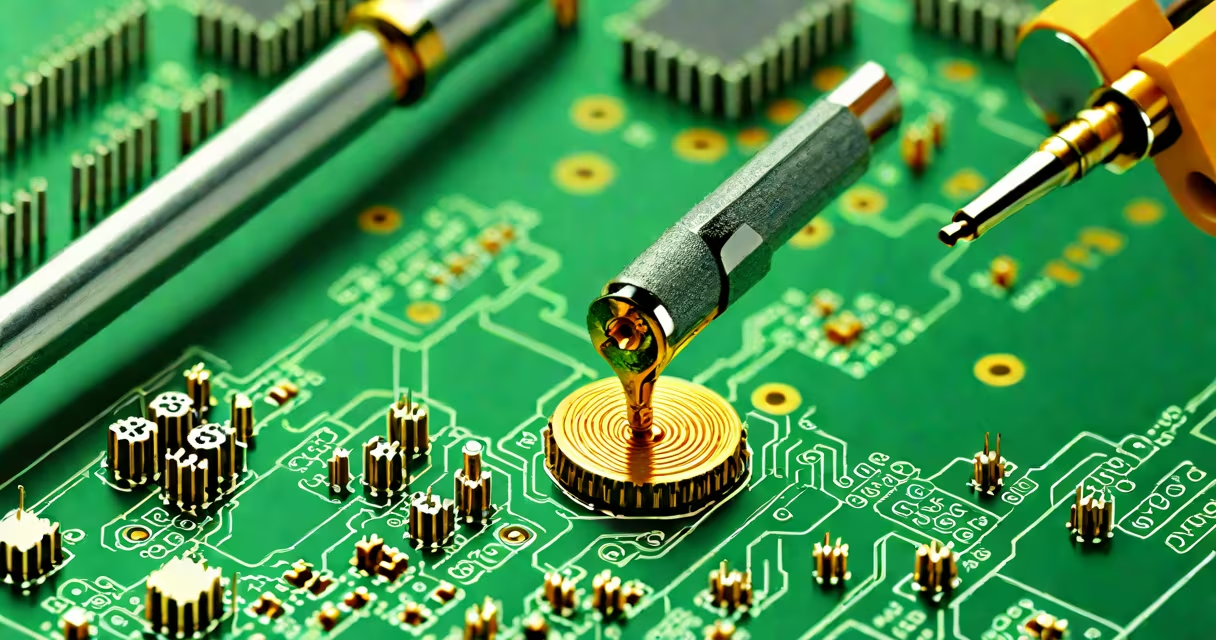
Soldering meaning in English describes the process of joining two or more metal surfaces using a filler metal-solder-that melts at a relatively low temperature, typically between 180°C and 350°C (356°F to 662°F). The solder flows into the joint via capillary action, creating a strong, conductive bond once cooled.
This method differs from welding, which melts the base metals themselves. Soldering preserves the structural integrity of the original materials and is widely used in electronics, plumbing, and metalwork. It requires precision tools like soldering irons, solder wire, flux, and proper ventilation.
The term "soldering" originates from Middle English *solderen*, derived from Old French *solder*, meaning "to seal with lead." Modern soldering uses alloys such as tin-lead or lead-free alternatives like tin-silver-copper, depending on application safety standards.
Soldering relies on heat to melt the solder material, which then wets the surfaces being joined. Wetting occurs when the molten solder spreads evenly across clean metal surfaces due to surface tension and chemical bonding. Poor wetting results in cold joints-weak, unreliable connections.
Flux is essential in this process. It removes oxides from metal surfaces and prevents further oxidation during heating. Without flux, solder won't adhere properly. Flux residues can be corrosive, so cleaning is required after soldering, especially in electronic circuits.
A typical soldering session involves preheating the joint area, applying flux, placing solder wire against the heated metal, and allowing the solder to flow into the gap. Once solidified, the joint must withstand mechanical stress and electrical current without failure.
Different soldering techniques suit specific tasks based on temperature, precision, and material compatibility.
| Type | Temperature Range | Common Uses | Key Materials |
|---|---|---|---|
| Soft soldering | 180-350°C (356-662°F) | Electronics, jewelry, plumbing | Tin-lead, tin-silver-copper |
| Hard soldering (silver soldering) | 600-900°C (1112-1652°F) | Plumbing, automotive, structural repairs | Silver-copper-zinc alloys |
| Reflow soldering | 210-250°C (410-482°F) | Surface-mount PCB assembly | Lead-free solder paste |
Reflow soldering, used in mass-produced circuit boards, applies heat uniformly across the entire board using infrared ovens or hot air. This ensures all components are joined simultaneously without manual intervention.
For hobbyists and small-scale work, hand soldering with a temperature-controlled iron remains standard. A 30-watt iron set to 300°C (572°F) is sufficient for most through-hole and surface-mount components.
Many assume soldering is simply "melting metal with a hot tool." That's inaccurate. The key is controlled heat transfer to the joint, not the component itself. Overheating can damage sensitive parts like integrated circuits or degrade insulation.
A frequent error is applying too much solder. Excess solder creates bridges between adjacent pins, causing short circuits. A good solder joint should form a smooth, concave fillet around the connection point-not a blob.
Another mistake is skipping flux. Even clean copper traces oxidize quickly when exposed to air. Flux prevents this and improves wetting. Some beginners use toothpaste or household cleaners as substitutes-but they lack the necessary chemical properties and leave residues that interfere with conductivity.
One non-obvious fact: solder joints fail more often due to thermal cycling than poor initial quality. Repeated heating and cooling cause micro-cracks in the solder, leading to intermittent connections. Engineers account for this by designing joints with slight flexibility or using higher-strength alloys.
Consider a pair of headphones with a broken audio jack. The issue lies in a cracked solder joint connecting the internal wire to the plug's contact pin. To fix it:
After successful repair, the headphones function normally. This process demonstrates how soldering meaning in English translates to practical problem-solving in everyday devices.
During a recent electronics workshop, I repaired five defective Arduino boards using hand soldering. All failed due to cold joints caused by insufficient heat or improper flux use. After correcting these issues, each board powered up correctly. The difference between success and failure came down to consistent temperature control and attention to detail.
Soldering is not welding. Welding melts the base metals to fuse them together, while soldering keeps the base metals intact and uses a lower-melting filler. Attempting to weld copper wires with a soldering iron results in weak, unreliable joints.
It's also not gluing. Adhesives like epoxy or super glue do not conduct electricity and cannot handle high temperatures. A glued connection may fail under thermal stress or vibration.
Some confuse soldering with brazing. Brazing uses higher temperatures (above 450°C) and produces stronger joints, but it's not suitable for delicate electronics. Soldering remains the preferred method for circuits because it avoids damaging sensitive components.
The International Electrotechnical Commission (IEC) defines soldering standards in IEC 61131-3, which governs industrial automation systems. These standards specify acceptable joint geometry, minimum wetting angles, and inspection criteria.
According to the National Institute of Standards and Technology (NIST), proper soldering reduces failure rates in printed circuit boards by up to 70%. Their research confirms that inadequate flux application and inconsistent temperature profiles are primary causes of defective joints.
For safety, the U.S. Environmental Protection Agency (EPA) regulates lead content in solders. Lead-free solder (e.g., SnAgCu) is mandatory in consumer electronics manufactured after 2006 under RoHS (Restriction of Hazardous Substances) directives.
Understanding soldering meaning in English is important for anyone working with electronics, plumbing, or DIY projects. It's not just about melting metal-it's about controlled bonding, reliability, and long-term performance.