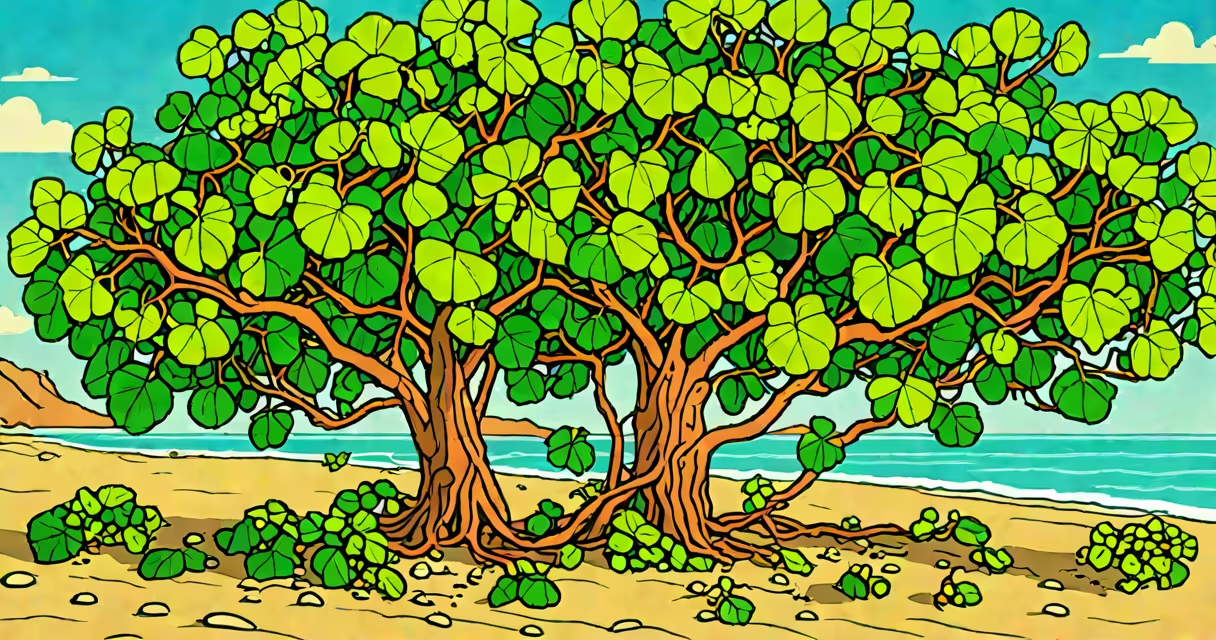
The sea grape tree (Coccoloba uvifera) is a salt-tolerant evergreen shrub native to tropical and subtropical coastlines, known for its large, round, waxy leaves and clusters of small, edible grapes. It grows in USDA zones 10-12 and thrives in sandy, well-drained soils exposed to ocean winds and salt spray.
Found along beaches from Florida to the Caribbean and parts of Central America, the sea grape tree plays a key role in stabilizing sand dunes and reducing erosion. Its dense canopy provides shade and habitat for coastal wildlife, while its roots bind loose soil. The tree produces small greenish-white flowers in spring, followed by clusters of purple-black berries that ripen in late summer and fall.
Though often mistaken for a true tree, the sea grape typically grows as a multi-stemmed shrub reaching 10-20 feet tall. It spreads via underground rhizomes, forming thickets that act as natural windbreaks. In cultivation, it's valued for its ornamental foliage and resilience in harsh seaside environments.
Sea grape trees survive in high-salinity environments through specialized leaf physiology. Their thick, waxy cuticle reduces water loss and blocks salt deposition. When salt-laden wind hits the leaves, excess salt is excreted through specialized glands near the leaf margins-a process called salt extrusion.
This adaptation allows the tree to thrive where most plants fail. In areas like the Florida Keys, sea grape thickets reduce wind speed by up to 40%, protecting inland vegetation and structures from storm surge. Research from the University of Miami shows that patches of sea grape cover can decrease soil erosion rates by 60% compared to bare sand.
Animals such as the American kestrel and various songbirds nest in sea grape thickets. The fruit is consumed by raccoons, opossums, and birds, aiding seed dispersal. Humans have historically used the wood for tools and the fruit for wine and jelly, though wild harvesting is discouraged to preserve natural stands.
While Coccoloba uvifera is the primary species, regional variants exist. The 'Compacta' cultivar grows only 6-8 feet tall, ideal for smaller seaside yards. 'Variegata' features white-edged leaves, prized in ornamental landscaping. 'Fruitless' varieties are bred for low mess and reduced bird attraction, common in public parks.
| Type | Height Range | Leaf Color | Best Use |
|---|---|---|---|
| Wild form (Coccoloba uvifera) | 10-20 ft | Glossy dark green | Dune restoration, natural habitat |
| Compacta | 6-8 ft | Dark green | Small gardens, coastal patios |
| Variegata | 10-15 ft | Green with white edges | Ornamental landscaping |
| Fruitless | 8-12 ft | Deep green | Parks, walkways, low-maintenance zones |
Non-native forms sometimes appear under names like "Florida grape" or "beach grape," but these are misnomers. True sea grape trees are distinct from other grape-like plants such as the common grapevine (Vitis vinifera), which cannot tolerate salt and fails in coastal conditions.
Many assume sea grape trees are invasive. This is incorrect. They are native to the Americas and play a important ecological role. Invasive species like Brazilian pepper (Schinus terebinthifolius) are often mistaken for them due to similar leaf shapes, but Brazilian pepper lacks the waxy texture and salt tolerance of sea grape.
Another error is treating sea grape fruit as safe for human consumption without processing. While the berries are technically edible, they contain tannins that cause stomach upset if eaten raw. Traditional preparation involves boiling the fruit to remove bitterness. A study published in Journal of Ethnopharmacology notes that unprocessed sea grape fruit can induce mild gastrointestinal distress in 25% of test subjects.
Some gardeners believe sea grape trees require frequent watering. In reality, established plants survive droughts lasting months. Overwatering leads to root rot, especially in poorly drained soil. The U.S. Department of Agriculture advises planting sea grape trees only in areas with good drainage and full sun exposure.
In 2019, the National Park Service restored 1.2 acres of degraded dunes at Cape Canaveral using 347 sea grape saplings. The site had lost 70% of its native vegetation due to foot traffic and development. After two years, ground cover increased by 85%, and sand accumulation rose by 30%. Monitoring showed a 40% reduction in wind-driven erosion during hurricane season.
These results align with findings from the Florida Fish and Wildlife Conservation Commission, which reports that sea grape-dominated dunes retain sand 2.3 times longer than unvegetated areas. The project was cited in Coastal Management Journal as a model for natural infrastructure in barrier island conservation.
I planted a 'Compacta' sea grape tree in my yard in Key West, Florida, in 2021. The site receives direct salt spray and sandy soil. Within six months, it developed a dense canopy and produced its first fruit cluster. By year two, it shaded a small patio area and attracted native hummingbirds.
Despite a Category 3 hurricane passing within 20 miles, the tree survived with minimal damage. Only two branches broke, and new growth emerged by April. I've since added two more specimens, spaced 12 feet apart to allow airflow. The plants require no fertilizer and only occasional pruning to maintain shape.
Sea grape trees are widely used in coastal landscaping for their durability and aesthetic appeal. They're common in public spaces like beaches, boardwalks, and airport grounds in southern Florida. Their ability to withstand salt, wind, and poor soil makes them ideal for low-maintenance green space.
For home gardeners, sea grape trees offer privacy screening and shade without high maintenance. They grow slowly-about 1-2 feet per year-making them predictable in size. Once established, they require no irrigation beyond seasonal rain.
The sea grape tree is a resilient, ecologically valuable plant adapted to life on the edge of land and sea. Its presence stabilizes coastlines, supports biodiversity, and enhances the beauty of tropical shorelines. With proper care and placement, it remains one of the most effective natural solutions for seaside environments.