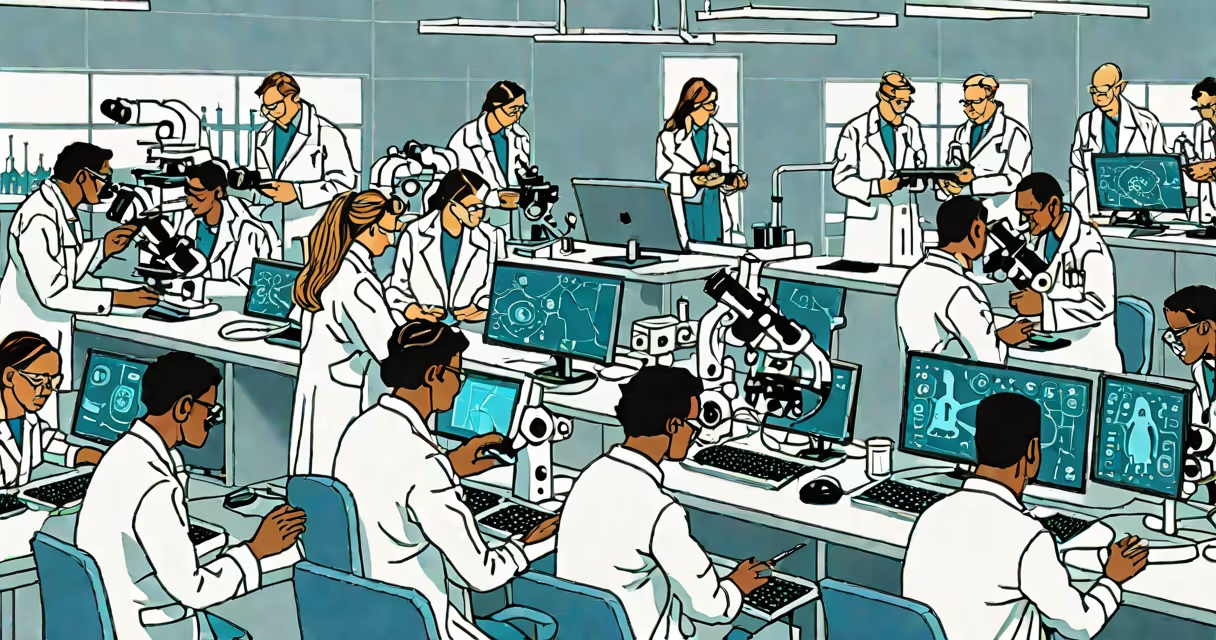
A scientist is a professional who uses systematic methods to study the natural world, test hypotheses, and generate evidence-based knowledge. Their work spans disciplines including biology, physics, chemistry, environmental science, and data science, all grounded in empirical observation and reproducible results.
Scientists begin with a question about how something works-why plants grow toward light, how viruses spread, or whether a new drug reduces symptoms. They design experiments or analyze existing data to test possible answers. Results are recorded, shared with peers through journals, and subjected to scrutiny before being accepted as valid. This process ensures findings are accurate and free from bias.
The term "scientist" applies broadly. A marine biologist studies ocean ecosystems, a materials scientist develops stronger alloys for aircraft, and a computational biologist models protein folding using algorithms. While roles differ, all rely on the scientific method: observe, hypothesize, experiment, analyze, conclude.
Every scientific investigation follows a structured approach. First, a researcher identifies a gap in current understanding-perhaps a disease with no effective treatment. They formulate a testable hypothesis: "Drug X reduces tumor size in mice." Next, they plan controlled experiments-administering Drug X to one group, a placebo to another-and measure outcomes over time.
Data collection is precise. In a clinical trial, researchers record patient weight, blood pressure, and symptom severity daily. Measurements are logged digitally to avoid human error. After gathering results, scientists apply statistical tools to determine if differences between groups are meaningful or due to chance.
For example, a 2021 study published in Nature examined the effects of a new antiviral compound on SARS-CoV-2 in cell cultures. Researchers exposed infected lung cells to varying doses of the drug and measured viral RNA levels after 48 hours. The data showed a 90% reduction in viral load at high doses, leading to further animal testing. This progression-from lab dish to animal model-is standard in pharmaceutical development.
Scientists specialize based on subject area and methodology. The table below outlines major categories, their focus, and typical workplaces.
| Type | Focus Area | Common Workplace | Example Task |
|---|---|---|---|
| Biochemist | Molecular processes in living organisms | University labs, biotech firms | Isolating enzymes from bacteria to improve industrial fermentation |
| Environmental Scientist | Human impact on ecosystems | Government agencies, conservation NGOs | Measuring nitrogen runoff in rivers near farmland |
| Data Scientist | Patterns in large datasets | Technology companies, healthcare systems | Using machine learning to predict hospital readmission rates |
| Geophysicist | Earth's physical properties and processes | Oil exploration teams, earthquake monitoring centers | Analyzing seismic waves to map underground rock layers |
Not all scientists work in labs. Field ecologists spend weeks in remote forests tracking bird migration patterns. Astrophysicists analyze telescope data from space missions like the James Webb Space Telescope. Even within a single field, tasks vary widely-some scientists build instruments, others write software to process data.
Scientists do not make decisions based on belief, emotion, or popular opinion. A common misconception is that science proves absolute truths. In reality, scientific conclusions are provisional-they remain valid until new evidence challenges them. The theory of evolution, for instance, is supported by fossil records, genetic comparisons, and observed changes in populations over time-but it remains open to refinement.
Another misunderstanding is equating "science" with "technology." While scientists often contribute to innovation, their primary goal is understanding, not invention. A chemist may discover a reaction that produces a new polymer, but the decision to manufacture it lies with engineers and business leaders-not the scientist.
Not all people who use the word "science" in their job title are scientists. A medical sales representative may describe themselves as "scientific," but they don't conduct original research. True scientists engage in peer-reviewed inquiry, publish findings, and participate in academic discourse.
In early 2020, epidemiologists at the Centers for Disease Control and Prevention (CDC) began analyzing reports of pneumonia cases in Wuhan, China. They collected data on symptoms, travel history, and contact networks. Using statistical models, they estimated the virus's reproduction rate-how many people each infected person would likely infect.
Within days, they identified a pattern: most cases were linked to a seafood market. This led to targeted testing and isolation measures. By comparing genetic sequences from patients worldwide, scientists traced the virus's origin to bats and identified intermediate hosts. These findings informed public health policies globally.
This process illustrates how scientists collaborate across borders and disciplines. Biologists sequenced the virus genome, computer scientists modeled transmission risks, and public health officials applied the results to real-world interventions.
I once observed a team of virologists at a university lab during a pandemic surge. They worked 16-hour shifts, extracting viral RNA from swabs, running PCR tests, and uploading results to a shared database. Their work wasn't glamorous-it involved meticulous pipetting, calibration checks, and constant troubleshooting-but it directly shaped local quarantine guidelines.
Success in science requires analytical thinking, attention to detail, and persistence. Scientists must interpret complex data, recognize anomalies, and revise theories when necessary. They also need technical skills: operating microscopes, programming in Python, or calibrating spectrometers.
Communication is critical. A discovery is useless if it cannot be explained to colleagues, funders, or policymakers. Writing grants, presenting at conferences, and editing manuscripts are part of daily life. According to the National Science Foundation, over 60% of funded research projects fail to secure renewal because of poor proposal quality.
Understanding how science works helps everyone-citizens, students, and professionals-evaluate claims about climate change, vaccines, or artificial intelligence. When you hear a news report about a breakthrough, ask: Was it tested? Were controls used? Can other labs replicate it?
Science advances not through sudden insights but through consistent, rigorous effort. Whether studying DNA or modeling weather patterns, the role of a scientist remains the same: to uncover how the world works, one experiment at a time.