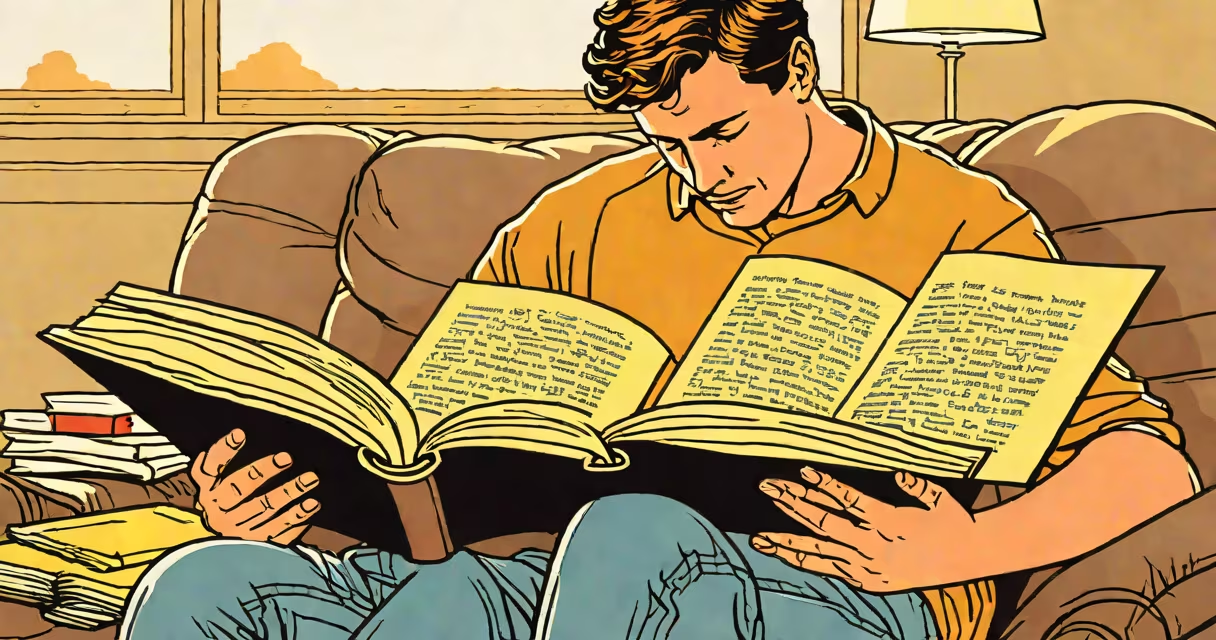
"Read something great" means encountering a piece of writing-fiction, nonfiction, poetry, or essay-that offers lasting insight, emotional depth, or intellectual rigor beyond surface entertainment. It's not about popularity or speed, but about impact: a work that changes how you see people, ideas, or yourself.
Great reading doesn't just inform-it lingers. A passage may stay with you for years, not because it was easy, but because it demanded attention. The phrase often appears in book recommendations, reading lists, and personal reflections where the goal is not consumption, but transformation.
For example, reading Toni Morrison's *Beloved* isn't just learning about slavery-it's confronting the psychological weight of memory, identity, and love under trauma. You don't "get through" it quickly. You feel its weight. That's what makes it great.
Great reading activates multiple mental processes simultaneously: decoding language, interpreting metaphor, tracking character development, and connecting themes to lived experience. It requires sustained focus and emotional investment.
Neuroscience shows that reading complex narratives increases activity in brain regions linked to empathy and theory of mind-the ability to understand others' thoughts and feelings. A 2013 study published in *Science* found that readers of literary fiction scored higher on tests measuring social perception than those who read nonfiction or popular fiction.
When you read something great, your brain doesn't just absorb facts-it simulates experiences. You imagine the setting, hear the dialogue, feel the tension. This simulation strengthens neural pathways tied to decision-making and emotional regulation.
There's no single checklist, but several qualities consistently appear in works labeled "great." These include narrative complexity, authentic voice, thematic depth, and linguistic precision.
Consider *The Waste Land* by T.S. Eliot. Its fragmented structure, layered allusions, and shifting voices reflect the disorientation of post-WWI Europe. It's not easy-readers often need annotations-but its power lies in how it captures collective disillusionment through form and language.
| Type | Key Traits | Example |
|---|---|---|
| Fiction | Complex characters, moral ambiguity, layered plot | *Middlemarch* by George Eliot |
| Nonfiction | Argumentative rigor, original insight, narrative drive | *The Immortal Life of Henrietta Lacks* by Rebecca Skloot |
| Poetry | Compression, sonic texture, symbolic density | *"The Fish"* by Elizabeth Bishop |
| Essays | Personal reflection fused with cultural critique | *"On Writing"* by Stephen King (nonfiction essay) |
Not all great works are widely known. Some gain influence slowly. *Their Eyes Were Watching God* by Zora Neale Hurston was overlooked for decades after publication, then recognized as a foundational American novel due to its lyrical prose and exploration of Black womanhood.
"Read something great" appears in classrooms, book clubs, and personal journals. It signals intentionality-choosing depth over distraction.
In education, teachers assign great works not to test recall, but to build critical thinking. A high school class studying *To Kill a Mockingbird* isn't just learning about racism in the South-they're analyzing how narrative perspective shapes truth, and how courage looks different in children versus adults.
At home, people use the phrase to resist the noise of algorithm-driven content. A friend told me they deleted their social media apps after realizing they were consuming 50 articles a day-none of which left them changed. They started reading one great book a month instead. After six months, they said, "I stopped feeling hollow."
Many assume "great" means "classic" or "long." But length doesn't guarantee depth. A 30-page story by Alice Munro can be more emotionally precise than a 600-page epic with flat characters.
Another mistake is equating "great" with "enjoyable." Greatness isn't always pleasurable. Reading *Notes from Underground* by Dostoevsky is unsettling-its narrator is paranoid, self-destructive, and unlikable. Yet the novel remains essential for understanding modern alienation and internal conflict.
Also, "read something great" isn't about perfection. A flawed novel-say, *Moby-Dick* with its digressions on whale biology-can still be great because it explores obsession, fate, and the limits of human knowledge. The imperfections are part of its power.
Start small. Pick one book, essay, or poem that someone you trust calls "great." Read it slowly. Take notes. Ask: What did I learn about people? About myself? What surprised me?
Try this: Read one chapter of *The Power of Now* by Eckhart Tolle-not to agree, but to notice how the language shapes attention. Then ask: Did my mind slow down? Did I feel less reactive afterward?
Use trusted sources. The *New York Times Book Review* and *The Guardian's* longform essays often show works with lasting impact. The National Endowment for the Humanities also publishes annual lists of books that have shaped American thought.
Finally, remember: you don't need to finish every great book. Sometimes, stopping halfway through *Lolita*-not because it's bad, but because it's too psychologically intense-is a sign of respect for the work's difficulty.
Reading something great isn't about achievement. It's about presence. It's the opposite of scrolling. It's choosing to sit with uncertainty, beauty, pain, and meaning-on the page, in silence.
When you read something great, you aren't just absorbing words. You're becoming someone new-just a little.