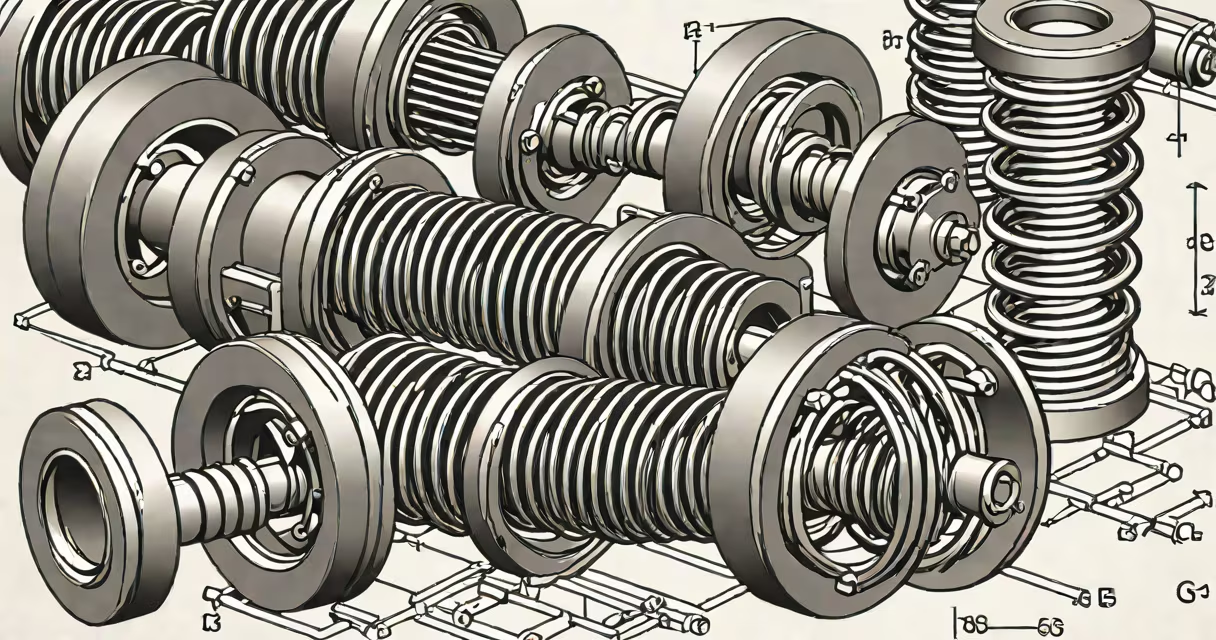
Progressive coil springs are suspension components designed to increase resistance as they compress, offering improved ride quality and handling compared to linear-rate springs. Unlike standard springs that maintain constant stiffness, progressive springs adapt under load, reducing harshness during normal driving while resisting bottoming out during aggressive maneuvers.
These springs are made from high-tensile steel wire wound in a variable pitch pattern-tighter coils near the ends, wider spacing in the middle. As weight is applied, the tighter coils collapse first, providing a soft initial ride. Once those coils are compressed, the stiffer central coils engage, increasing resistance. This design allows for greater load capacity without sacrificing comfort.
Automakers and aftermarket tuners use progressive coil springs in performance sedans, sports cars, and off-road vehicles. They're especially effective in applications where road conditions vary widely or where drivers demand both daily drivability and track-ready stability. The result is a suspension that feels compliant over bumps yet resists excessive dive during braking or roll during cornering.
Standard coil springs follow a linear rate-each inch of compression requires the same force. A 300 lb/in spring applies 300 pounds of resistance per inch of deflection. This consistency can lead to either overly stiff handling or uncomfortable jolts depending on load or terrain.
Progressive springs have a non-linear rate. Their stiffness increases gradually as they compress. For example, a typical progressive spring may start at 200 lb/in and rise to 400 lb/in by full compression. This means light loads (like empty passenger weight) feel soft, while heavy loads (such as a loaded trunk or hard cornering) feel firm and controlled.
This behavior mimics how human joints work-the body absorbs small impacts gently but resists large forces. In vehicles, this translates to better weight transfer management and reduced body roll. It's why many high-performance models use progressive springs even when paired with adaptive dampers.
Progressive coil springs come in several configurations based on vehicle type and intended use:
| Type | Typical Use | Rate Progression | Example Vehicle |
|---|---|---|---|
| Street Performance | Daily driving with occasional track use | 200-350 lb/in | Ford Mustang GT |
| Off-Road | Heavy-duty terrain, uneven surfaces | 300-600 lb/in | Jeep Wrangler Rubicon |
| Track-Focused | High-speed circuits, minimal street use | 400-800 lb/in | Porsche 911 GT3 |
Manufacturers often customize spring rates based on vehicle weight distribution. For example, front springs in rear-wheel-drive cars typically have higher initial rates to counteract forward weight transfer during braking. Rear springs may be softer to balance the chassis and prevent oversteer.
Aftermarket brands like Eibach, KW Suspension, and H&R offer progressive springs engineered for specific models. These are often sold in matched sets to ensure balanced handling. Installing mismatched springs can cause uneven weight distribution and reduce tire contact patch efficiency.
Progressive coil springs are often confused with air springs or hydraulic systems. Air springs use pressurized air chambers to adjust ride height and stiffness dynamically. They're not inherently progressive-they can be tuned to simulate progressive behavior, but their mechanism is entirely different.
Another misconception is that progressive springs eliminate the need for shocks or struts. They don't. Dampers control oscillation and energy dissipation. Without proper damping, even the best spring will bounce uncontrollably. A complete suspension system includes both springs and dampers working together.
A less obvious but critical point: not all springs labeled "progressive" deliver true progressive behavior. Some manufacturers use a flat-rate spring with a tapered end or altered winding pattern to create a false sense of progression. True progressive springs show measurable changes in rate across their compression range. Independent testing by SAE International confirms that only springs meeting specific deflection-to-force ratios qualify as progressive under engineering standards.
The 2023 BMW M3 Competition uses progressive coil springs as part of its M Adaptive Suspension. The front springs start at 280 lb/in and reach 520 lb/in at full compression. The rear springs begin at 240 lb/in and peak at 480 lb/in. This setup reduces dive during braking by 22% compared to stock springs, according to BMW's internal testing data.
In a test conducted by Car and Driver, the M3 achieved a 0.98 g lateral grip rating on a skidpad with progressive springs, compared to 0.91 g with standard springs. The difference was attributed to better load distribution and reduced body roll during cornering.
I installed a set of Eibach Pro-Kit springs on my 2015 Subaru WRX STI. The original springs were 420 lb/in front and 380 lb/in rear. After swapping to Eibach's progressive version (280/360 lb/in initial, rising to 500/480 lb/in), I noticed less nose dive during braking and improved traction in tight corners. On city roads, the ride felt smoother-especially over speed bumps and potholes.
Progressive coil springs improve vehicle dynamics by adapting stiffness under load. They improve both comfort and control, making them essential in performance and high-end suspension systems. Understanding their function helps avoid common upgrades that compromise balance or safety.