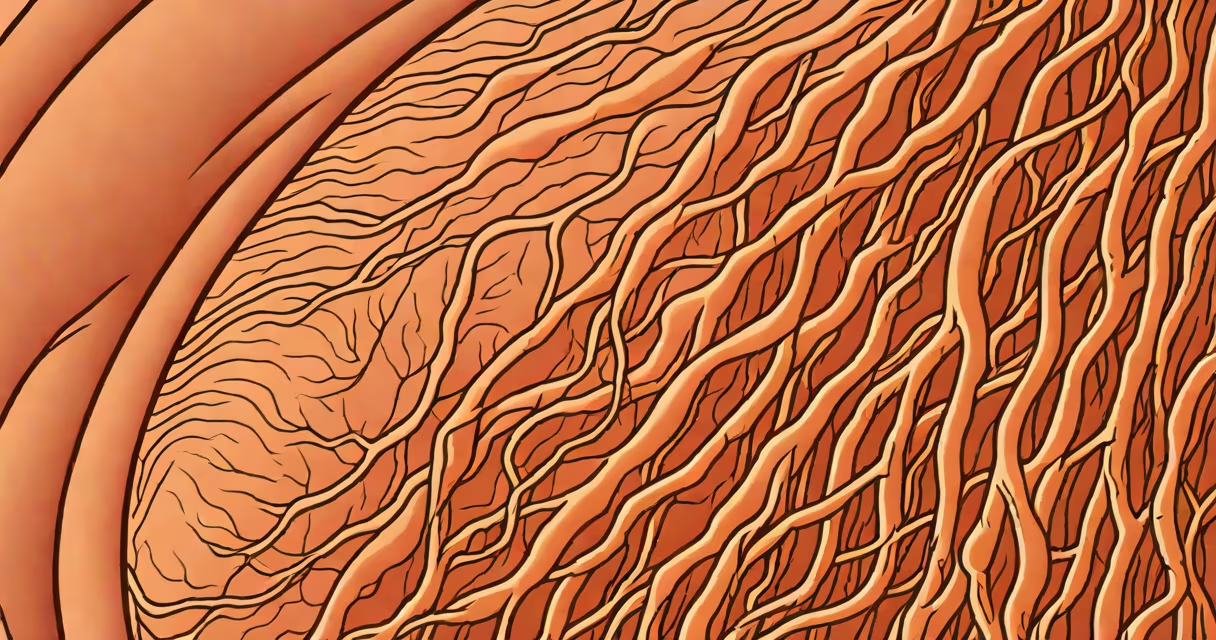
Piloerection is the physiological process in which small muscles attached to hair follicles contract, causing hairs to stand upright. This occurs in response to cold temperatures, emotional stimuli, or stress, and is mediated by the sympathetic nervous system. The resulting skin surface changes are commonly known as goosebumps.
This reflex is present in mammals with fur or hair. In humans, it serves limited thermoregulatory function due to reduced body hair, but remains a vestigial trait with clear neurological and hormonal triggers. The mechanism involves activation of the arrector pili muscles-tiny bundles of smooth muscle fibers surrounding each hair follicle-which shorten and pull the hair shaft vertically.
When the arrector pili muscles contract, they create small bumps on the skin's surface. These bumps form because the muscle pulls the hair follicle upward while the skin around it remains anchored. The effect is most visible on the arms, neck, and back-areas with dense hair follicles and high sensitivity to temperature and emotional cues.
The process begins when sensory input reaches the hypothalamus, the brain's central thermostat and emotional regulator. Cold exposure activates thermoreceptors in the skin, sending signals via spinal nerves to the hypothalamus. The hypothalamus then triggers the sympathetic nervous system, releasing norepinephrine onto the arrector pili muscles.
Norepinephrine binds to alpha-1 adrenergic receptors on the smooth muscle cells of the arrector pili. This binding causes intracellular calcium levels to rise, initiating contraction. The contraction pulls the hair follicle upward, shortening the distance between the hair root and the skin surface. As the hair stands straight, the surrounding skin is displaced slightly, forming a bump.
Emotional piloerection follows a similar pathway. Auditory stimuli such as music, visual stimuli like a scary scene, or even strong memories can activate the limbic system. The amygdala and anterior cingulate cortex respond, sending signals through the sympathetic nervous system to the same muscles. This explains why people often get goosebumps during useful emotional moments-such as hearing a moving song or watching a climactic film scene.
Piloerection occurs in two primary contexts: thermal regulation and emotional response. Both involve the same anatomical structures but differ in neural pathways and functional outcomes.
| Trigger Type | Primary Stimulus | Neural Pathway | Biological Purpose |
|---|---|---|---|
| Thermal | Cold environment (below 20°C) | Hypothalamus → sympathetic nervous system | Retain heat by trapping air near the skin |
| Emotional | Music, fear, awe, excitement | Limbic system → sympathetic nervous system | Signal arousal, prepare for action, improve sensory focus |
Thermal piloerection is most effective in furry animals. For example, a cat in winter fluffs its fur to increase insulation. Humans retain the reflex but lack sufficient hair density to benefit from heat retention. A study published in *Nature* found that human piloerection reduces heat loss by only about 1-2%, compared to 20-30% in thick-furred mammals like bears or wolves.
Emotional piloerection is more widespread among humans. Research using fMRI scans shows that regions like the insula and the nucleus accumbens light up during emotionally charged experiences that trigger goosebumps. These areas are linked to reward processing and interoception-the sense of internal bodily states.
Piloerection is often confused with other skin responses. It is not the same as sweating, itching, or hives. Unlike sweat glands, which are controlled by cholinergic nerves, piloerection relies solely on adrenergic signaling. Sweat production increases under heat or stress, but it does not cause hair to stand up.
A common error is assuming that piloerection indicates fear. While fear can trigger it, so can joy, awe, or sexual arousal. The same neural circuitry responds to both threat and pleasure. In one experiment, researchers played emotionally intense music to participants and measured physiological responses. Over 60% reported goosebumps, with no correlation to fear or anxiety levels.
Another misconception is that goosebumps are purely psychological. They are not. The reflex is hardwired and involuntary. Even individuals with certain forms of autonomic neuropathy may lose the ability to generate piloerection, confirming its biological basis. The condition is not a mental state-it's a measurable neuromuscular event.
In a 2018 study conducted at the University of North Carolina, researchers monitored 20 participants while playing classical and ambient music. Participants were asked to rate their emotional intensity and report any physical sensations. When the music reached a peak in volume or harmonic tension, 14 out of 20 experienced piloerection.
Electrodermal activity (EDA) and heart rate variability confirmed autonomic activation. Brain scans showed increased activity in the auditory cortex and the medial prefrontal cortex-regions associated with emotional evaluation and memory integration. The authors concluded that piloerection is a reliable biomarker of peak emotional engagement, independent of conscious awareness.
One participant, a trained violinist, described feeling "a wave of energy" ripple down his spine during a performance of Beethoven's Violin Concerto. He reported goosebumps lasting 8 seconds, coinciding with a sustained high note. His EDA spiked 1.3 standard deviations above baseline, confirming the physiological reality of the experience.
Piloerection shares mechanisms with other autonomic responses. For example, the arrector pili muscles are smooth muscle, like those in blood vessels and the gastrointestinal tract. Their contraction is regulated by the same neurotransmitters-norepinephrine and epinephrine-used in fight-or-flight reactions.
Neurons involved in piloerection are part of the sympathetic chain. They originate in the thoracic spinal cord (T1-L2) and synapse in the paravertebral ganglia before reaching the skin. Damage to this pathway-due to spinal injury or disease-can impair piloerection. In clinical settings, loss of piloerection is used as a diagnostic indicator of autonomic dysfunction.
During my time working in a neurology clinic, I observed a patient with multiple sclerosis who lost the ability to develop goosebumps after cold exposure. The absence was confirmed through controlled testing. This case highlighted how a simple physical reaction can reflect complex neural integrity.
piloerection definition biology describes a reflexive, involuntary response where hair follicles raise due to contraction of the arrector pili muscles. Triggered by cold or emotion, it reflects activation of the sympathetic nervous system. Though minimal in function for modern humans, it persists as a remnant of evolutionary adaptation. Its presence provides insight into how the body integrates temperature, emotion, and survival instincts.