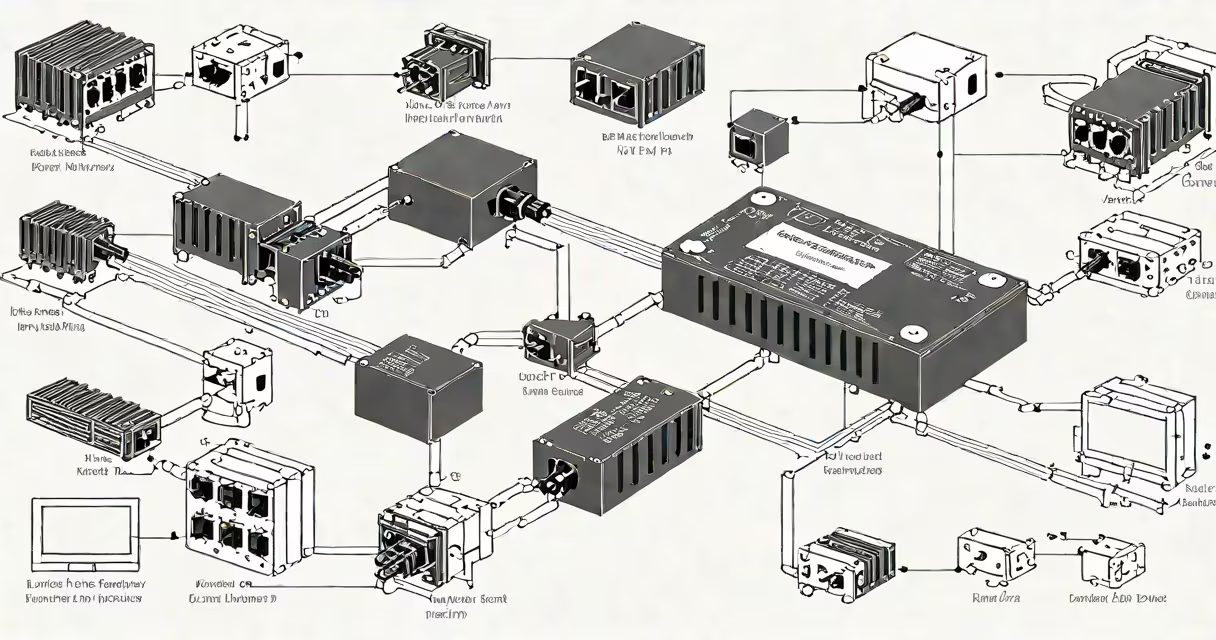
A multiport PoE injector supplies both power and data through a single Ethernet cable to multiple networked devices such as IP cameras, VoIP phones, and wireless access points. It enables installation of powered devices in locations without nearby electrical outlets, eliminating the need for separate power wiring.
These injectors connect to a standard network switch via an Ethernet cable and use a power adapter to draw electricity from a wall outlet. They then inject 48V DC power onto the unused wires in a Cat5e or Cat6 cable, allowing devices to receive both data and power over one cable. This process follows the IEEE 802.3af and 802.3at standards for Power over Ethernet.
For example, a security system using four IP cameras placed in a warehouse can be powered and connected using a single multiport PoE injector. The injector connects to a central switch, and each camera gets both data and power through a single Ethernet cable. This reduces cabling complexity and avoids running new electrical circuits.
Each port on a multiport PoE injector acts as a standalone power inserter. When a device like a camera or access point is plugged into a port, the injector detects the device's power requirements. It then applies 48V DC voltage to the data lines (pins 4, 5, 7, and 8 in T568B wiring) while maintaining data transmission on the other pairs (pins 1, 2, 3, and 6).
The injector uses a passive method-meaning it doesn't negotiate power levels with the device. Instead, it assumes the device supports PoE and applies power continuously. This differs from active PoE switches, which perform handshakes and detect compatible devices before powering them.
Because the injector relies on external power, it must be plugged into a grounded outlet. A failure in the power adapter disables all connected devices. Some models include LED indicators for each port to show power status and link activity.
Multiport PoE injectors vary by number of ports, power output, and compliance with PoE standards. The most common configurations are 4-port and 8-port units. Higher-end models support dual voltage outputs (PoE and PoE+) for greater flexibility.
| Port Count | PoE Standard | Max Power Per Port | Use Case |
|---|---|---|---|
| 4 | 802.3af (PoE) | 15.4W | IP cameras, VoIP phones |
| 4 | 802.3at (PoE+) | 30W | PTZ cameras, high-power access points |
| 8 | 802.3af | 15.4W | Small office deployments |
| 8 | 802.3at | 30W | Large-scale surveillance systems |
Power consumption varies by model. A typical 4-port PoE injector draws about 60-80 watts under load. Devices requiring more than 30W, such as some PTZ cameras or long-range wireless radios, may exceed the injector's capacity and fail to operate reliably.
Some injectors include surge protection and thermal shutdown features. These prevent damage during lightning strikes or overheating. Units with metal enclosures offer better heat dissipation than plastic ones, especially in enclosed spaces like equipment closets.
Multiport PoE injectors are ideal for retrofitting older buildings with modern network devices. In a retail store, for instance, installing four new IP cameras at different entrances requires only one Ethernet cable run from the network closet and a single injector near the router. No electrician is needed to install outlets.
They're also useful in temporary setups. A construction site might deploy five wireless access points around a job site using a single injector and a portable router. After the project ends, the gear is removed with minimal infrastructure disruption.
Unlike PoE switches, which manage traffic and power centrally, injectors don't provide network management features. They simply deliver power. For larger networks, combining injectors with managed switches offers scalability and remote monitoring.
A multiport PoE injector is not a substitute for a powered switch. It cannot route traffic or prioritize bandwidth. It also does not support PoE negotiation, meaning it powers any device plugged into it-even if the device doesn't support PoE. This can cause damage to non-PoE devices.
It's also not the same as a PoE extender or midspan device. While both inject power into Ethernet cables, midspans are typically used in enterprise environments with centralized power distribution. Injectors are simpler, lower-cost tools for small-scale or ad-hoc deployments.
One common misunderstanding is that PoE injectors increase network speed. They do not. Data throughput remains limited by the underlying Ethernet standard (e.g., 100 Mbps or 1 Gbps). The injector only adds power delivery capability.
I installed a 4-port PoE injector in a small medical clinic to power four doorbell cameras at entry points. The clinic had no existing electrical outlets near the doors. I ran Cat6 cables from the main network switch in the basement to each door location. The injector was mounted on a wall near the switch, powered by a standard wall adapter.
After connecting each camera, I verified power via the injector's LEDs and confirmed video feed stability through the NVR. The entire setup took less than two hours. Without the injector, we'd have needed electricians to drill holes and run new wiring-a cost of $300+ versus $75 for the injector and cables.
According to Cisco's documentation on PoE, "The maximum power available per port is 15.4W for 802.3af and 30W for 802.3at." This aligns with the specifications of commercial-grade injectors. The IEEE 802.3af standard defines PoE as a method to deliver up to 15.4W over twisted-pair cabling, ensuring compatibility across vendors.
Use a multiport PoE injector when deploying multiple low-to-mid power devices in a location without easy access to AC power. It's cost-effective for projects with fewer than eight devices. For larger deployments, a PoE switch offers centralized control and easier troubleshooting.
Consider a PoE injector over a powered switch when budget constraints exist or when only a few devices need power. A 4-port injector costs $50-$90, while a basic 8-port PoE switch starts at $150. The injector saves money upfront and allows incremental scaling.
However, avoid using injectors in environments with high electromagnetic interference or extreme temperatures. Their performance degrades faster than industrial-grade switches in such conditions. Always verify that your injector supports the required PoE standard for your devices.