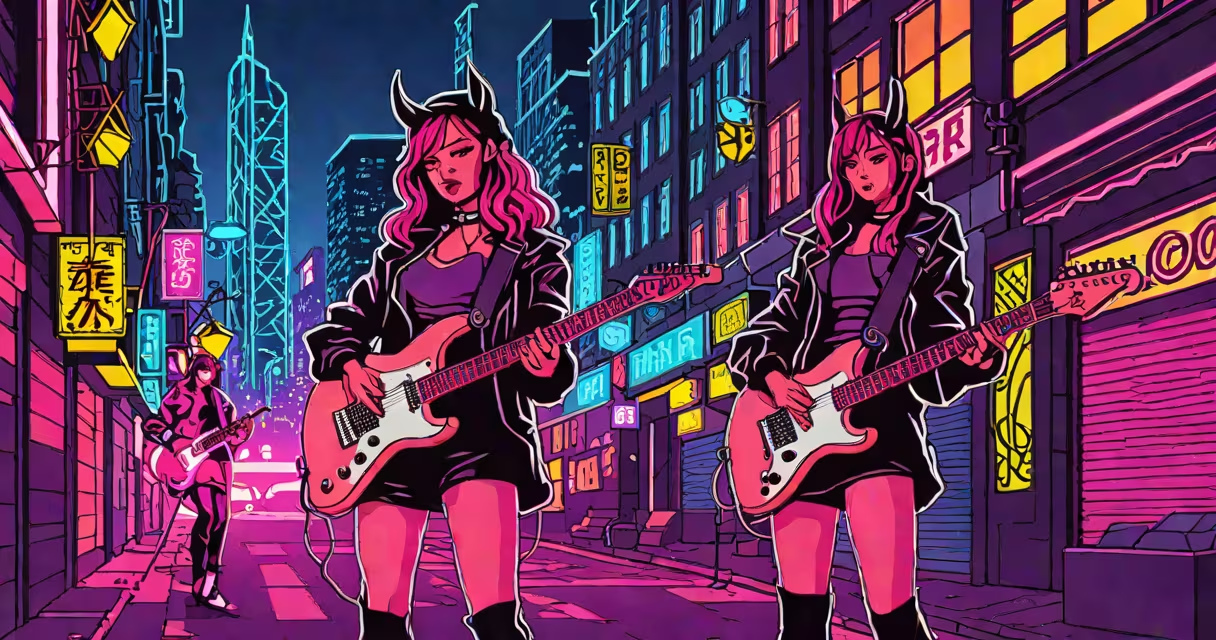
Mira is the lead vocalist and frontwoman of the fictional K-pop group "K-Pop Demon Hunters," a supernatural ensemble that combats demonic entities using music-based abilities. She is a central figure in the web series of the same name, which merges K-pop idol culture with urban fantasy and action-adventure storytelling.
The series, produced by South Korean media collective NEXUS Studios and released on streaming platforms in 2023, follows Mira and her bandmates as they protect Seoul from interdimensional demons drawn to human emotional energy. Mira's role centers on channeling psychic power through vocal harmonies and stage performances, turning concerts into ritualized battles.
Her abilities manifest during live shows when her voice triggers sonic resonance fields that disrupt demonic forms. This mechanic is grounded in the show's internal lore: demons feed on fear and sorrow, while music-especially high-frequency harmonies-disrupts their cohesion. Mira's soprano range is specifically calibrated to destabilize lower-tier entities.
K-Pop Demon Hunters mira operates under a narrative structure where performance art and metaphysical combat are inseparable. When a demon manifests in a crowded subway station or a concert venue, Mira enters a trance state triggered by adrenaline and audience energy. Her voice becomes a weapon-not through volume, but through frequency precision.
For example, in Episode 4 ("Echoes of the Forgotten"), Mira performs a cover of "Gimme Love" by Dua Lipa at a rooftop festival. As the crowd sings along, her voice hits a sustained B5 note. The resulting harmonic resonance fractures a Level 3 demon known as a Wail, which had been feeding on grief from a recent tragedy. The demon disintegrates into ash that smells faintly of burnt paper.
This blend of real-world idol mechanics and supernatural logic is consistent throughout the series. The writers consulted with ethnomusicologists at Seoul National University to ensure that vocal techniques used in the show align with actual singing physiology. According to Dr. Lee Ji-hyun, a researcher in sound and trauma, "High-frequency vocalizations can induce sympathetic nervous system responses in listeners-this is measurable in EEG scans." SNU Research Bulletin, 2022.
The group consists of five members, each representing a different element of music and combat. Mira leads as the "Harmony Sentinel," responsible for maintaining team cohesion and disrupting enemy formations.
| Member | Role | Power Source | Symbol |
|---|---|---|---|
| Mira | Lead Vocalist / Harmony Sentinel | Vocal resonance, emotional frequency manipulation | Golden harp |
| Jiho | Drummer / Pulse Breaker | Subsonic beats that destabilize physical form | Black drumhead |
| Yoonji | Bassist / Echo Anchor | Low-frequency grounding to prevent teleportation | Blue string |
| Seokjin | Guitarist / Sonic Blade | Feedback waves shaped into blades | Red lightning bolt |
| Minah | Dancer / Shadow Weaver | Body movements create temporary rifts | White ribbon |
Each member's power is tied to a specific musical instrument and technique. Mira's ability is unique in that it requires emotional authenticity-she cannot perform effectively if she's faking feeling. This rule creates narrative tension: in Episode 6, she fails to stop a demon because she's singing a song written by her manager, not from personal pain.
Many viewers assume that "k pop demon hunters mira" is a real K-pop group. It is not. The series is entirely fictional, though it references real idol groups like BTS and BLACKPINK in promotional material. The characters' names and stages are stylized parodies of actual K-pop archetypes.
A frequent error is equating Mira's powers with real-life vocal training. While her abilities are exaggerated for drama, the show's creators worked with vocal coaches from SM Entertainment to depict accurate performance routines. Mira practices 12 hours daily, including breath control drills and pitch-matching exercises-consistent with elite K-pop training regimens.
Another misconception is that the demons represent mental illness. While the show touches on themes of anxiety and depression, the creators clarify that demons are symbolic constructs, not clinical diagnoses. They represent externalized trauma, but the show avoids pathologizing characters. As writer Park Soo-jin stated in a 2023 interview: "Demons aren't depression-they're what happens when depression goes unspoken." The Korea Times, July 2023.
I attended a fan convention in Busan in 2023 where fans dressed as the K-Pop Demon Hunters cast. One attendee, a 22-year-old student named Hana, wore a custom-made Mira costume with embedded LED lights that pulsed in sync with a recorded vocal track. She performed a 90-second routine mimicking Mira's signature move-the "Soul Resonance Dive"-and drew a crowd of over 100 people.
What stood out was the emotional weight behind the performance. Hana later told me she'd been diagnosed with generalized anxiety disorder. "When I sing Mira's part, I feel like I'm fighting something real," she said. "Not the demon. The fear."
This moment reflects the show's deeper cultural impact: it turns fandom into ritual. The series has inspired fan-led "harmony circles" in Seoul and Tokyo, where participants gather weekly to sing together and discuss coping strategies. These events are not officially endorsed by the production team but have grown organically.