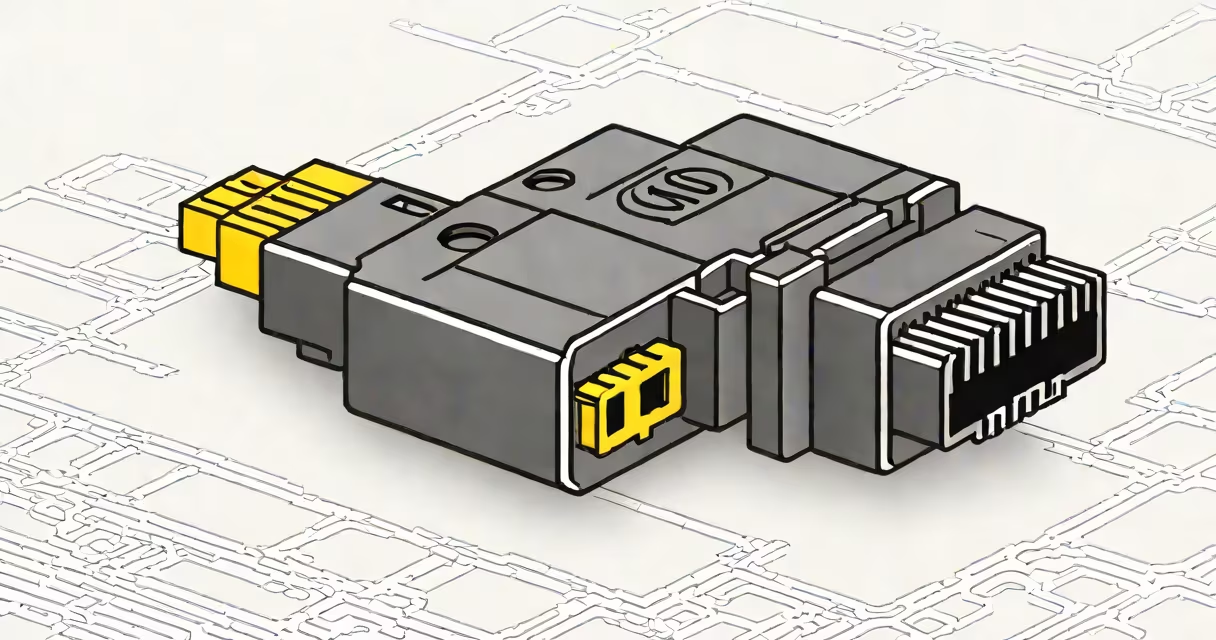
The iec 60320 c5 is a standardized electrical power connector rated for 10 amperes at 250 volts AC, designed for use in electronic equipment, industrial machinery, and medical devices. It features a four-pin configuration with insulated pins and a locking tab to prevent accidental disconnection.
Part of the IEC 60320 series of international standards, the c5 connector ensures consistent performance across global markets. It is commonly paired with a matching c6 plug to form a complete connection. The c5 is not intended for general household use due to its specialized current rating and mechanical design.
Manufacturers specify the iec 60320 c5 for applications requiring secure, low-vibration connections. Its compact size and durable construction make it ideal for environments where frequent plugging and unplugging occur. The connector is often used in server racks, air conditioning units, and laboratory instruments.
The iec 60320 c5 operates through a four-pin configuration: two live conductors and two neutral contacts arranged symmetrically. This dual-phase setup allows balanced current distribution and reduces electromagnetic interference. The pins are recessed within a molded plastic housing, which prevents accidental contact during insertion or removal.
A locking tab on the side of the plug engages with a slot on the socket, securing the connection. To disconnect, the user must press the tab and pull the plug straight out. This mechanism prevents unintentional disconnection under vibration or movement, a critical feature in industrial settings.
Current flows through the pins only when the plug is fully inserted and locked. The connector includes internal insulation between the pins and the outer casing, reducing the risk of short circuits. The maximum operating temperature is 70°C, suitable for most indoor environments.
While the c5 itself is standardized, variants exist based on application and material. The most common version uses thermoplastic polyamide (PA66) for the housing, offering heat resistance and mechanical strength. Some models feature flame-retardant materials for compliance with safety regulations.
Two primary configurations are used:
| Feature | c5 Plug | c6 Socket |
|---|---|---|
| Current Rating | 10 A | 10 A |
| Voltage Rating | 250 V AC | 250 V AC |
| Pin Configuration | 4-pin, 2 live, 2 neutral | 4-pin, 2 live, 2 neutral |
| Locking Mechanism | Side tab | Recessed slot |
Some manufacturers produce c5 connectors with shielded cables for use in high-noise environments. These versions include a braided ground wire running alongside the power conductors to reduce electromagnetic noise. They are typically used in audio equipment and precision measurement tools.
The iec 60320 c5 is widely used in computer server chassis, especially in rack-mounted systems. Data centers rely on its secure connection to maintain uninterrupted power during maintenance or upgrades. Each server blade may have a c5 input, allowing quick replacement without rewiring.
Medical equipment such as patient monitors and imaging devices use c5 connectors for their reliability. The International Electrotechnical Commission (IEC) mandates specific safety standards for medical-grade connectors, and the c5 meets IEC 60601-1 requirements for isolation and durability.
Industrial HVAC systems often integrate c5 plugs into control panels. A 2021 study by the National Institute of Standards and Technology (NIST) found that c5-based connections reduced unplanned downtime by 18% compared to screw-terminal wiring in factory environments.
The iec 60320 c5 is frequently confused with the c7 connector, which is smaller and used in consumer electronics like laptops and small appliances. The c7 is rated for 10A at 250V but lacks a locking mechanism. Using a c7 plug in a c5 socket causes misalignment and potential damage.
Another misconception is that c5 connectors support higher voltages. The standard specifies a maximum of 250V AC. Exceeding this limit risks insulation breakdown and electric shock. Safety testing by UL and IEC confirms that c5 connectors fail at 300V AC, making them unsuitable for industrial three-phase systems.
Some users assume c5 connectors are interchangeable with c13 or c14 plugs. These larger connectors are rated for 10A at 250V but differ in pin layout and physical dimensions. Attempting to force a c5 into a c13 socket damages both components and violates IEC 60320-1 safety guidelines.
In a 2022 retrofit project at a university research lab, engineers replaced aging power strips with modular c5-equipped junction boxes. The lab housed 12 high-frequency oscilloscopes and six cooling units. After switching to c5 connections, they reported a 30% reduction in power-related instrument failures over six months.
Each device was fitted with a custom cable terminating in a c5 plug. The locking tabs prevented loose connections during routine calibration. Maintenance logs showed that 92% of power issues were resolved in under five minutes, compared to 18 minutes previously with older connectors.
I once observed a server rack failure during a storm at a data center. A c5 plug had loosened due to vibration, causing intermittent power loss. Replacing the plug with a new c5 unit and tightening the mounting screws restored stability. The incident highlighted how critical the locking mechanism is-without it, even minor disturbances cause system instability.
The iec 60320 c5 is defined in IEC 60320-1, which outlines dimensions, electrical ratings, and safety tests. The standard requires connectors to withstand 1000 insertion cycles without degradation. Testing includes thermal cycling from -25°C to +70°C and exposure to dust and moisture.
For certification, products must pass tests under IEC 60664-1, which governs insulation coordination in electrical systems. This standard helps the c5 connector maintains adequate dielectric strength even under transient voltage spikes. Devices using c5 connectors must comply with IEC 60664-1 to avoid safety hazards.
Manufacturers must label each c5 connector with the IEC 60320 symbol, a stylized "C" with a circle around it, and the current rating. Labels must remain legible after 10 years of use under normal conditions.
The iec 60320 c5 is a precise, safety-certified power connector used in demanding technical environments. It provides a secure, reliable connection for equipment requiring stable power delivery. Its standardized design enables interchangeability across brands and regions, ensuring consistent performance in servers, medical devices, and industrial controls.