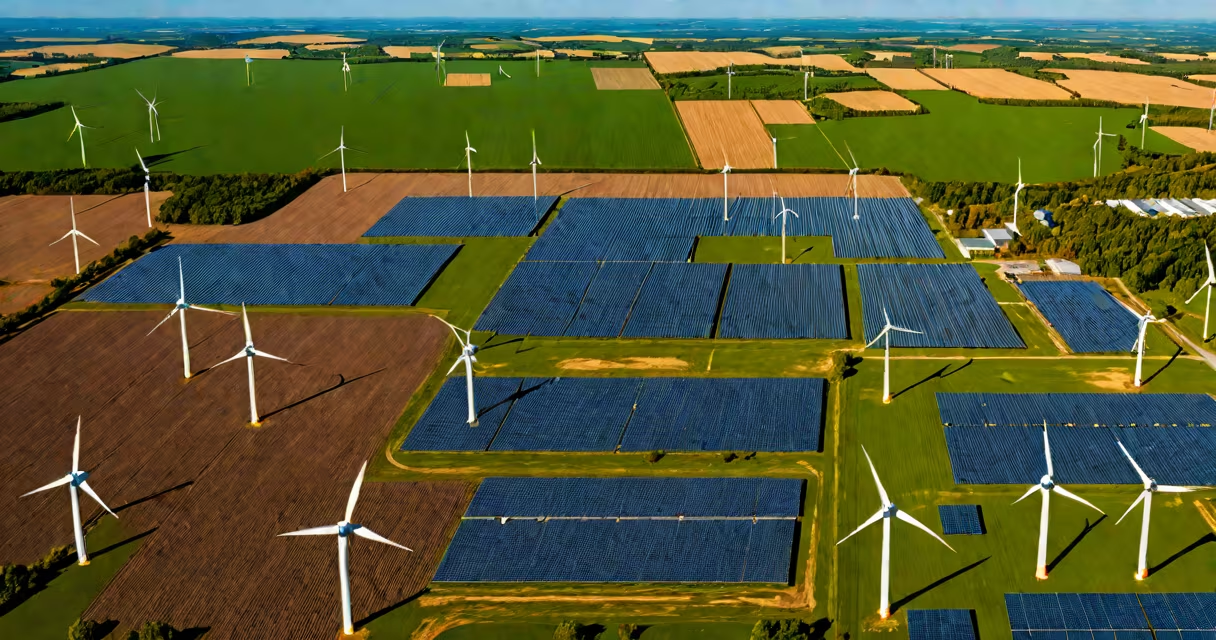
Renewable energy converts natural flows-sunlight, wind, water movement, and heat from Earth's core-into electricity or heat without depleting finite resources or emitting carbon during operation. This process powers homes, industries, and transportation through technologies like photovoltaic panels, wind turbines, and hydroelectric dams.
Electricity from renewable sources begins with capturing energy from nature. Solar panels absorb sunlight and convert it directly into direct current (DC) electricity using semiconductor materials like silicon. Wind turbines capture kinetic energy from moving air, turning blades connected to generators that produce alternating current (AC). Hydropower plants channel flowing water through turbines, spinning them to generate electricity. Geothermal systems tap underground steam or hot water to drive turbines.
These energy sources feed into electrical grids or operate independently in off-grid systems. Grid-connected systems send power to distribution networks, where utilities balance supply and demand. Off-grid setups rely on batteries to store excess energy for use when generation drops. For example, a residential solar system in California may produce 6 kilowatt-hours (kWh) on a sunny day, storing surplus in lithium-ion batteries for nighttime use.
Renewable energy systems fall into four main categories based on their primary resource:
| Source | Conversion Method | Typical Scale | Example Application |
|---|---|---|---|
| Solar | Photovoltaic cells or concentrated solar thermal | Residential to utility-scale | Roof-mounted panels in Germany, solar farms in Rajasthan, India |
| Wind | Rotating blades driving electric generators | Onshore or offshore clusters | Offshore wind farms in Denmark, onshore arrays in Texas |
| Hydropower | Water flow turns turbine blades | Small run-of-river to massive dams | Three Gorges Dam in China, micro-hydro in Nepal |
| Geothermal | Steam or hot water drives turbines | Local district heating or grid-connected plants | Geothermal plants in Iceland, ground-source heat pumps in Sweden |
Each system requires site-specific conditions. Solar needs consistent sunlight; wind depends on steady airflow; hydropower requires flowing rivers or reservoirs; geothermal demands accessible underground heat. A 100-megawatt (MW) solar farm in Nevada generates about 200 gigawatt-hours (GWh) annually-enough to power roughly 40,000 homes-based on average insolation levels.
Renewable energy doesn't always align with energy demand. Sunlight fades at dusk; wind slows overnight. This mismatch creates challenges known as intermittency. The solution lies in grid management tools and storage.
Grid operators use forecasting models to predict output. For example, the National Renewable Energy Laboratory (NREL) uses machine learning to forecast solar generation across U.S. states with 90% accuracy over 24 hours. When supply exceeds demand, excess power can be stored in batteries or redirected to industrial users. When supply falls short, backup sources-like natural gas peaker plants or imported electricity-step in.
Battery storage systems have grown rapidly. Tesla's Hornsdale Power Reserve in South Australia, a 150 MW/194 MWh lithium-ion installation, reduced grid instability events by 90% after commissioning in 2017. It responds within milliseconds to frequency fluctuations, stabilizing the network.
Many assume renewable energy is inherently unreliable. But data from the U.S. Energy Information Administration (EIA) shows renewables supplied 22% of U.S. electricity in 2023, with wind and solar contributing 13% combined. In countries like Uruguay and Costa Rica, renewables provide over 95% of national electricity needs daily.
Another misconception is that renewable systems require constant maintenance. Modern solar panels last 25-30 years with minimal upkeep. A study by the Fraunhofer Institute found that solar installations in Germany required only 0.5% annual maintenance cost relative to installed capacity-well below fossil fuel plants.
Some confuse "renewable" with "zero-emission." While operational emissions are near zero, manufacturing and disposal do emit CO₂. Producing a single solar panel generates about 40 kg of CO₂ equivalent-equivalent to driving a car 200 km. However, over its lifetime, a panel offsets 20 times that amount through clean power generation.
In 2021, a village in western Kenya installed a hybrid renewable system combining 15 kW solar panels and a 5 kW wind turbine. The system charges a 24 kWh battery bank each day. During peak daylight, solar provides 80% of the load. At night, wind supplements battery discharge. When both sources fail, a diesel generator kicks in-but only for 2 hours per week on average.
The system powers 30 homes, a clinic, and a school. Monthly electricity costs dropped from $15 per household (using kerosene) to $3. Over five years, the community saved $12,000 in fuel and health expenses related to indoor air pollution. This model demonstrates how decentralized renewable energy improves access and reduces poverty-related energy burdens.
I built a similar off-grid solar setup for a remote cabin in Montana. Using a 3-kW range and a 12-kWh battery bank, I powered lights, a refrigerator, and a small heater. The system ran reliably for two winters, even with snow cover-thanks to tilt adjustment and temperature compensation in the charge controller.
Intermittency remains a key challenge. Solutions include smart grids, demand response programs, and green hydrogen production. Excess solar power can split water into hydrogen and oxygen via electrolysis. The hydrogen stores energy long-term and can later fuel vehicles or power gas turbines. Germany's "Hydrogen Valley" project plans to deploy 100 MW of electrolyzers by 2025.
How do we use renewable energy? By converting natural flows into usable electricity through targeted technologies, integrating them into grids with storage and forecasting, and scaling systems responsibly. The shift is underway-not as a replacement for existing systems, but as a foundation for resilient, low-carbon energy.