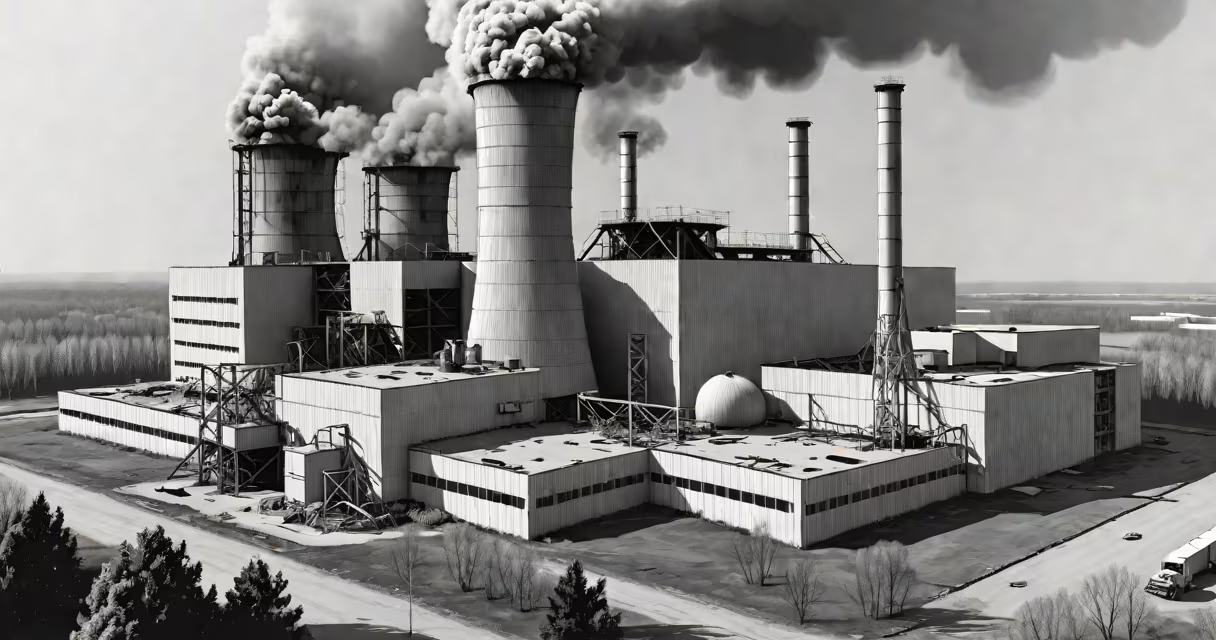
The Chernobyl disaster occurred on April 26, 1986, when Reactor No. 4 at the Chernobyl Nuclear Power Plant in Ukraine exploded during a routine safety test, releasing massive amounts of radioactive material into the atmosphere. The event resulted from a combination of flawed reactor design, inadequate safety protocols, and human error during operations.
The RBMK-1000 reactor at Chernobyl used graphite as a neutron moderator and water as a coolant. Unlike Western pressurized water reactors, the RBMK had a positive void coefficient-a dangerous instability where steam bubbles in the coolant reduced neutron absorption, causing power to spike uncontrollably. This flaw was known to Soviet engineers but not addressed due to political and technical inertia.
On the night of the incident, operators conducted a test to see if the turbine's residual rotation could provide enough power to keep cooling systems running during a blackout. They disabled multiple automatic safety systems to reduce power levels. When the reactor dropped below 700 megawatts thermal, the core became unstable. Operators then inserted control rods too quickly, triggering a sudden surge in power that ruptured fuel channels and caused a steam explosion. A second explosion blew off the reactor's 1,000-ton cover, exposing the core to the air.
Three interlocking causes led to the disaster: reactor design, operational decisions, and organizational culture. The RBMK reactor's positive void coefficient meant that as coolant boiled, reactivity increased-an inverse behavior compared to most reactors. This made the reactor inherently unstable at low power levels.
Operators bypassed safety systems and ignored warning signs. The test required the reactor to run at low power, but the team failed to maintain stable conditions. When they attempted to insert control rods, the design caused a brief but intense power surge-up to 100 times normal-before the rods fully engaged. The rods' graphite tips initially increased reactivity before suppressing it, worsening the situation.
After the explosions, the exposed core burned for nine days, releasing radiation equivalent to 400 Hiroshima bombs. Winds carried fallout across Europe, contaminating large areas of Belarus, Ukraine, and Russia. Immediate evacuation of Pripyat began within hours, and over 100,000 people were relocated from the exclusion zone.
| Factor | Description | Impact |
|---|---|---|
| Reactor Design | RBMK-1000 with positive void coefficient | Power surged when coolant boiled, leading to uncontrolled chain reaction |
| Operator Actions | Bypassed safety systems; ran test at low power | Reduced stability and triggered cascade failure |
| Organizational Culture | Pressure to meet production targets; lack of transparency | Delayed reporting and poor emergency response |
Many assume the Chernobyl disaster was caused solely by a single mistake. In reality, it was the convergence of multiple failures. The myth that the reactor "melted down" oversimplifies the event-the core didn't melt through the floor; it exploded and burned in the open air.
Another widespread belief is that the Soviet government knew about the risks. Internal documents show engineers warned of the RBMK's instability as early as 1976. However, the Ministry of Medium Machine Building suppressed reports and continued construction. Safety improvements were delayed until after the accident.
A lesser-known fact is that the graphite fire burned for nearly ten days. Radioactive particles coated the firemen who fought it, many of whom died within months. The fire was extinguished using sand, lead, and boron dropped from helicopters-materials chosen for their ability to absorb neutrons and suppress fission.
Health effects included acute radiation sickness in 134 plant workers and firefighters, 28 of whom died within months. Long-term studies by the World Health Organization (WHO) estimate over 4,000 additional cancer cases may result from exposure, though direct attribution remains complex due to population mobility and varying dosages.
The exclusion zone remains restricted. As of 2023, the New Safe Confinement structure-completed in 2016-covers the destroyed reactor. This $2 billion steel arch shelters the site, preventing further release of contamination and allowing safe dismantling work.
I visited the Chernobyl Exclusion Zone in 2019. Walking through Pripyat's abandoned schoolyard, I saw a child's backpack left behind in a classroom. The silence was overwhelming. That moment underscored how deeply the disaster disrupted lives-not just through radiation, but through loss, displacement, and collective trauma.
Chernobyl prompted global reforms. The International Atomic Energy Agency (IAEA) updated safety standards, requiring independent oversight and mandatory risk assessments. Today's reactors are designed with negative feedback loops, passive cooling, and fail-safe mechanisms absent in 1986.
For example, the AP1000 reactor uses gravity-fed water tanks that automatically cool the core in emergencies-no human intervention needed. These features stem directly from lessons learned at Chernobyl.
Understanding how Chernobyl happened isn't just historical-it informs current nuclear policy. The Fukushima Daiichi accident in 2011 shared similarities: underestimated natural hazards, reliance on manual responses, and delayed emergency actions. Both events show the danger of assuming safety margins are infinite.
Today, nuclear facilities worldwide implement stricter training, simulation drills, and real-time monitoring. The goal is not to eliminate risk entirely-impossible-but to build systems resilient to human and mechanical error.
Learning how Chernobyl happened reveals that disasters aren't accidents. They're outcomes of choices, constraints, and cultures that allow danger to accumulate. The event remains a benchmark for engineering ethics and crisis management.