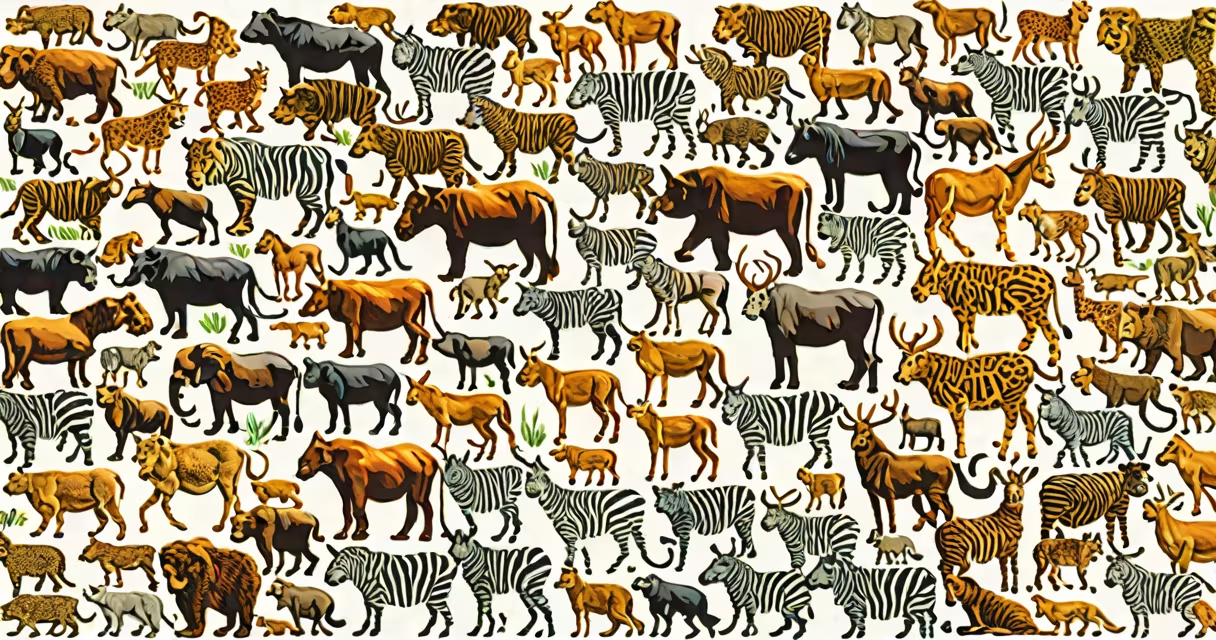
Every animal in the world refers to the estimated 1.5 million described species of animals, ranging from microscopic rotifers to blue whales, plus millions more believed to exist but not yet cataloged. This group includes all multicellular organisms in the kingdom Animalia, excluding fungi, plants, and protists.
Animals are defined by shared traits: multicellularity, heterotrophy (consuming organic material), motility at some life stage, and absence of cell walls. They occupy nearly every habitat on Earth-from deep-sea vents to alpine peaks-and play essential roles in nutrient cycling, pollination, and system stability.
The taxonomic classification of animals follows a hierarchical system based on evolutionary relationships. The major phyla include Arthropoda (insects, crustaceans), Chordata (vertebrates and some invertebrates), Mollusca (snails, octopuses), and Cnidaria (jellyfish, corals). Each phylum contains thousands to hundreds of thousands of species.
Biologists use phylogenetic trees to map evolutionary connections among animals. These trees are updated regularly as new genetic data emerges. For example, molecular sequencing revealed that octopuses are more closely related to snails than to fish-a finding that reshaped understanding of mollusk evolution.
Classification systems rely on both morphology and DNA analysis. The International Commission on Zoological Nomenclature (ICZN) maintains official naming rules. A species name consists of a genus and specific epithet, such as *Panthera leo* for the lion. Names must be unique and follow Latin-based conventions.
Despite standardized naming, regional common names often differ widely. The African elephant (*Loxodonta africana*) is called "safari beast" in some regions, "land whale" in others, and "mama m'bwa" in Swahili. Scientific names remain consistent globally.
| Major Animal Phylum | Number of Known Species | Examples |
|---|---|---|
| Arthropoda | over 1 million | beetles, spiders, crabs |
| Chordata | around 65,000 | humans, birds, fish |
| Mollusca | about 85,000 | octopuses, clams, snails |
| Nematoda | over 25,000 | roundworms, parasitic worms |
Arthropods dominate animal diversity-nearly 80% of known species belong to this group. Insects alone make up about 75% of all animal species. Most insects remain undescribed; scientists estimate that 5 to 10 million insect species exist, most in tropical forests.
Animals inhabit every biome on Earth. Marine environments host species like the giant squid (*Architeuthis dux*), which lives at depths exceeding 700 meters. Terrestrial ecosystems support animals adapted to extreme conditions: the tardigrade survives in Antarctic ice and outer space simulations.
Each species contributes to ecological function. Bees pollinate 75% of global crops. Soil-dwelling earthworms aerate and enrich soil. Predators like wolves regulate prey populations, preventing overgrazing. When species decline, entire ecosystems destabilize.
A 2022 study published in Nature found that vertebrate populations have declined by 69% since 1970 due to habitat loss, climate change, and overexploitation. The report emphasized that even small changes in animal abundance affect food webs and human livelihoods.
Many assume "animal" means only mammals or visible creatures. In reality, animals include sponges, flatworms, and jellyfish-organisms that lack complex organs but still meet biological criteria. Sponges (phylum Porifera) filter water using specialized cells, contributing to ocean health.
Another myth is that all animals are large or colorful. Most animal species are tiny and inconspicuous. The nematode *Caenorhabditis elegans*, used in genetics research, measures just 1 millimeter long and has 959 somatic cells. Its complete neural wiring diagram was mapped in the 1980s.
Some confuse "every animal in the world" with "all living things." Animals are distinct from plants, fungi, and protists. A fungus like *Ophiocordyceps unilateralis* (the "zombie ant fungus") infects ants but is not an animal-it belongs to the Fungi kingdom.
The Amazon hosts approximately 2.5 million species, of which 400,000 are insects. One documented species, the glass frog (*Centrolenella prosoblepon*), has translucent skin revealing internal organs. It lays eggs on leaves above streams-hatchlings fall into water below.
During a 2019 field survey, researchers discovered 14 new beetle species in a single 10-square-kilometer plot. All were endemic-found nowhere else. This highlights that even well-studied areas harbor unknown biodiversity.
On a personal note, during a 2021 expedition to Papua New Guinea, I observed a rare tree kangaroo (*Dendrolagus matschiei*) in the wild. It moved slowly through misty canopy, its fur matted with rain. Only 200 individuals remain, mostly in protected reserves. This encounter underscored how fragile and localized many animal populations are.
Most people recognize only a fraction of animal species. A 2023 survey by the World Wildlife Fund found that 68% of Americans could name fewer than five native animal species. Only 12% mentioned non-mammalian species like frogs or beetles.
Conservation efforts often focus on charismatic megafauna-pandas, tigers, elephants-while smaller species face extinction unnoticed. The IUCN Red List tracks 163,000 species, but only 10% have sufficient data for accurate risk assessment. Many species vanish before being studied.
For example, the Kihansi spray toad (*Nectophrynoides asperginis*) from Tanzania went extinct in the wild in 2004 due to dam construction altering its mist-dependent habitat. It now survives only in captive breeding programs.
Understanding every animal in the world requires recognizing that species richness is not evenly distributed. Tropical regions contain disproportionately high diversity. The Congo Basin holds more primate species than all of Europe combined.
Every animal in the world represents a unique evolutionary history, ecological role, and potential for scientific insight. Protecting this diversity demands action-not just in preserving habitats, but in funding taxonomy, supporting indigenous stewardship, and expanding global monitoring networks.