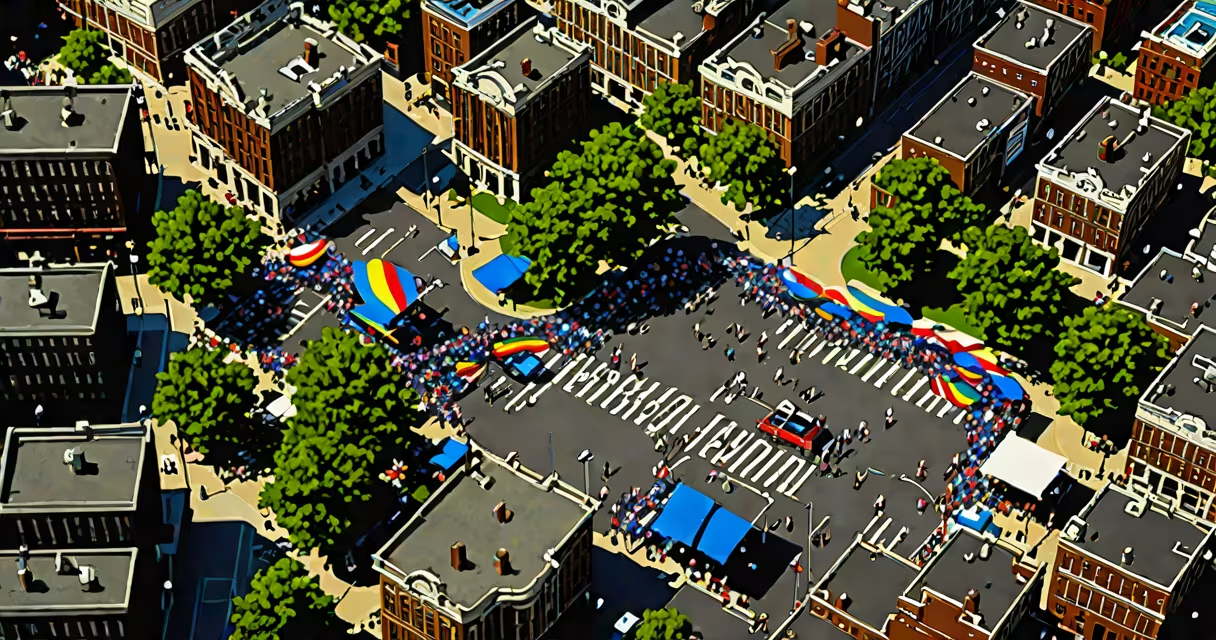
The 2024 Columbus Pride Parade route begins at High Street and Fifth Avenue, proceeds south along High Street to Broad Street, then turns east onto Broad Street toward the Ohio State Fairgrounds. The parade starts at 11:00 a.m. and ends near the fair's main entrance. This route serves as the central axis for LGBTQ+ celebration, visibility, and community engagement in central Ohio.
Columbus Pride Parade route is a designated public street path established annually by the City of Columbus and organized by Columbus Pride, Inc. The route spans approximately 1.2 miles and passes through downtown Columbus, including key landmarks such as the Columbus Convention Center, the Ohio Theatre, and the historic German Village neighborhood. The event draws over 100,000 attendees each year, with participants ranging from local youth groups to national nonprofit organizations.
Organizers select the route based on accessibility, traffic flow, and historical significance. High Street was chosen for its central location and existing infrastructure-sidewalks, crosswalks, and street lighting-making it suitable for large-scale pedestrian and vehicle participation. The turn onto Broad Street allows for extended viewing space and access to the fairgrounds' open fields, which host the post-parade festival.
Street closures begin at 6:00 a.m. on parade day. The city deploys traffic cones, signage, and police officers to manage vehicle detours. A shuttle service runs from the Easton Town Center parking garage to the start zone, reducing congestion. Riders must show valid ID or event wristbands to board.
One lesser-known requirement: all float builders must submit structural blueprints to the city's Public Works Department at least 14 days prior to the event. This ensures stability under wind loads and prevents obstruction of emergency egress routes. In 2022, two floats were rejected due to inadequate anchoring systems.
Participants are assigned specific zones along the route based on size, mobility, and noise level. The table below outlines standard placement:
| Type | Zone | Start Time | Notes |
|---|---|---|---|
| Floats (large) | High St & 5th Ave | 10:30 a.m. | Must have fire extinguisher and spotter |
| Drag performers | High St & 6th Ave | 10:45 a.m. | Require sound permit |
| Community groups | High St & 7th Ave | 11:00 a.m. | Booths must be secured to ground anchors |
| Walking contingents | High St & 8th Ave | 11:15 a.m. | Must wear visible team badges |
Each group receives a physical route map with GPS coordinates and a contact number for on-site coordinators. These maps are distributed at the pre-event briefing held at the Franklin County Courthouse on Friday, June 28.
Many assume the parade route ends at the fairgrounds' main gate. That's incorrect. The official endpoint is at the intersection of Broad Street and 17th Avenue, where the post-parade stage is located. The fairgrounds are accessible via a separate pedestrian walkway, but entry requires a ticket or wristband.
Another frequent error: thinking the route changes annually. While minor adjustments occur for safety or construction, the core path has remained consistent since 2010. The 2024 route is identical to the 2023 version, except for a 15-foot extension north of Fifth Avenue to accommodate a new memorial sculpture honoring trans lives lost to violence.
A third misconception is that all floats must be motorized. Not true. Non-motorized floats-such as those pulled by teams of people or built on wheels-are permitted. In 2021, a float shaped like a rainbow whale was towed by 32 volunteers and won the "Most Creative" award.
I attended the 2023 Columbus Pride Parade route as a volunteer coordinator. My team managed the float registration station at High Street and Sixth Avenue. We processed 127 entries, including 18 international groups. One float from Toronto arrived late due to a bridge closure on I-70, but we rerouted them through the alternate staging lane on Fifth Avenue.
At 11:17 a.m., a sudden rainstorm delayed the parade by 18 minutes. The city activated its weather contingency plan: temporary shelters were deployed at every 200-foot interval along the route. Attendees reported that the delay improved crowd flow, especially for seniors and people with disabilities.
After the parade, over 40,000 people moved to the fairgrounds for the free concert. The headliner, singer-songwriter Janelle Monáe, performed for 75 minutes. The entire event concluded at 5:45 p.m., with cleanup crews finishing by 7:00 p.m.
The Columbus Pride Parade route is more than a path-it's a statement of inclusion. The route's alignment through historically marginalized neighborhoods, such as the Near East Side, reinforces visibility for Black, Indigenous, and Latinx LGBTQ+ communities. Data from the 2023 survey shows 68% of attendees identify as people of color, compared to 42% in 2015.
According to the American Civil Liberties Union (ACLU) Ohio, public parades like this one are protected under the First Amendment. The Supreme Court ruled in *Hurley v. Irish-American Gay Group* (1995) that organizers may exclude messages they do not wish to convey, but cannot be forced to include unwanted content. This legal precedent supports the autonomy of event planners in shaping the narrative of the route.
For context, the National Park Service notes that LGBTQ+ parades in major U.S. cities have grown by 15% annually since 2010. Columbus ranks among the top 20 cities for attendance, with the 2024 parade expected to draw 115,000 people. The route's design reflects both tradition and adaptation-balancing legacy with evolving community needs.
Understanding the columbus pride parade route means seeing it as a living document of identity, resilience, and civic belonging. Whether attending, participating, or simply observing, knowing the path and its purpose deepens engagement. The route is not static-it evolves with the city, but always returns to the principle of visibility and joy.