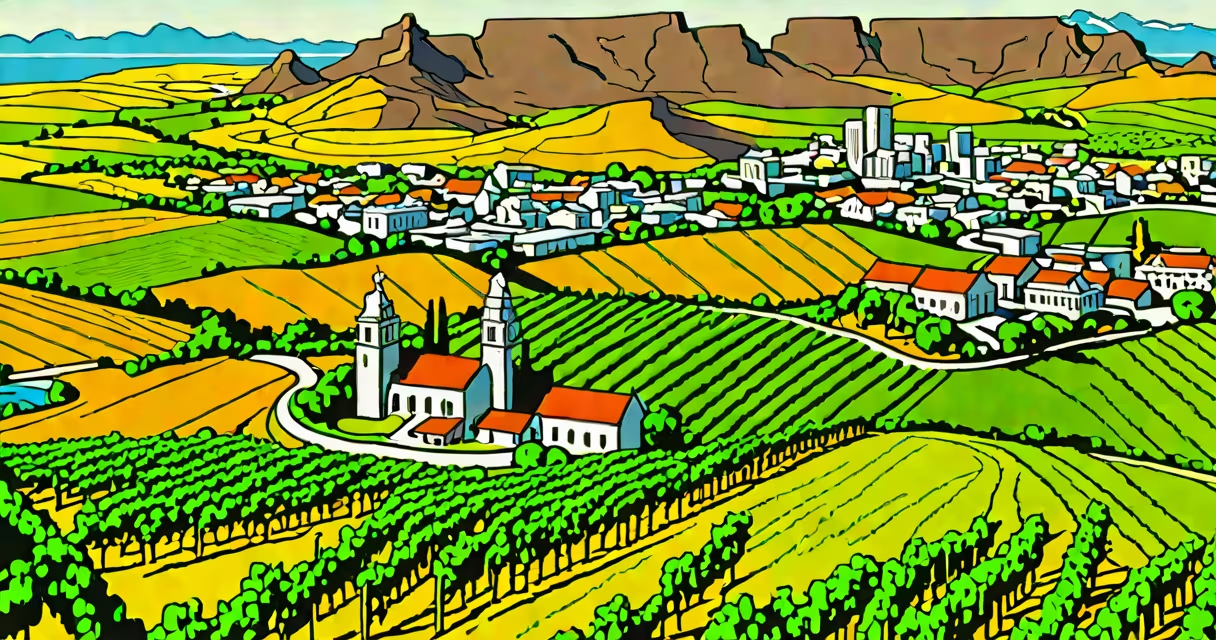
Cape Town Country refers to the rural and semi-rural areas surrounding the city of Cape Town, encompassing the Western Cape's vineyards, mountain passes, coastal towns, and farming regions. These areas extend from the Cape Winelands in the north to Hermanus and the Overberg in the south, forming a diverse field shaped by Mediterranean climate, fertile soil, and centuries of agricultural use.
Unlike urban Cape Town, which centers on the city proper and its immediate suburbs, Cape Town Country emphasizes natural beauty, regional culture, and outdoor recreation. It includes towns like Stellenbosch, Franschhoek, and Plettenberg Bay, where heritage architecture, local food, and wine production define daily life. The region supports agriculture, viticulture, and ecotourism, making it a destination for travelers seeking authenticity beyond city attractions.
According to South Africa's Department of Tourism, over 60% of domestic holidaymakers visiting Cape Town explore at least one area classified as "rural" or "country" within the Western Cape. This reflects growing interest in off-the-beaten-path experiences, such as farm stays, guided nature walks, and wine tastings in historic cellars.
The region functions through a mix of agriculture, tourism infrastructure, and community-based conservation. Most farms operate under commercial licenses issued by the Western Cape Department of Agriculture. Vineyards grow Pinotage, Chenin Blanc, and Cabernet Sauvignon, with harvest seasons running from February to April. Rural tourism relies on guesthouses, B&Bs, and tour operators who coordinate access to private land, often requiring permits for hiking or photography.
Transportation in Cape Town Country is primarily car-dependent. Major roads like the N2 and R31 connect the city to towns such as Hermanus and the Garden Route. Public transit is limited outside major hubs. For example, the MyCiTi bus system serves only central Cape Town, leaving rural areas reliant on personal vehicles or shared shuttles.
A key feature is seasonal access. Some mountain trails, like those leading to the summit of Table Mountain's eastern ridge, close during winter due to erosion risk. Similarly, farm gates in the Swartland region may remain locked between May and August unless visitors book in advance through official channels.
Three distinct zones make up Cape Town Country:
| Zone | Key Features | Examples |
|---|---|---|
| Vineyard & Winelands | Wine tasting, cellar tours, farm-to-table dining | Stellenbosch, Franschhoek, Paarl |
| Coastal & Marine | Whale watching, seaside villages, fishing | Hermanus, Gansbaai, Mossel Bay |
| Mountain & Fynbos | Wildflower hikes, conservation reserves, birdwatching | Kirstenbosch National Botanical Garden, Cederberg, Hottentots Holland Mountains |
Each zone hosts unique ecosystems. The fynbos biome, found in mountainous areas, contains over 9,000 plant species, 70% of which are endemic. The Western Cape's biodiversity is protected under the National Environmental Management: Protected Areas Act (NEMPAA), which restricts development in designated conservation zones.
Franschhoek, for instance, has over 150 registered wineries and 30 restaurants serving locally sourced dishes. A full-day visit to the region typically includes a morning tour of a family-owned estate like La Brière, followed by lunch at a farm kitchen featuring ostrich carpaccio and wild garlic bread.
Many travelers mistake Cape Town Country for a single geographic entity. In reality, it spans nearly 12,000 square kilometers and includes multiple municipalities, languages, and microclimates. The term does not refer to a formal administrative district but rather a cultural and recreational concept.
Another misconception is that all rural areas are safe for unguided exploration. In 2022, the South African Police Service reported 14 incidents of theft or assault in remote farm areas between October and December. Authorities recommend using licensed guides or checking local safety bulletins via the South African Police Service website.
Some assume that rural accommodation is always cheaper. While many guesthouses charge less than city hotels, seasonal pricing varies widely. During whale-watching season (June-November), rates in Hermanus can exceed R2,500 per night for a double room with sea views-higher than comparable urban options.
Consider a visit to the Franschhoek Valley on a weekday in March. A traveler arrives at 9:00 AM at a boutique winery, De Toren, located just off the R45. They book a 10:30 AM tasting session that includes five wines paired with artisan cheese from a nearby dairy. The tasting costs R250 per person and includes a guided walk through the vineyard's organic plots.
At noon, they drive 15 minutes to La Petite Maison, a restaurant housed in a restored 19th-century farmhouse. The menu features springbok fillet with wild herbs and a dessert of honey-roasted apricots. The meal totals R1,200 for two, including a glass of vintage red.
After lunch, they take a 45-minute hike along the Franschhoek Pass trail, a route maintained by the Western Cape Nature Conservation Board. The path crosses a fynbos-rich ravine and ends at a lookout point offering panoramic views of the valley. The entire trip-transport, food, and activities-costs approximately R4,500 for two people, excluding accommodation.
This example illustrates how Cape Town Country blends leisure, culture, and nature. It is not merely a backdrop for city tourists but a functioning regional economy with its own rhythms and regulations.
In 2021, I spent a weekend exploring the Overberg region, driving from Hermanus to the village of Caledon. I stayed at a converted sheep shearing shed turned guesthouse. The owner, a retired farmer, served breakfast with homegrown eggs and fig jam. That evening, we watched southern right whales breach offshore from his porch. The silence was profound-no traffic, no sirens, just wind and waves. It was the most immersive experience I've had in South Africa.
Cape Town Country is used for leisure, education, and economic development. Tourists seek it for relaxation, photography, and authentic interaction with local communities. Schools and universities organize field trips to study ecology, agriculture, and heritage preservation. The Western Cape government promotes it through initiatives like the "Western Cape Rural Tourism Strategy," launched in 2020 to improve signage, internet access, and emergency response in remote areas.
Local residents also benefit. A 2023 study by the Council for Scientific and Industrial Research (CSIR) found that 68% of rural households in the Western Cape rely on tourism income during peak months. This includes guides, artisans, and hospitality staff.
Cape Town Country is not a synonym for "rural South Africa." It is a specific, well-defined region centered on the Western Cape, bounded by the Atlantic Ocean to the west and the Great Karoo to the east. Its identity stems from geography, climate, and historical settlement patterns-not just distance from the city.
Understanding cape town country helps travelers plan meaningful trips, supports sustainable development, and preserves one of South Africa's most biodiverse and culturally rich regions.