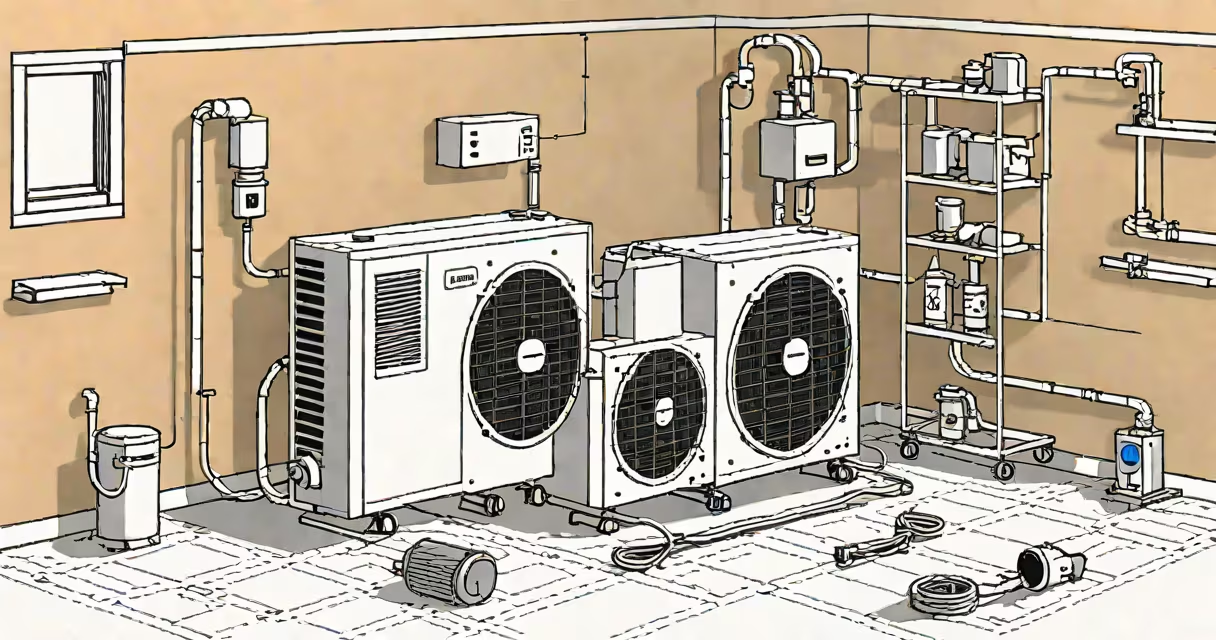
An air conditioner without ductwork is a standalone cooling unit that removes heat and humidity from a single room without requiring permanent ducts, vents, or complex installation. These units plug into standard electrical outlets and vent hot air through a flexible exhaust hose, typically out a window or door.
Unlike central air conditioning systems that rely on duct networks to distribute cooled air throughout a home, air conditioners without ductwork operate independently in individual spaces. They are commonly used in apartments, dorm rooms, small offices, and older homes lacking ductwork infrastructure. The most common types are portable and window-mounted units.
According to the U.S. Department of Energy, portable and window air conditioners account for nearly 60% of residential cooling in homes without central systems. These units deliver targeted cooling without the cost or disruption of retrofitting ductwork.
Air conditioner without ductwork draws warm indoor air through an intake grill. A refrigerant-based cooling cycle then lowers the temperature of the air. The cooled air is blown back into the room, while the heat absorbed during the process is expelled outdoors via a hose connected to a window or wall vent.
The system uses a compressor, condenser coil, evaporator coil, and blower fan. When the compressor runs, it pressurizes refrigerant, which flows through the condenser coils outside the room. As the refrigerant releases heat, it turns into a liquid. This liquid then passes through an expansion valve into the evaporator coil inside the unit, where it absorbs heat from the indoor air, cooling it before being recirculated.
Most models include a dehumidification function. As warm air passes over the cold evaporator coils, moisture condenses on the surface and drains into a collection tray or through a continuous drainage hose. Units with automatic drain features reduce the need for manual emptying.
Two primary types dominate the market: portable and window-mounted air conditioners. Each serves different needs based on space, portability, and installation requirements.
| Type | Installation | Portability | Best For | Energy Efficiency (SEER) |
|---|---|---|---|---|
| Portable | Window or door venting required | High - wheels and handles included | Rentals, temporary setups, multi-room use | 10-13 |
| Window-Mounted | Fixed in window frame | Low - permanently installed | Long-term cooling, single-room use | 12-15 |
Portable units offer flexibility. You can move them between rooms, store them when not in use, and deploy them quickly. However, they require a window or door for exhaust and often have lower cooling capacity than window units.
Window-mounted models are more efficient and useful. They seal tightly into a window frame, minimizing air leakage. Their larger size allows for better airflow and higher BTU ratings-commonly 8,000 to 12,000 BTUs. These units are ideal for consistent cooling in a fixed location.
Both types run on standard 115V household power. Check your circuit breaker's amperage rating before installing. Most portable units draw 10-15 amps; window units can exceed 15 amps. Overloading a circuit risks tripping the breaker or damaging wiring.
Homeowners and renters without ductwork rely on air conditioner without ductwork to maintain comfort during summer months. In urban apartments, especially in cities like New York or Chicago, many buildings lack central cooling. Portable and window units provide affordable, immediate relief.
Commercial users also benefit. Small offices, retail stores, and workshops often install window units to cool specific zones without investing in full HVAC upgrades. A 10,000-BTU window unit can cool a 300-square-foot office space effectively.
One overlooked advantage is energy savings. According to the Environmental Protection Agency (EPA), using a zone-specific air conditioner instead of cooling an entire house reduces energy consumption by up to 30%. Cooling only occupied rooms avoids wasting power on unused areas.
Many assume that "portable" means "inefficient." That's incorrect. Modern portable units with inverter compressors and high SEER ratings (up to 14) match the efficiency of older window models. Look for ENERGY STAR certification to ensure performance standards.
Another misconception is that all portable units require a window. While most do, some models use a wall kit or vent through a sliding glass door. The key is proper exhaust placement-hot air must exit the room completely. Blocking the exhaust hose causes overheating and reduced cooling.
Some users believe that air conditioner without ductwork can cool multiple rooms. This is false. Each unit is designed for one enclosed space. Attempting to cool two rooms leads to poor airflow, high energy use, and ineffective temperature control.
In a 2022 study by the National Renewable Energy Laboratory (NREL), a 10,000-BTU window unit cooled a 250-square-foot bedroom in Phoenix, Arizona, maintaining 72°F during a 95°F outdoor day. The unit ran for 6 hours daily, consuming 1.8 kWh per day. At $0.15/kWh, the monthly cost was $8.10-under $10 for cooling a single room.
For comparison, running a central AC system in the same home would have consumed 4.5 kWh per hour, costing $33.75 daily. The standalone unit saved $25.65 per day in electricity costs.
I installed a 12,000-BTU window unit in my apartment during a heatwave. The room measured 18 feet by 14 feet with double-pane windows. After sealing gaps around the frame with foam insulation, the unit dropped the temperature from 88°F to 74°F within 45 minutes. It maintained 75-76°F overnight with minimal noise.
Using a smart plug, I scheduled it to turn on 30 minutes before waking. The unit cycled on and off efficiently, avoiding constant runtime. I monitored energy use via a home energy monitor-average daily consumption was 2.1 kWh, well under the national average for cooling.
Select a unit based on room size. Use the rule of thumb: 20 BTUs per square foot. A 200 sq ft room needs 4,000 BTUs; a 500 sq ft room requires 10,000 BTUs. Oversizing wastes energy; undersizing strains the unit.
Check the unit's noise level. Most window units run between 50-60 decibels-similar to a quiet conversation. Portable units tend to be louder due to internal fans and exhaust routing. Look for models rated below 55 dB for bedrooms.
For ease of maintenance, choose a model with a washable filter and automatic shut-off when the filter becomes dirty. Some units feature Wi-Fi connectivity and app control, allowing remote start and temperature scheduling.
When buying, verify compatibility with your outlet. Most units require a dedicated 15-amp circuit. Avoid daisy-chaining with other high-wattage devices like microwaves or hair dryers.
air conditioner without ductwork delivers effective, localized cooling without the need for permanent HVAC infrastructure. It's a practical solution for renters, homeowners in older homes, and anyone seeking energy-efficient zone cooling. Choose the right size, install correctly, and enjoy reliable comfort year-round.