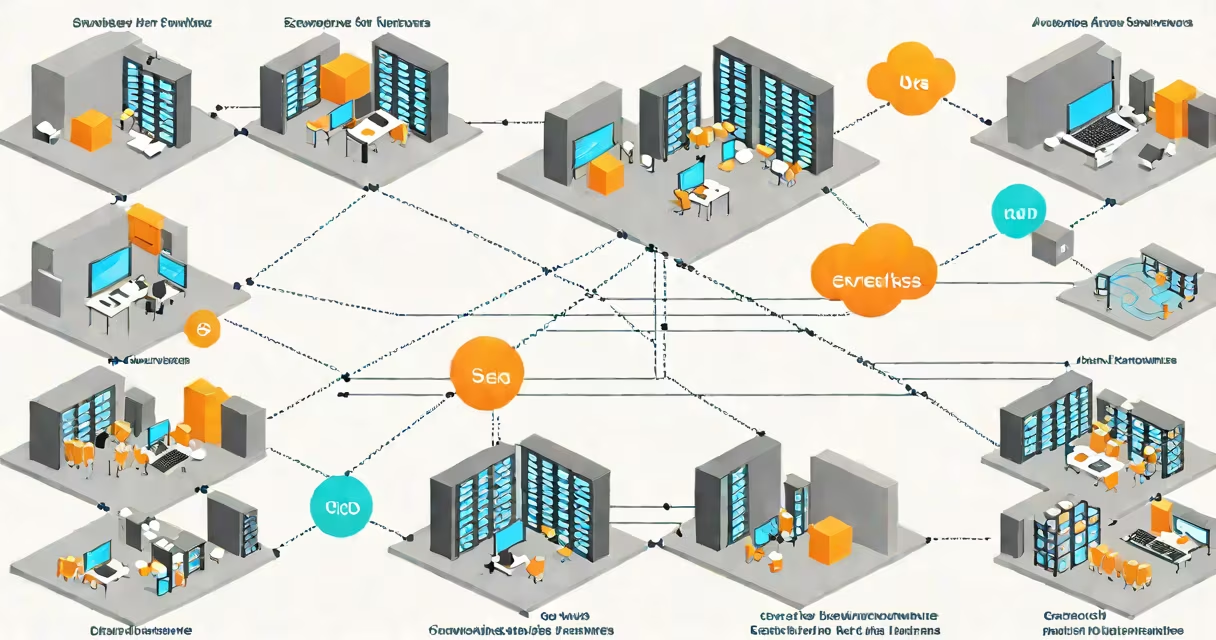
Serverless architecture is a cloud computing model where the provider dynamically manages the allocation and provisioning of servers. You pay only for the compute time your code consumes, and the infrastructure scales automatically based on demand. This eliminates the need to provision, manage, or scale servers manually.
Unlike traditional deployments that require dedicated virtual machines or containers, serverless runs code in response to events-such as HTTP requests, file uploads, or database changes-without maintaining a persistent runtime environment. The model is designed around functions, often called "functions as a service" (FaaS), where developers deploy small, stateless units of logic.
Major providers like AWS, Google Cloud, and Microsoft Azure offer serverless platforms. AWS Lambda is the most widely adopted, enabling execution of code in response to triggers while automatically managing capacity, networking, and security. This allows teams to focus on business logic rather than infrastructure maintenance.
When an event occurs-like a user uploading a photo to a web app-the system triggers a function. The cloud provider allocates resources instantly, executes the code, and then deallocates them when done. There's no idle server running 24/7.
Each function runs in isolation. Input data is passed via parameters, and output is returned through a response or stored in a database. Functions are stateless by design-any persistent data must be stored externally in services like Amazon S3, DynamoDB, or RDS.
For example, when a user submits a form on a website, the frontend sends the data to an API endpoint. That endpoint invokes an AWS Lambda function, which validates the input, saves it to a database, and sends a confirmation email using Amazon SES. All within seconds-and no server was ever explicitly managed.
Serverless architecture relies on three key layers:
Not all serverless implementations are equal. Some systems use container-based serverless (like AWS Fargate or Google Cloud Run), which allow longer-running processes. But pure serverless-especially FaaS-has strict execution limits: maximum 15 minutes per invocation, and memory ranges from 128 MB to 10 GB.
Despite these constraints, many workloads fit perfectly. Image resizing, PDF generation, real-time chat processing, and data pipeline orchestration are common use cases. For example, a media company uses AWS Lambda to automatically resize uploaded videos into multiple formats, storing outputs in S3. The process starts when a new file lands in a bucket-no cron jobs or monitoring needed.
The primary advantage of serverless architecture is cost efficiency. You're charged only for actual execution time, measured in milliseconds. A function that runs for 100ms and processes 100 requests per day costs less than $0.01 monthly. Compare that to a reserved EC2 instance costing $20/month-even for idle time.
Scalability is automatic. During traffic spikes-like a product launch or viral post-serverless handles thousands of concurrent executions without configuration. AWS Lambda can scale to tens of thousands of simultaneous invocations per second, distributing load across regions and availability zones.
Deployment speed improves dramatically. Code can be pushed directly from a Git repository to a Lambda function via CI/CD pipelines. A developer in Seattle can deploy a fix to production in under 60 seconds, with zero downtime. This enables rapid iteration and continuous delivery.
Reliability is higher due to built-in redundancy. Providers replicate functions across multiple AZs. Failures are isolated to individual invocations, not entire instances. If a function crashes during processing, retries happen automatically with exponential backoff.
A real-world example: a healthcare startup uses serverless to process patient appointment data. Every time a new appointment is booked, a Lambda function checks availability, sends a confirmation SMS via Twilio, and updates a shared calendar. Over 10,000 appointments are processed monthly-zero server management required.
Many assume serverless means "no servers." That's incorrect. Servers exist-they're just hidden. The provider owns and maintains them. You don't touch them, but they're still there.
Another myth: serverless is always cheaper. While it excels at variable or low-volume workloads, high-frequency, long-running tasks can exceed costs. A function that runs continuously for hours accumulates charges quickly. For such scenarios, containerized services like AWS Fargate may be more economical.
Latency is another concern. Cold starts-when a function hasn't run recently-can delay execution by 100-500ms. However, AWS offers provisioned concurrency, which keeps functions warm and reduces latency. A retail site using this feature saw average response times drop from 420ms to 110ms during peak shopping hours.
Security is often misunderstood. Serverless functions inherit IAM roles assigned to them. Misconfigured permissions can lead to privilege escalation. Always follow least-privilege principles. For example, a function that writes to S3 should have only s3:PutObject permission-not full S3 access.
| Feature | Traditional Architecture | Serverless Architecture |
|---|---|---|
| Scaling | Manual or auto-scaling groups; requires capacity planning | Automatic; scales to zero when idle |
| Cost Model | Fixed hourly rate for VMs, even when idle | Pays per execution; no charge when idle |
| Deployment Time | Minutes to hours; involves build, test, and rollout steps | Seconds; direct push from version control |
| Operational Overhead | Monitoring, patching, backups, and security audits required | Provider handles infrastructure; focus shifts to code |
One non-obvious fact: serverless can reduce attack surface. Since functions are ephemeral and isolated, attackers cannot persist malicious code between invocations. Even if a function is compromised, the breach ends when execution stops.
I once deployed a serverless backend for a student-run hackathon platform. We used AWS Lambda with API Gateway and DynamoDB. The system handled 12,000 sign-ups in 48 hours, scaled smoothly, and cost less than $1.50 total. No alerts, no outages. The team focused on features, not uptime.
For deeper integration, explore how AWS Lambda fits into larger architectures, including event-driven workflows, microservices, and hybrid models. Tools like SAM (Serverless Application Model) simplify deployment and testing locally.
Serverless architecture isn't a replacement for all traditional systems-but it's ideal for event-driven, sporadic, or changing workloads. When you need agility, cost control, and automatic scaling, the advantages of serverless architecture make it a useful choice.