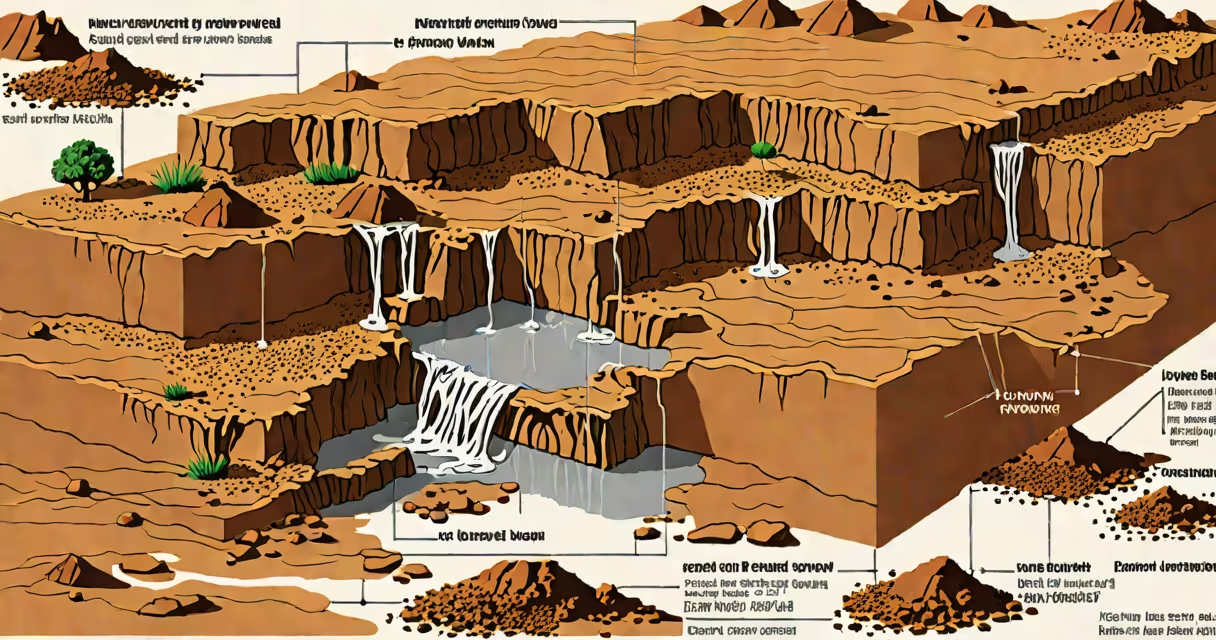
Clay soil holds the most water of any common soil type because its tiny particles create a large surface area and strong capillary forces that trap moisture. This high water retention stems from physical structure, not chemical composition.
Soil water-holding capacity depends on particle size and pore space distribution. Clay particles measure less than 0.002 millimeters in diameter. Their small size generates immense surface area relative to volume-up to 1,000 square meters per gram. This allows clay to bind water molecules tightly through electrostatic attraction and capillary action.
When dry, clay soil shrinks and forms wide cracks. When wet, it swells and becomes sticky. These properties result from the layered silicate structure of clay minerals like montmorillonite, which can absorb up to 300% of their weight in water. This swelling capacity increases water retention compared to coarser soils.
Water remains in soil primarily through capillary forces created by narrow pores between particles. Smaller pores generate stronger capillary suction. Clay soils have the smallest average pore size-typically 0.001 to 0.005 mm-compared to silt (0.005-0.05 mm) and sand (0.05-2.0 mm).
For example, a cubic meter of sandy soil may hold only 0.15 m³ of water. The same volume of clay soil can retain up to 0.45 m³. That's three times more water despite similar bulk density. The difference lies in pore geometry and surface chemistry.
Organic matter enhances water retention across all soil types by improving aggregation and increasing surface area. However, its effect is most pronounced in sandy soils, where it can double water-holding capacity. In clay soils, organic matter adds only modest improvement-around 10-15%-because the mineral matrix already captures most available water.
The following table compares typical water retention values for major soil types at field capacity-the maximum amount of water held against gravity after drainage.
| Soil Type | Average Particle Size | Water Held at Field Capacity (m³/m³) | Drainage Rate (mm/hour) |
|---|---|---|---|
| Clay | <0.002 mm | 0.35-0.45 | 1-5 |
| Silty Clay Loam | 0.002-0.05 mm | 0.30-0.40 | 5-10 |
| Loam | 0.05-2.0 mm | 0.20-0.30 | 10-20 |
| Sand | >2.0 mm | 0.10-0.15 | 50-100 |
Field capacity values are measured under standard conditions (20°C, atmospheric pressure). Actual retention varies with compaction, root presence, and seasonal temperature shifts.
Many assume that dark-colored or rich soils automatically hold more water. While organic-rich soils often retain more moisture, color alone doesn't predict water-holding capacity. A light-colored clay soil can outperform a dark sandy loam in water retention.
Another misconception is that high water retention always benefits plants. Excess moisture in clay soils leads to poor aeration. Roots suffocate when oxygen levels drop below 10%. This creates anaerobic conditions that promote root rot and inhibit nutrient uptake.
For example, a study at the University of California's Agricultural Experiment Station found that tomato yields declined by 40% in clay soils with prolonged saturation, even when nutrients were sufficient. The issue wasn't lack of water-it was lack of oxygen.
Clay soils dominate agricultural regions with high rainfall and low evaporation rates. The Mississippi Delta in the U.S. features fertile clay-rich alluvial soils that support cotton and soybean farming. These soils retain enough moisture during rainy seasons to sustain crops through dry periods.
In contrast, arid zones like the Sonoran Desert rely on sandy soils with low water retention. Plants such as saguaro cacti survive by rapidly absorbing water during brief rain events and storing it in thick tissues. They cannot thrive in clay soils, which remain saturated too long.
During my time managing a community garden in Portland, Oregon, we experienced persistent root rot in raised beds filled with native clay soil. After mixing in 30% compost and coarse sand, drainage improved dramatically. Crop survival increased from 60% to 95% within one growing season. The solution wasn't adding more water-it was adjusting soil texture.
Soil water retention is influenced by multiple factors beyond particle size. Compaction reduces pore space and limits infiltration. A compacted clay layer can reduce water entry by up to 70% compared to loose soil.
Root systems modify water dynamics. Deep-rooted species like alfalfa increase macropore formation, enhancing infiltration and reducing runoff. Conversely, shallow roots in turfgrass can cause surface ponding and erosion.
Climate plays a role too. In humid climates, clay soils stay wet longer. In Mediterranean climates, they dry slowly but still lose moisture through evaporation. The balance between precipitation and evaporation determines whether water is retained or lost.
According to the USDA Natural Resources Conservation Service, clay soils account for about 20% of global land area. Despite their high water-holding capacity, they represent only 10% of cultivated farmland due to management challenges like poor drainage and difficulty tilling.
While clay soil holds the most water, optimal plant growth requires balancing water retention with drainage. The ideal soil for most crops combines moderate water retention with good aeration-loam soils typically meet this criterion.
Understanding what type of soil holds the most water helps avoid mismanagement. Overwatering clay soils causes root damage. Underwatering sandy soils leads to drought stress. Matching soil type to crop needs prevents both outcomes.