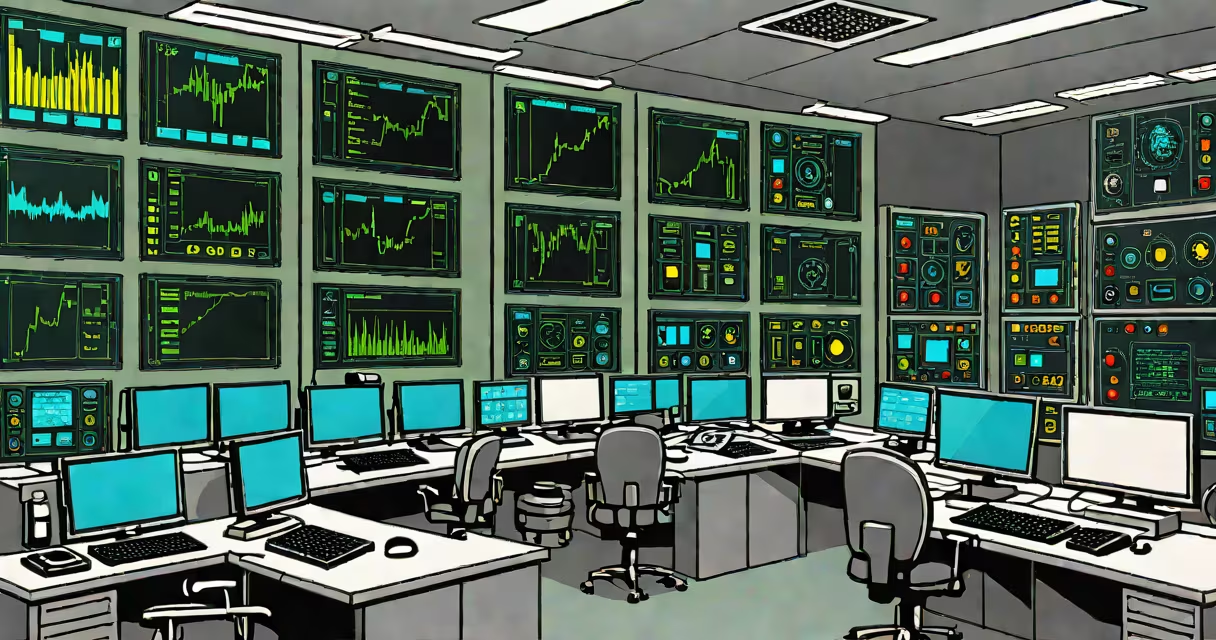
A programmable logic controller (PLC) is a ruggedized industrial computer that monitors inputs and outputs to make real-time decisions in automated machinery. Supervisory Control and Data Acquisition (SCADA) is a system that collects data from remote locations and presents it to operators through centralized dashboards. Together, they form the core of modern industrial automation.
PLCs execute control logic based on sensor input and actuator commands. They run programs stored in memory, responding to changes in equipment status within milliseconds. SCADA systems gather data from multiple PLCs across a facility and display it in real time, enabling supervisors to oversee entire production lines from a single console.
These systems are not interchangeable. A PLC handles immediate, localized control tasks such as starting a conveyor belt when a weight sensor triggers. SCADA manages high-level monitoring, alarm reporting, historical data logging, and operator interaction across many devices spread over large areas.
PLCs operate at the machine level. When a pressure switch detects rising fluid levels in a tank, the PLC evaluates the condition and opens a valve to prevent overflow. This decision happens in under 10 milliseconds, independent of network delays.
SCADA systems collect this same data from dozens of PLCs across a plant. For example, in a water treatment facility, each pumping station runs a PLC that controls pumps and valves. The SCADA system pulls data every 2 seconds, showing flow rates, tank levels, and pump status on a central map.
When a PLC reports an abnormal temperature reading, SCADA generates an alert on the operator's screen. An engineer can then remotely access the PLC's program via SCADA to diagnose the issue without walking the site.
PLCs come in different forms based on size and application:
| Type | Use Case | Example |
|---|---|---|
| Compact | Small machines, standalone operations | Allen-Bradley Micro800 series |
| Modular | Larger systems needing expansion | Siemens S7-1500 |
| High-Performance | Complex motion control, safety-critical systems | Rockwell ControlLogix with safety modules |
SCADA systems vary by scale and architecture:
According to the International Society of Automation (ISA), over 90% of industrial control systems rely on PLCs for real-time execution, while SCADA systems manage 85% of process monitoring in energy and water utilities.
Many assume SCADA is just a fancy dashboard. It is not. SCADA includes data acquisition, historian databases, alarm management, and integration with enterprise systems like ERP software.
Another error is thinking PLCs can replace SCADA. A PLC cannot efficiently track trends across 50 machines in a factory. It lacks the database infrastructure and visualization tools needed for long-term analysis.
Some believe both systems require proprietary hardware. While early systems were vendor-specific, modern PLCs and SCADA platforms support open standards like OPC UA (Open Platform Communications Unified Architecture), allowing interoperability between brands.
I once worked on a food packaging line where a PLC failed to detect a jam because a sensor was miswired. The SCADA system logged the drop in motor current and triggered an alert. Without SCADA, the fault would have gone unnoticed until product loss occurred. That incident showed me how SCADA catches issues invisible to the PLC alone.
In a refinery, hundreds of sensors measure temperature, pressure, and flow rate in pipelines. Each measurement feeds into a local PLC that adjusts valves to maintain safe operating ranges.
At the control center, a SCADA system displays a live 3D model of the refinery. Red zones indicate high-pressure warnings. Operators can click on any unit to see real-time data, historical trends, and maintenance logs.
During a storm, wind sensors detected vibration in a storage tank. The PLC shut down the feed pump automatically. SCADA recorded the event, sent an email alert to maintenance, and displayed the shutdown sequence in a timeline view. This coordination prevented a potential rupture.
For context, the U.S. Department of Energy reports that SCADA systems reduced unplanned downtime by 37% in refineries between 2015 and 2022. PLCs enabled the rapid response; SCADA provided oversight and documentation.
Security is critical. Both PLCs and SCADA systems are now connected to networks, making them targets for cyberattacks. The Industrial Control Systems Cyber Emergency Response Team (ICS-CERT) reported a 60% increase in attacks targeting SCADA systems between 2020 and 2023.
Ensure your SCADA platform supports role-based access. Only authorized personnel should be able to change control logic or override alarms.
Choose PLCs with built-in redundancy features if uptime is essential. Some models offer dual processors and failover modes. Pair them with SCADA systems that log all configuration changes for audit trails.
Understanding the difference between what is plc and scada helps avoid costly design mistakes. A PLC automates a machine. SCADA watches the whole factory.