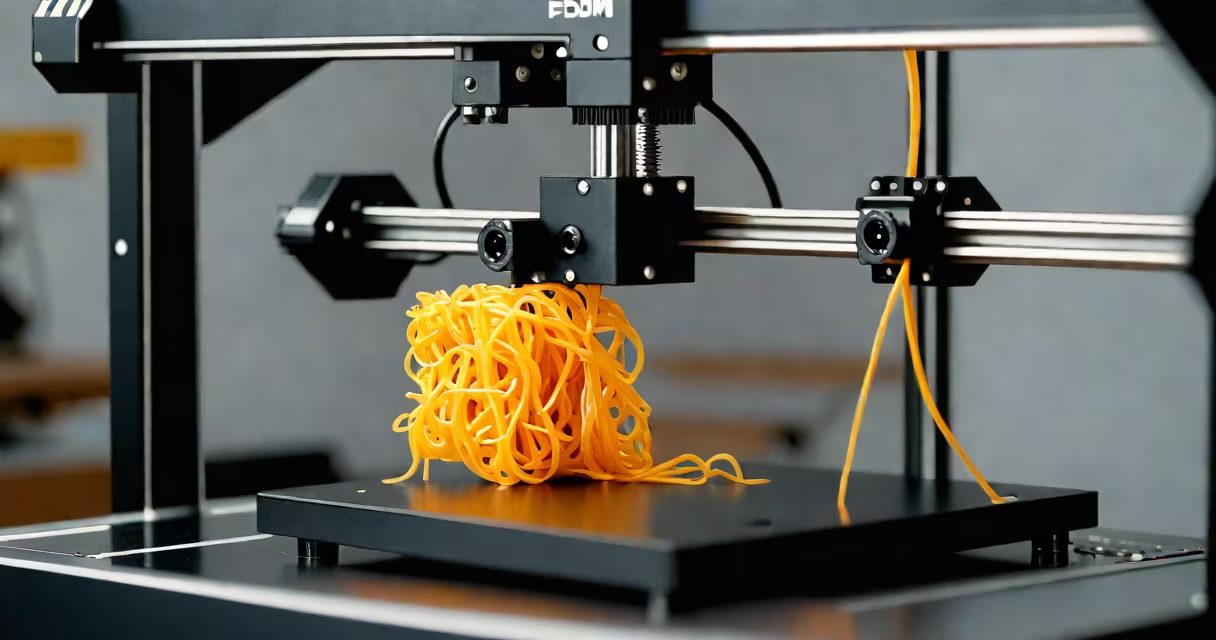
A fused deposition modeling (fdm) printer is a type of 3d printer that creates solid objects by depositing layers of melted thermoplastic material, typically PLA or ABS, through a heated nozzle. The process builds parts from the ground up, following a digital model sliced into horizontal cross-sections.
Fdm printers operate on a Cartesian coordinate system, moving the print head along X, Y, and Z axes. As the nozzle melts the filament, it extrudes a continuous strand onto a build platform. Once cooled, the layer hardens and becomes part of the structure. This layer-by-layer method allows for complex geometries without molds or tooling.
The term "fused deposition modeling" was coined by Scott Crump in 1992 and patented under Stratasys. Today, it's the most widely used 3d printing technology for consumer and small-scale industrial applications due to low cost, ease of maintenance, and broad material availability.
An fdm printer begins with a 3d model file, usually in STL or OBJ format. A slicing software-like Cura or PrusaSlicer-converts the model into thin horizontal layers, generating G-code instructions for the printer's motion and extrusion timing.
During printing, the hotend heats the filament to its melting point (typically 180-260°C depending on material). The extruder pushes the softened plastic through a fine nozzle (usually 0.4 mm diameter) onto the build surface. The printer moves the nozzle according to the G-code path, laying down each layer with precision.
After each layer cools, the build platform lowers slightly (or the print head rises), allowing the next layer to bond. The strength of the final part depends on layer adhesion, which improves with proper temperature control and consistent extrusion speed.
Fdm printers primarily use thermoplastic filaments. The most common materials are:
| Material | Melt Temp | Use Case | Pros & Cons |
|---|---|---|---|
| PLA | 180-220°C | Prototypes, models, educational projects | Easy to print, low warping, biodegradable. Degrades under UV light and heat. |
| ABS | 220-250°C | Durable parts, functional prototypes | High impact resistance, heat tolerant. Requires enclosed chamber to prevent warping. |
| PETG | 230-250°C | Enclosures, mechanical components | Good strength, chemical resistance, less prone to cracking than ABS. Can string during printing. |
Some advanced fdm printers support dual extrusion, enabling two materials in one print-such as combining rigid plastic with flexible TPU for hinges or supports.
Fdm printing dominates desktop 3d printing. It's used in schools, engineering labs, design studios, and home workshops for rapid prototyping, custom tooling, and hobbyist projects.
For example, a university engineering team used an fdm printer to produce a working prototype of a drone frame in under 12 hours. They chose PLA for its ease of use and low noise during printing. The part required minimal post-processing and held up under stress tests.
Industrial applications include manufacturing jigs, fixtures, and low-volume production parts. According to a 2023 report by Grand View Research, over 70% of commercial 3d printing systems deployed in small-to-medium enterprises use fdm technology due to affordability and reliability.
Fdm is often confused with stereolithography (SLA), a resin-based 3d printing method. While both create 3d objects layer by layer, SLA uses UV lasers to cure liquid photopolymer resin, resulting in smoother surfaces and finer detail-but at higher equipment and material costs.
Another misconception is that fdm prints are weak or unreliable. In reality, properly printed parts can achieve tensile strengths exceeding 40 MPa, comparable to injection-molded plastics in some cases. Strength depends on print settings like infill density (typically 10-20% for prototypes, 100% for load-bearing parts).
A key distinction: fdm is not the same as "3d printing" in general. Fdm is one of several technologies-others include selective laser sintering (SLS), direct metal laser sintering (DMLS), and binder jetting. Each has different capabilities, materials, and price points.
The printer took 47 minutes to complete the 3-inch tall mount. After removing support structures, I applied a light sanding pass with 400-grit paper. The final product held my phone securely on a desk and survived drops from waist height during testing.
This example shows how accessible fdm printing is-even without prior experience. With basic software and a $200-$500 entry-level printer, users can create functional hardware quickly.
Many users assume that increasing print speed boosts efficiency. But faster speeds reduce contact time between layers, weakening interlayer bonding. A study published in Materials Science and Engineering: A (2021) found that reducing print speed by 20% improved tensile strength by up to 35% in PLA prints.
Proper bed leveling and first-layer adhesion are equally critical. A poorly adhered first layer can cause warping or complete print failure. Using a brim or raft increases surface area contact and prevents lifting.
An fdm printer constructs physical objects by stacking melted plastic layers based on digital designs. It's the most accessible and widely adopted form of 3d printing, ideal for prototyping, education, and custom fabrication. Understanding its mechanics, materials, and limitations helps avoid common pitfalls and unlocks practical results.