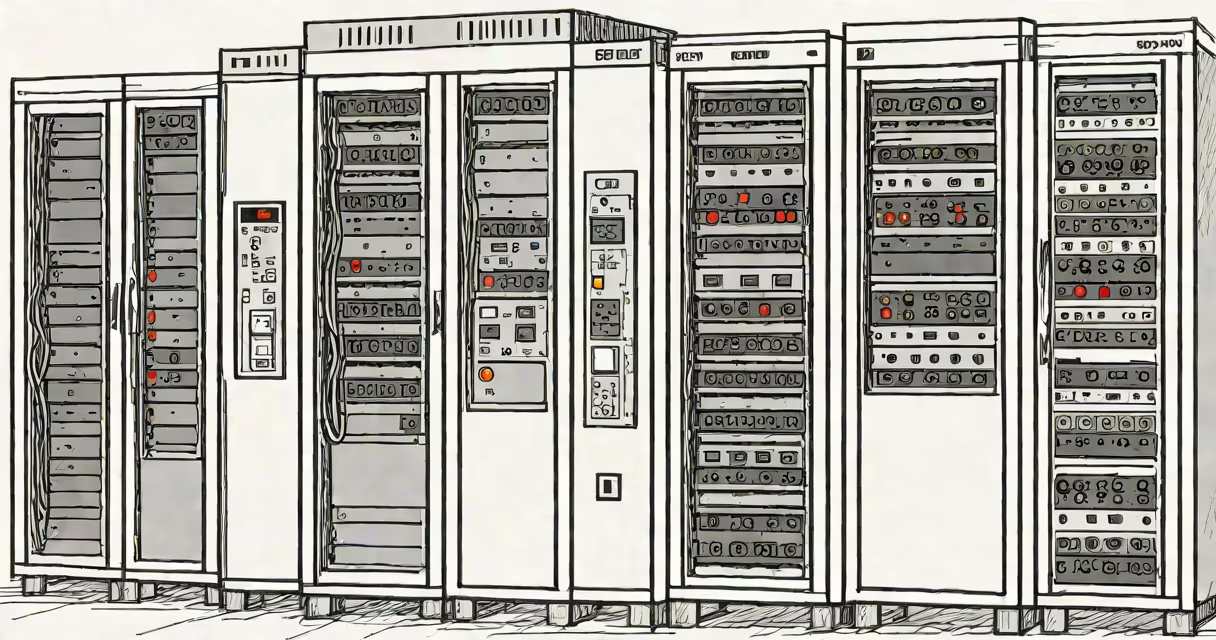
A CDU, or power distribution unit, is a device that receives electrical power from a main source and distributes it to individual devices within a server rack or data center. It ensures stable voltage delivery, monitors power usage, and prevents overloads by managing electrical loads across connected equipment.
CDUs are essential in environments where multiple high-wattage devices-like servers, switches, and storage arrays-must operate simultaneously without tripping circuit breakers. They act as centralized control points for power flow, often including features like remote monitoring, surge protection, and circuit-level metering.
For example, a typical 42U server rack may house 20 servers drawing 300 watts each. Without a CDU, connecting them all to a single outlet risks exceeding the circuit's capacity. A CDU splits the load across multiple circuits, tracks usage in real time, and alerts administrators if power draw exceeds safe thresholds.
A CDU sits between the facility's main electrical feed and the equipment it powers. It takes in AC power-usually 120V or 208V-through a primary input, then divides it into multiple output circuits. Each circuit can be independently monitored and controlled.
Inside, a CDU contains a main breaker, branch breakers for each outlet, and often a microprocessor that logs current draw, voltage levels, and power factor. Some models support SNMP or IP-based communication, allowing integration with data center management systems like DCIM (Data Center Infrastructure Management).
When a device draws too much current, the CDU trips its associated circuit breaker to prevent overheating or fire. Modern CDUs can also send alerts via email or SMS when thresholds are breached, enabling proactive maintenance.
CDUs come in several configurations based on physical form, power handling, and monitoring capabilities. The most common types are:
| Type | Use Case | Power Capacity | Monitoring Features |
|---|---|---|---|
| Basic PDU | Small racks, office environments | 15-30A | None or basic outlet status |
| Smart PDU | Data centers, remote sites | 30-60A | Remote on/off, current logging, SNMP |
| Redundant CDU | High-availability systems | 60-120A | Dual power feeds, failover support |
| Remote Power Switch | Server reboot, troubleshooting | 15-30A | Web interface, individual outlet control |
Redundant CDUs are critical in mission-critical data centers. They receive power from two independent sources-often from separate UPS systems-to ensure uptime even if one fails. This redundancy is required in Tier III and Tier IV data centers, according to Uptime Institute standards.
Smart PDUs go beyond distribution. They allow administrators to remotely turn off and restart devices, which is invaluable during system crashes or firmware updates. For example, a server stuck in a boot loop can be reset via a web interface without needing physical access.
Many people confuse a CDU with a UPS (Uninterruptible Power Supply). While both manage power, they serve different purposes. A UPS provides battery backup during outages and conditions power to stabilize voltage. A CDU manages distribution and load balancing but does not store energy.
Another misconception is that all CDUs are the same. In reality, a basic wall-mounted power strip is not a CDU. CDUs are designed for industrial use-rated for higher amperage, with proper enclosures, grounding, and compliance with NEC Article 600 and IEEE 1100 standards.
One non-obvious fact: CDUs are not always passive. A smart CDU can actively balance loads across phases in a three-phase system. In a 208V three-phase setup, uneven phase loading causes inefficiency and increases risk of tripping breakers. Smart CDUs detect imbalances and redistribute devices across phases to maintain optimal load distribution.
In a recent deployment at a colocation facility in Ashburn, Virginia, a customer needed to install 12 blade servers in a single rack. Each server drew 400W, totaling 4.8kW. The facility's standard rack circuit was rated at 3.5kW.
Without a CDU, the rack would have exceeded its limit. The solution was a redundant smart CDU with dual inputs from separate UPS systems. The CDU split the load across three phases and monitored each outlet. When one server was powered on, the system showed a 1.2kW draw on Phase A. The remaining servers were assigned to Phases B and C to balance the load.
During a power fluctuation, the CDU logged a voltage dip and triggered an alert. The operations team responded before any device rebooted. This prevented downtime and avoided potential data loss.
As someone who has deployed CDUs in five data centers across the U.S., I've seen how a single misconfigured CDU can cause cascading failures. Proper planning-matching CDU capacity to load, using phase-balancing features, and setting thresholds-makes a measurable difference in uptime and safety.
Understanding what is a cdu is important for anyone involved in data center design, IT operations, or infrastructure planning. It's not just a power strip-it's a core component of reliable, scalable, and secure computing environments.