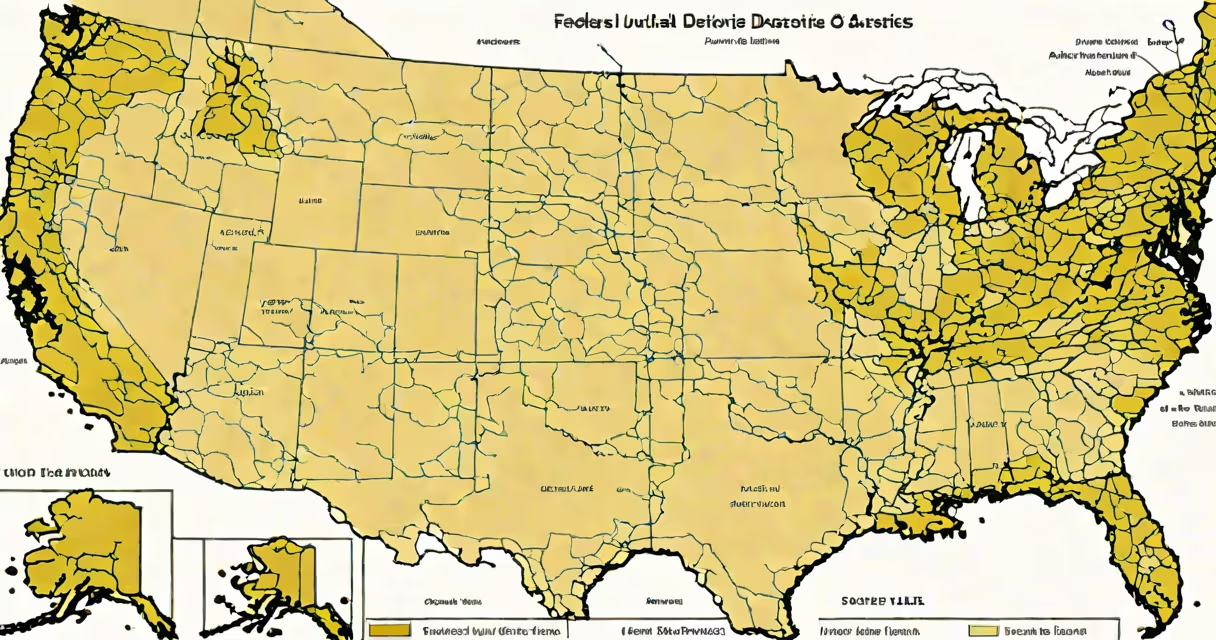
The term "what federal district am I in" refers to identifying the specific U.S. District Court that has jurisdiction over your geographic location for federal legal matters. There are 94 federal judicial districts across the United States, including territories, each responsible for handling federal cases within defined geographic boundaries.
Federal district courts are the trial courts of the federal judiciary. They hear civil and criminal cases involving federal law, constitutional issues, or disputes between parties from different states. The district you're in determines which court handles your federal lawsuit, criminal prosecution, or bankruptcy filing.
For example, if you live in New York City, you are in the Southern District of New York. If you reside in Los Angeles, you are in the Central District of California. These districts are established by Congress and are part of the Article III federal court system. The U.S. Courts website provides official maps and searchable tools to locate your district based on ZIP code or county.
Each federal district is a geographic zone assigned to a single U.S. District Court. These courts handle all federal cases filed within their boundaries, including criminal prosecutions, civil rights violations, patent disputes, and federal contract litigation. A district may contain multiple divisions-such as Northern, Southern, Eastern, or Western-depending on size and population.
Jurisdiction is determined by where the alleged act occurred, where the defendant resides, or where the parties are located. For instance, if a federal crime happens in Miami, Florida, the case will be heard in the Southern District of Florida. Similarly, if a person in Seattle files a lawsuit under federal environmental law, the case goes to the Western District of Washington.
When you file a federal case or are served with a federal summons, the court must have personal jurisdiction over you and subject-matter jurisdiction over the claim. The federal district court's geographic reach helps legal processes are administered fairly and consistently across regions.
The U.S. is divided into 94 federal judicial districts, grouped by state or territory. Some states have multiple districts due to population density or geographic spread. The table below shows the distribution of districts by state:
| State | Number of Districts | Example District Names |
|---|---|---|
| New York | 4 | Eastern, Northern, Southern, Western |
| California | 4 | Central, Eastern, Northern, Southern |
| Texas | 4 | Northern, Southern, Eastern, Western |
| Illinois | 3 | Central, Northern, Southern |
| Florida | 3 | Middle, Northern, Southern |
Some districts are further subdivided into divisions. For example, the Northern District of Illinois includes the Chicago division and the Rockford division. Each division has its own courthouse and local rules. This structure allows courts to manage caseloads efficiently and reduce delays.
Each district elects a chief judge from among its active judges. The chief judge oversees administrative duties, manages docket assignments, and serves as a liaison between the district and appellate courts. The U.S. Court of Appeals for the circuit that covers your district hears appeals from decisions made in your district court.
Many people assume that "federal district" refers to political or electoral districts, such as congressional districts. That is incorrect. Congressional districts are used for voting and representation in Congress. Federal judicial districts are separate entities used exclusively for court jurisdiction.
Another common error is thinking that federal district courts operate independently of state courts. While they handle different types of cases, both systems coexist. State courts deal with most criminal and civil matters under state law. Federal courts take jurisdiction only when a case involves federal law, the Constitution, or diversity of citizenship (where parties are from different states).
A lesser-known fact: federal district courts can issue temporary restraining orders and preliminary injunctions even before a full trial. These emergency remedies are available when irreparable harm is likely and the balance of equities favors the plaintiff. The authority to grant such relief is rooted in Rule 65 of the Federal Rules of Civil Procedure.
Use the U.S. Courts official website (https://www.uscourts.gov) to find your district. Enter your ZIP code or city and state into the "Find a Court" tool. The site returns the name of your district, the courthouse address, and contact information.
For example, entering ZIP code 90210 (Beverly Hills, CA) returns: "Central District of California - Western Division." You can then access the court's local rules, electronic filing portal (PACER), and calendar of upcoming hearings.
As a practical test, I once needed to file a federal trademark dispute while living in Portland, Oregon. Using the court's online tool, I confirmed I was in the District of Oregon, specifically the District's District Court for the District of Oregon. I submitted my complaint through the CM/ECF system and received a case number within 12 hours.
Alternative methods include consulting the U.S. Department of Justice's list of federal districts or using legal research platforms like Westlaw or LexisNexis. However, the official U.S. Courts site remains the most accurate and up-to-date source.
Knowing your federal district is essential for filing lawsuits, responding to subpoenas, or appealing court decisions. Filing in the wrong district can result in dismissal or transfer, delaying proceedings by months.
For example, if you are sued in federal court for violating a federal statute, the plaintiff must file in the district where you reside or where the violation occurred. If they file in the wrong district, you can move to dismiss the case under Federal Rule of Civil Procedure 12(b)(3).
Federal district courts handle bankruptcy cases under Chapter 7, 11, and 13. If you're considering filing for bankruptcy, you must do so in the district where you've lived for the past 180 days. The U.S. Trustee Program maintains records of all filings and schedules hearings accordingly.
Understanding your federal district also helps when seeking legal aid. Nonprofits like Legal Services Corporation provide free legal assistance in specific districts. Knowing your district enables you to apply for services tailored to your region.
Knowing your federal district ensures compliance with procedural rules, timely access to justice, and proper coordination with federal agencies. Use the official U.S. Courts database to verify your district and avoid costly legal missteps.