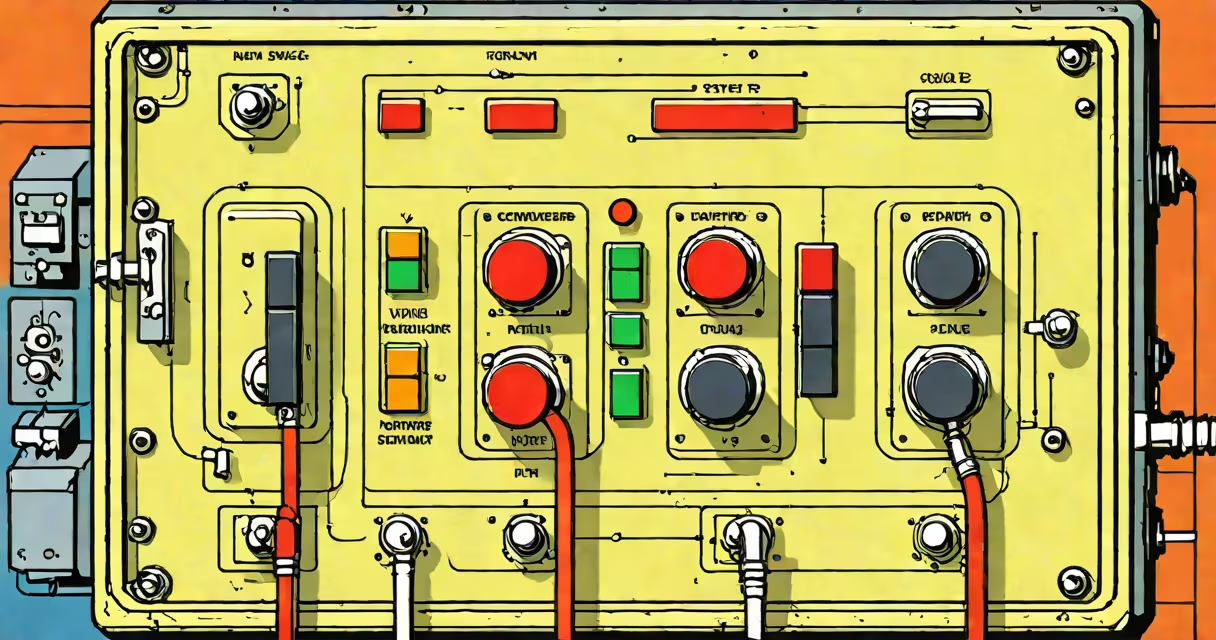
A double pole single throw (DPST) switch is an electrical device that opens or closes two independent circuits at the same time using a single control action. It is used to safely disconnect both live and neutral conductors in a circuit, often in high-voltage or high-current systems.
DPST switches are common in industrial equipment, home appliances, and lighting systems where dual-circuit isolation is required. They differ from single pole single throw (SPST) switches, which control only one circuit, and double pole double throw (DPDT) switches, which can reverse current direction between two sets of contacts.
The term "double pole" means the switch has two separate input and output terminals for two distinct electrical paths. "Single throw" indicates the switch has only one position for connecting the circuit-either fully on or fully off. There is no intermediate state or alternate routing.
When activated, a DPST switch simultaneously connects or disconnects both poles. This helps both sides of a circuit-such as hot and neutral lines-are broken at the same time. This prevents residual voltage from remaining in the system, reducing the risk of electric shock during maintenance.
For example, in a 240V AC heater circuit, the DPST switch cuts power to both the live and neutral wires. Without this, leaving one wire energized poses a hazard even if the other is disconnected. The switch's mechanical linkage ensures both contacts move together.
DPST switches are typically rated for specific voltage and current levels. A typical industrial DPST switch may be rated for 600V AC and 30A continuous load. Exceeding these limits causes arcing, contact welding, or fire risk.
DPST switches come in several forms based on actuation method and environment:
| Type | Actuation Method | Common Use Cases |
|---|---|---|
| Momentary DPST | Push-button (releases when pressure is removed) | Emergency stop buttons, machine start sequences |
| Toggle DPST | Rocking lever or flip switch | Power supplies, HVAC units, motor controls |
| Rotary DPST | Turn knob or dial | Industrial control panels, backup power systems |
| Relay-based DPST | Electromagnetic coil activation | Automated systems, PLC interfaces, remote control |
These switches are essential in systems requiring fail-safe disconnection. For instance, in a 480V three-phase motor control center, a DPST switch isolates both phases of a single-phase auxiliary circuit during servicing.
According to the National Electrical Code (NEC) Article 404.14, switches controlling branch circuits must interrupt both ungrounded conductors when used in locations where access is uncontrolled. DPST switches meet this requirement.
Many people confuse DPST with DPDT (double pole double throw). While both have two poles, a DPDT switch can route current between two different output pairs. A DPST cannot reverse polarity-it only turns two circuits on or off together.
Another mistake is assuming that a DPST switch can handle high inrush currents. In reality, DPST switches are not designed for motor starting or capacitor discharge scenarios. Using them in such cases leads to contact erosion and premature failure.
For example, a 15A DPST switch used in a 10kW induction motor starter will arc violently during startup due to the high initial current draw. The correct component here is a contactor with a DPST auxiliary contact, not a manual switch.
In a residential water heater installation, a 240V unit requires both hot legs to be disconnected during service. A DPST switch installed in the junction box ensures both conductors are cut simultaneously. This complies with NEC 422.10 and reduces technician risk.
I once encountered a faulty DPST switch in a commercial laundry room. The machine wouldn't shut off completely because one pole had degraded. Testing with a multimeter showed continuity on one side even when the switch was off. Replacing the switch restored full isolation. This incident highlighted that visual inspection isn't enough-contact resistance must be verified under load.
Understanding the differences between these switch types avoids wiring errors:
For instance, a DPDT switch can reverse the polarity of a DC motor. A DPST cannot do this-it only turns two circuits on or off.
According to IEEE Standard 100-2019, "Switches shall be selected based on the number of poles, throw configuration, and interrupting capacity." This standard reinforces that choosing the right switch type is critical for safety and reliability.
Double pole single throw (DPST) switches provide simultaneous control of two electrical circuits with a single action. They are important in applications requiring full isolation of both conductors. Always match the switch rating to the circuit's voltage, current, and duty cycle. When in doubt, consult the NEC or manufacturer specifications.