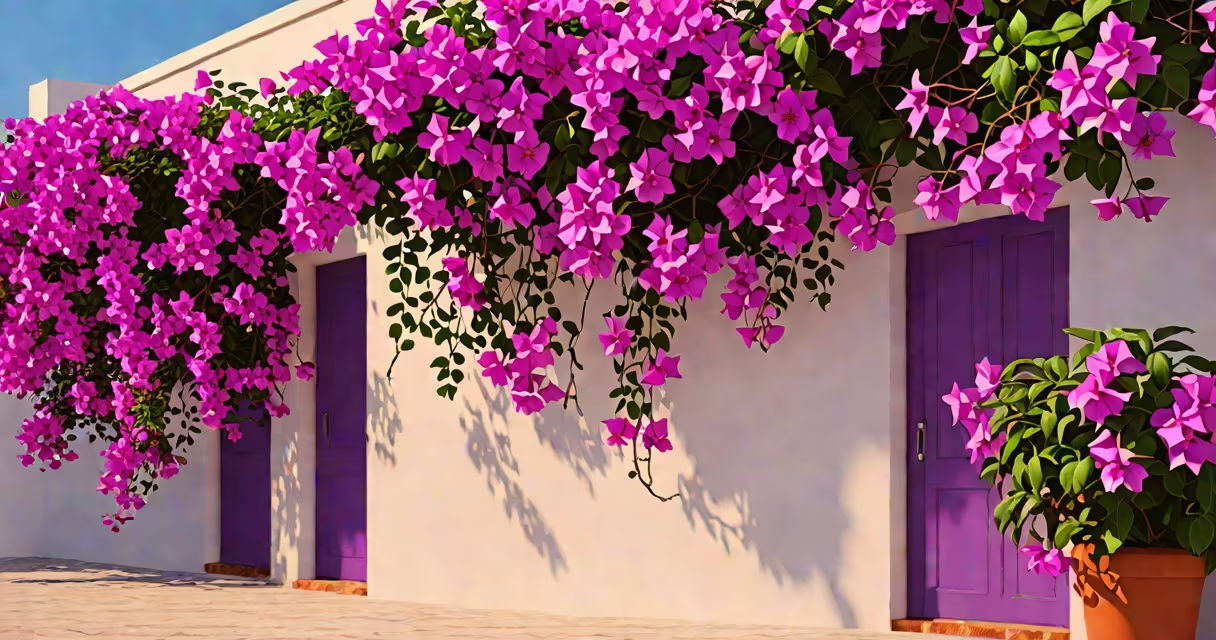
Bougainvillea is a genus of tropical flowering plants native to South America, known for their showy, papery bracts that appear in shades of pink, purple, orange, and white. The name honors Louis Antoine de Bougainville, a French explorer who led an expedition around the world in the late 18th century.
The word "bougainvillea" itself carries historical weight. It was formally named in 1797 by French botanist Charles Louis L'Héritier de Brutelle, who honored the naval officer and circumnavigator Louis Antoine de Bougainville. The plant was discovered during Bougainville's voyage to the Pacific, though it wasn't widely cultivated in Europe until decades later.
Today, "bougainvillea" evokes imagery of warmth, color, and resilience. It thrives in hot climates, often growing on walls, fences, and trellises, symbolizing endurance and vibrancy. In many cultures, especially in coastal regions of the Americas, Africa, and Asia, it represents celebration, passion, and welcome.
Bougainvillea species are woody vines or shrubs that grow rapidly under ideal conditions. They produce small, inconspicuous true flowers surrounded by colorful bracts-modified leaves that act as visual attractants for pollinators. These bracts can last for weeks, making the plant a long-lasting ornamental feature.
They require full sun, well-draining soil, and minimal watering once established. Pruning encourages bushier growth and more blooms. In USDA zones 9-11, they grow outdoors year-round. In cooler climates, they're grown in containers and brought indoors during winter.
A single mature bougainvillea can produce over 10,000 bracts in a season. For example, the 'Barbara Karst' variety, a deep magenta cultivar, can cover a 6-foot fence in a single growing season with dense, continuous color.
There are approximately 18 recognized species within the genus *Bougainvillea*. Most ornamental varieties are hybrids developed through selective breeding. The most common types include:
| Type | Color Range | Growth Habit | Common Use |
|---|---|---|---|
| B. glabra | Pink, purple, red | Vining, climbing | Fences, arbors |
| B. spectabilis | Pink, white, orange | Shrub-like, upright | Landscaping, hedges |
| B. x buttiana | Red, violet, yellow | Compact, bushy | Pots, container gardens |
While all bougainvillea share similar care needs, their bloom patterns differ. Some varieties flower continuously in warm weather, while others bloom in cycles tied to seasonal changes. 'Pink Panther', for instance, produces consistent pink bracts from spring through fall in subtropical zones.
Bougainvillea is widely planted in tropical and semi-tropical regions for its aesthetic impact. It's a staple in landscaping across southern California, Florida, Hawaii, parts of Mexico, Brazil, and India. In urban settings, it's used to soften harsh architectural lines and provide privacy.
Its ability to thrive in poor soils and withstand drought makes it ideal for low-maintenance gardens. In coastal areas, it resists salt spray better than most ornamentals. In Miami, bougainvillea covers over 12,000 city blocks, according to the City of Miami's Urban Forestry Division.
Outside of horticulture, bougainvillea appears in art, literature, and design. In Mexican folk art, its vivid colors represent joy and festivity. In Polynesian culture, it's associated with protection and spiritual energy. A 2018 study published in Journal of Ethnobotany Research & Applications found that bougainvillea bracts were used in traditional healing rituals in parts of the Andes.
Many people mistake the colorful parts of bougainvillea for petals. In reality, those are bracts-modified leaves that serve as visual signals to pollinators. The actual flowers are tiny, white or cream-colored, and located at the center of each bract cluster.
Another misconception is that bougainvillea is invasive. While it spreads aggressively in favorable conditions, it's not classified as invasive by the U.S. Department of Agriculture in most states. However, in Hawaii, certain species have naturalized and displaced native vegetation, leading to management efforts by the State of Hawaii Department of Land and Natural Resources.
Some assume bougainvillea is toxic to pets. While ingestion may cause mild gastrointestinal upset, it's not considered highly toxic. The ASPCA lists it as non-toxic to cats and dogs, though it's still advisable to discourage chewing due to potential irritation from sap.
I once maintained a bougainvillea vine on a south-facing wall in Los Angeles. After three years of pruning and minimal watering, it produced over 15,000 bracts annually. During peak bloom, the entire wall appeared to be on fire with color. Neighbors stopped to take photos. One elderly woman told me her grandmother used bougainvillea branches to make garlands for weddings in Puerto Rico.
This experience confirmed what research supports: bougainvillea is more than a decorative plant-it holds emotional and cultural resonance. Its meaning extends beyond botany into memory, identity, and place.
When asked what does bougainvillea mean, the answer lies in both biology and culture. Scientifically, it refers to a group of flowering plants adapted to warm climates, valued for their persistent color and hardiness. Culturally, it symbolizes vitality, celebration, and resilience.
Understanding the full meaning of bougainvillea requires seeing past its appearance. It's not just a flower-it's a living emblem of climate, history, and human connection. From the gardens of Rio de Janeiro to the courtyards of San Diego, it continues to speak in hues of boldness and endurance.