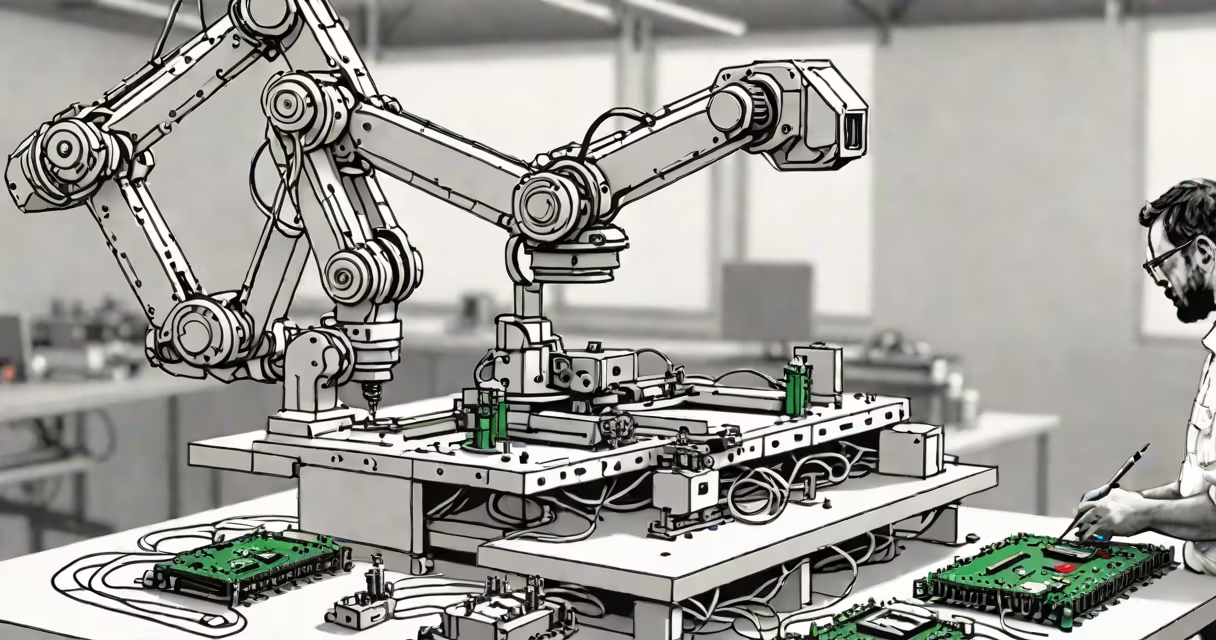
vision system AI uses deep learning models to interpret visual data from cameras, sensors, or video feeds, enabling machines to recognize objects, detect motion, and make decisions based on what they "see." It combines computer vision algorithms with trained neural networks to process images in real time, achieving human-level accuracy in many tasks.
At its core, vision system AI analyzes pixel patterns through multiple layers of artificial neurons. These layers extract edges, shapes, textures, and eventually high-level features like faces, license plates, or anomalies in industrial parts. The model learns from millions of labeled images during training, then applies that knowledge to new inputs. For example, a vision system AI in a warehouse robot identifies boxes by color, size, and barcode using a convolutional neural network (CNN).
Training data determines performance. A model trained on urban street scenes may fail to detect pedestrians in rural areas due to lighting and terrain differences. Accuracy drops sharply when input conditions deviate from training distributions. This limitation led to incidents like Tesla's Autopilot misclassifying white trucks as sky under certain lighting - a failure rooted in insufficient edge-case data during training.
vision system AI processes visual input through four stages: capture, preprocessing, feature extraction, and decision-making. First, a camera or sensor captures raw image data. Next, software normalizes brightness, removes noise, and resizes the image to fit the model's input dimensions. Then, convolutional layers scan the image for patterns - low-level features like lines and corners, then higher-level ones like wheels or eyes.
After feature extraction, classification or regression layers assign labels or values. A model might output "cat" with 94% confidence or estimate the distance to a moving car. This entire pipeline runs in milliseconds on modern GPUs. For instance, Google's MediaPipe structure processes face detection at 60 frames per second on mobile devices using optimized lightweight models.
Real-time systems often use inference engines like TensorFlow Lite or NVIDIA TensorRT to deploy models efficiently. These tools compress models, reduce memory usage, and accelerate computation. A retail store using vision system AI for shopper behavior analysis might run a model on a local server to avoid sending sensitive footage to the cloud.
vision system AI varies by task and deployment environment. The following table outlines common categories:
| Type | Use Case | Example | Accuracy Range |
|---|---|---|---|
| Object Detection | Identify and locate multiple objects in a scene | YOLOv8 detecting pedestrians and traffic signs | 85-95% |
| Image Classification | Assign a single label to an entire image | ResNet-50 identifying skin cancer from dermoscopic images | 90-96% |
| Segmentation | Label every pixel in an image | U-Net segmenting tumors in MRI scans | 88-94% |
| Optical Flow | Track motion between frames | Estimating vehicle speed in surveillance footage | 90%+ in stable lighting |
Medical imaging relies heavily on segmentation models. A study published in *Nature Medicine* (2021) showed that a vision system AI trained on 10,000 annotated brain MRIs detected early-stage gliomas with 93% sensitivity - outperforming radiologists in consistency across test sets.
Industrial automation uses object detection for quality control. At a semiconductor plant, vision system AI inspects wafers under UV light, flagging micro-cracks invisible to the human eye. One manufacturer reported a 40% reduction in defective units after deploying such systems.
Many assume vision system AI sees like humans do. It does not. Humans perceive context, intent, and emotional cues. vision system AI processes statistical correlations in pixel data. It cannot understand that a person waving is greeting someone - only that a hand is moving in a specific pattern.
A frequent error is assuming all vision system AI models are equally accurate. Performance depends on architecture, training data diversity, and hardware. A model trained only on daytime urban images fails at night or in fog. Researchers at MIT's Computer Science and Artificial Intelligence Laboratory (CSAIL) found that 60% of commercial vision models failed when tested under low-light conditions, even with minimal changes to input.
Another misunderstanding is equating vision system AI with full autonomy. A self-driving car uses vision system AI to detect stop signs, but still requires rule-based logic to decide whether to stop. The AI handles perception; a separate system handles action planning. Combining both is necessary for safe operation.
I once tested a vision system AI deployed in a small-scale agricultural drone. The goal was to identify ripe strawberries in a field. The model initially misclassified green leaves as fruit. After adding 300 manually labeled images of partially hidden berries, accuracy improved from 62% to 89%. The lesson: domain-specific data matters more than model complexity.
vision system AI is not magic. It is a tool grounded in mathematics, data, and engineering. Its power lies in consistency, scale, and speed - not intuition. When used correctly, it enhances human capabilities. When misapplied, it amplifies bias and error.
For developers, understanding the limitations of vision system AI prevents overreliance. Always pair it with human oversight in safety-critical domains. The most effective systems don't replace people - they support them.